Bell Tower and Baptistry

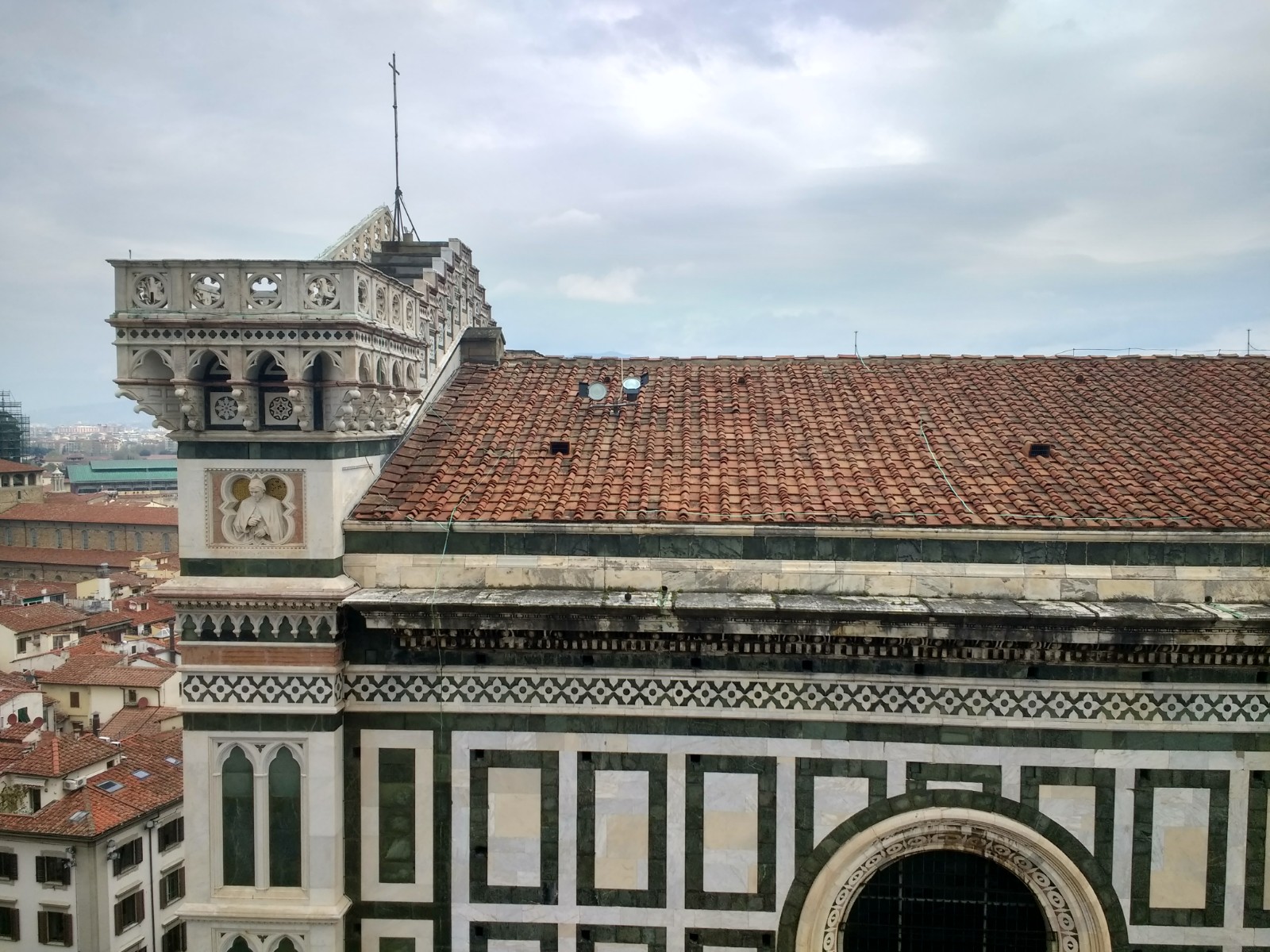
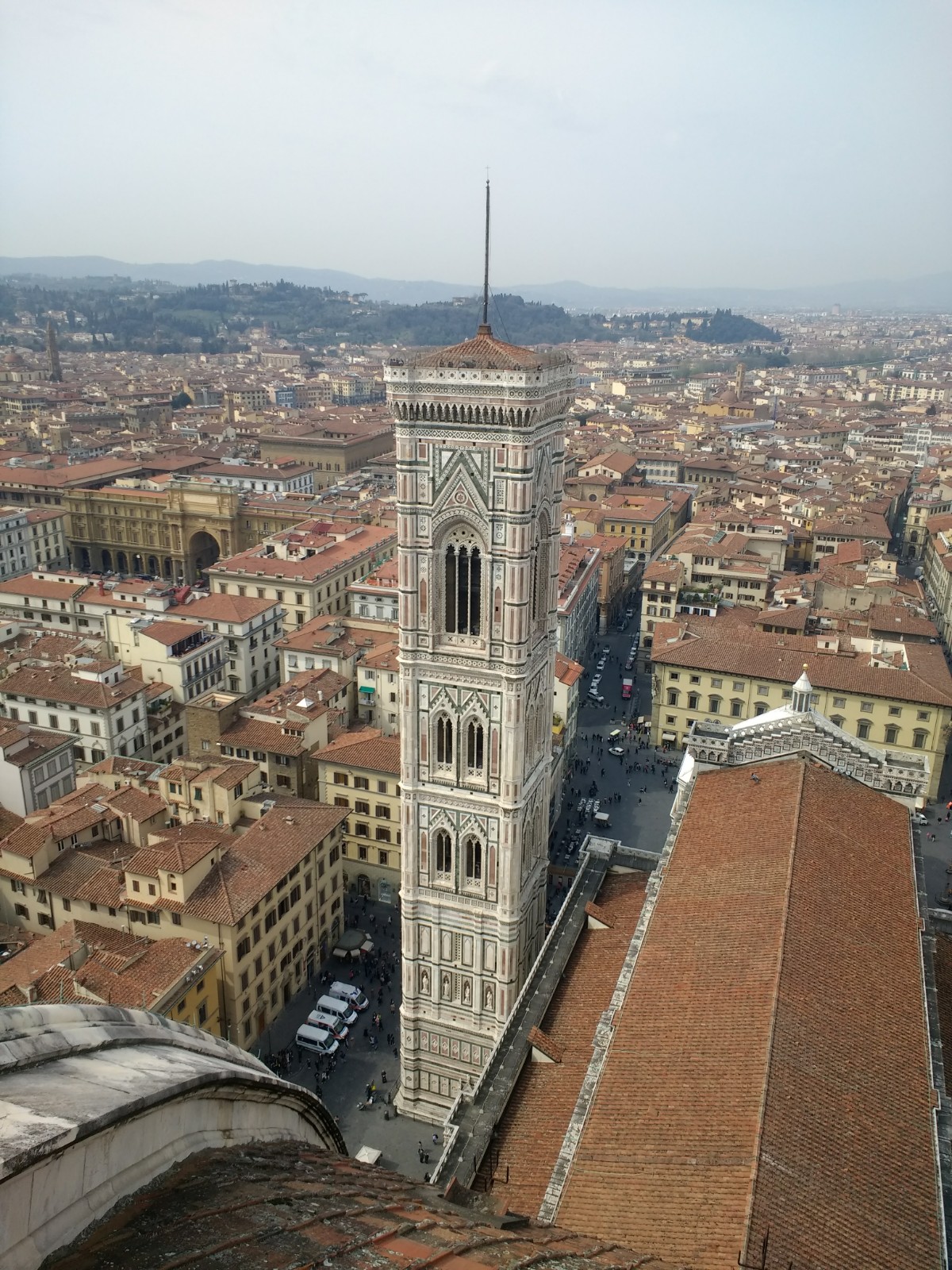
The bell tower or campanile is also known as Giotto’s Tower

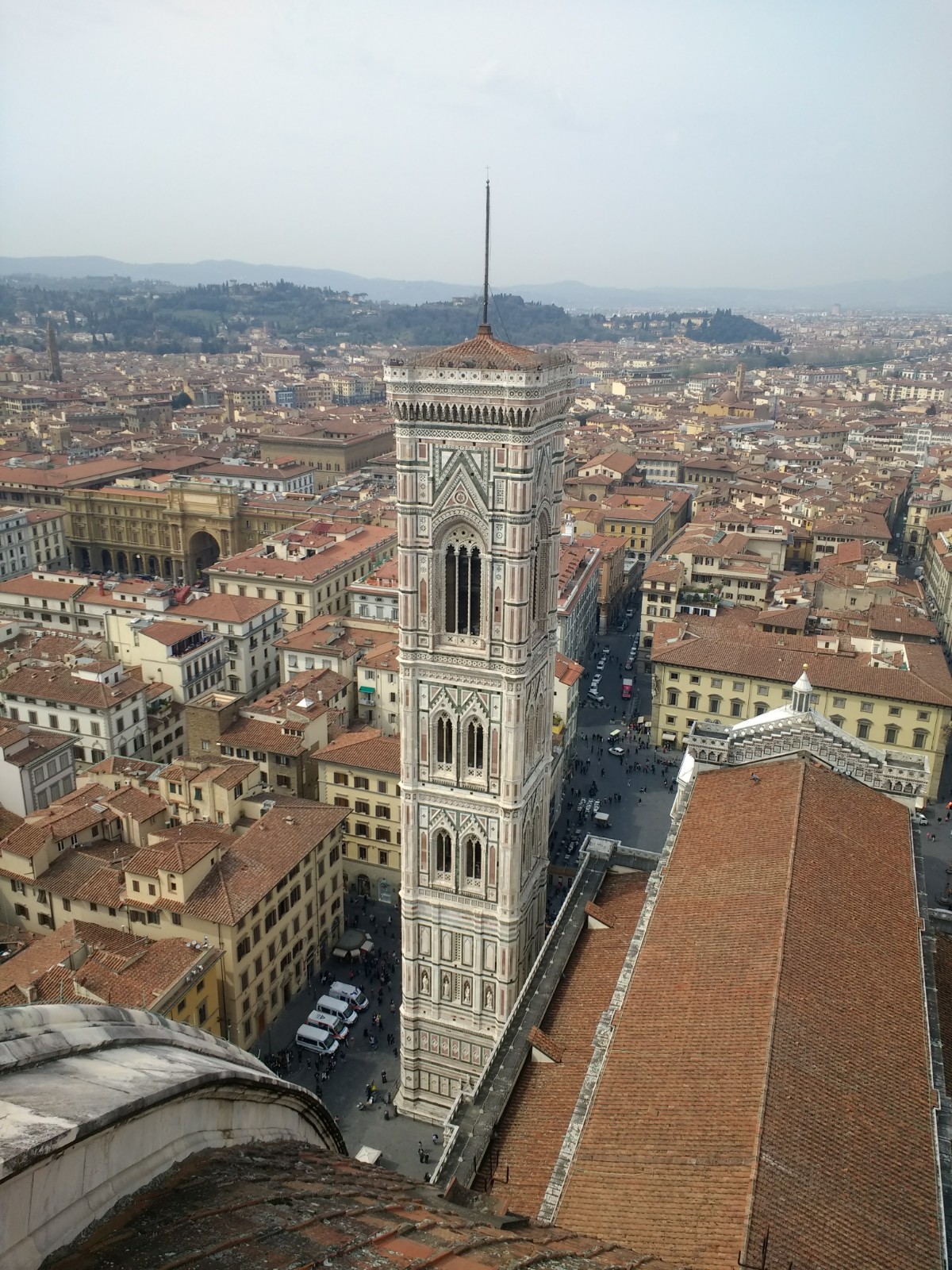
The bell tower of Florence Cathedral is considered to be the most beautiful in Italy. I climbed to the top without Mark today as he is still under the weather.

Although called Giotto’s tower, he died three years after building had begun and work was continued by Andrea Pisano, Alberto Arnoldi and Francesco Talenti, who is praised for his design of the large openings near the top, which give the tower a light feel.
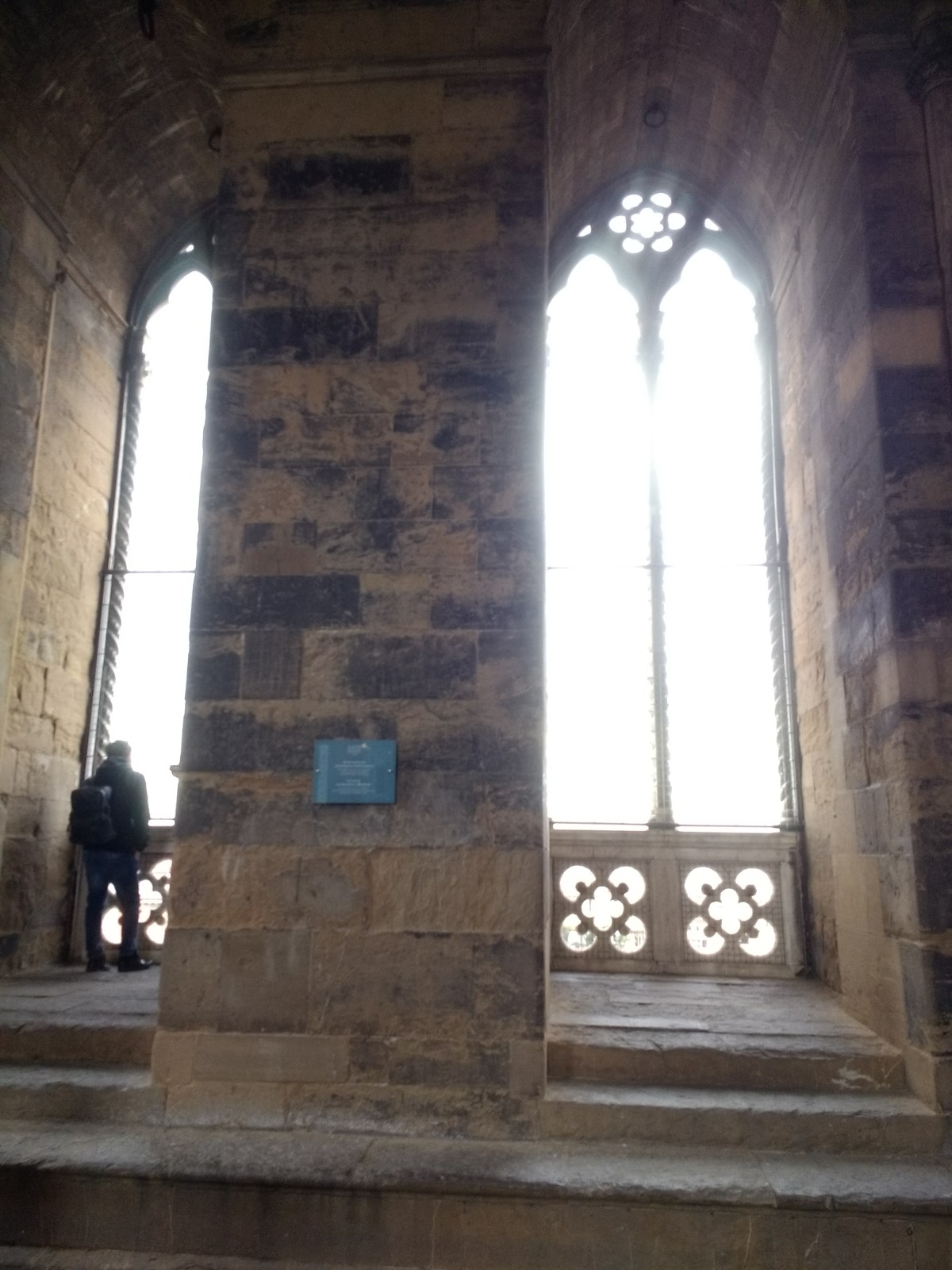
Looking out of the large openings on the top level.

The bell tower is slightly shorter than the dome (85m to the dome’s 114m) and has slightly fewer steps to climb (414 compared to 463 in the dome) but the views are just as good. You can also see the surroundings from four levels compared to the Dome’s one level. However, if you miss out the dome, you miss out on the frescoes inside the dome too.
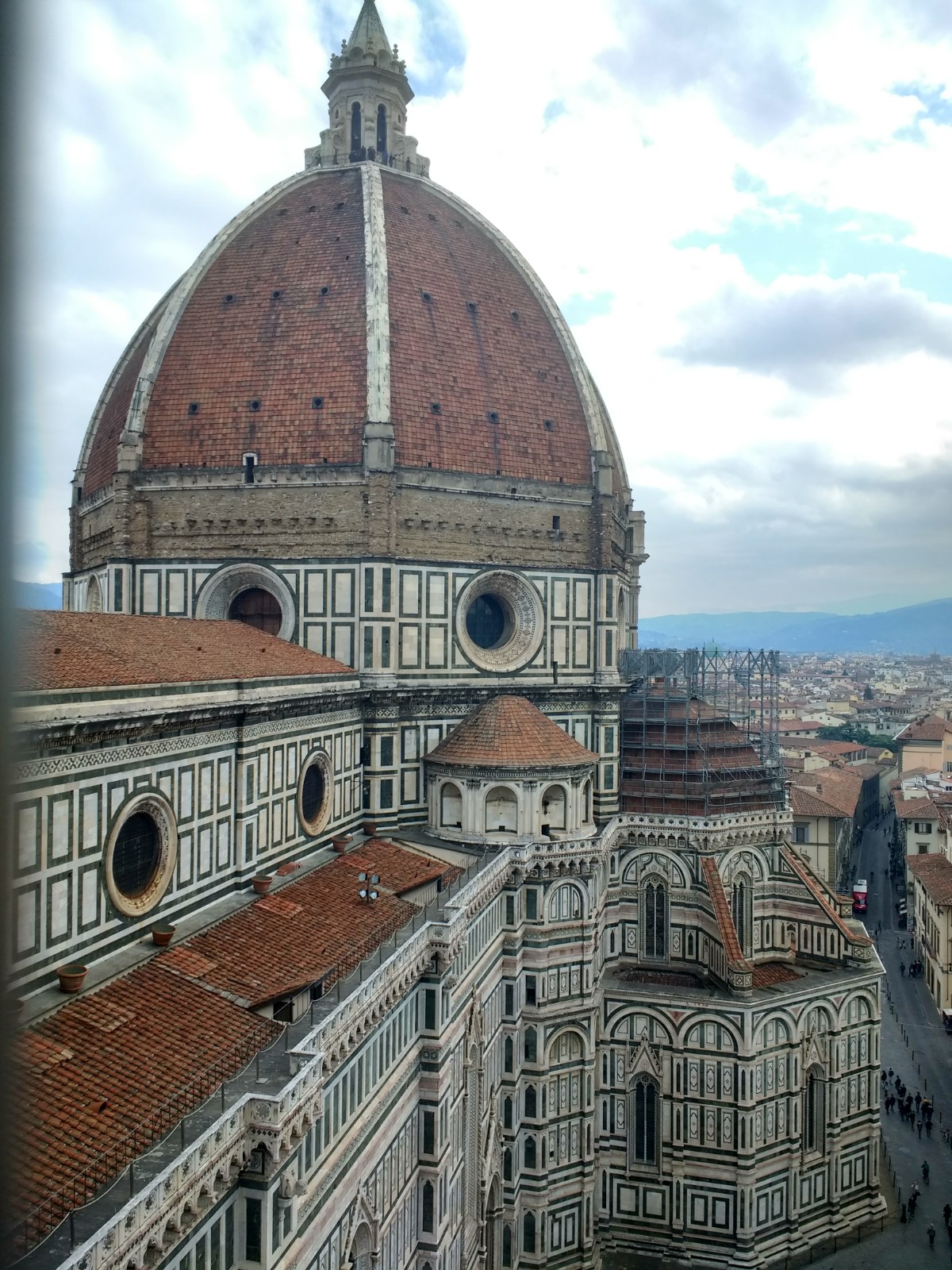
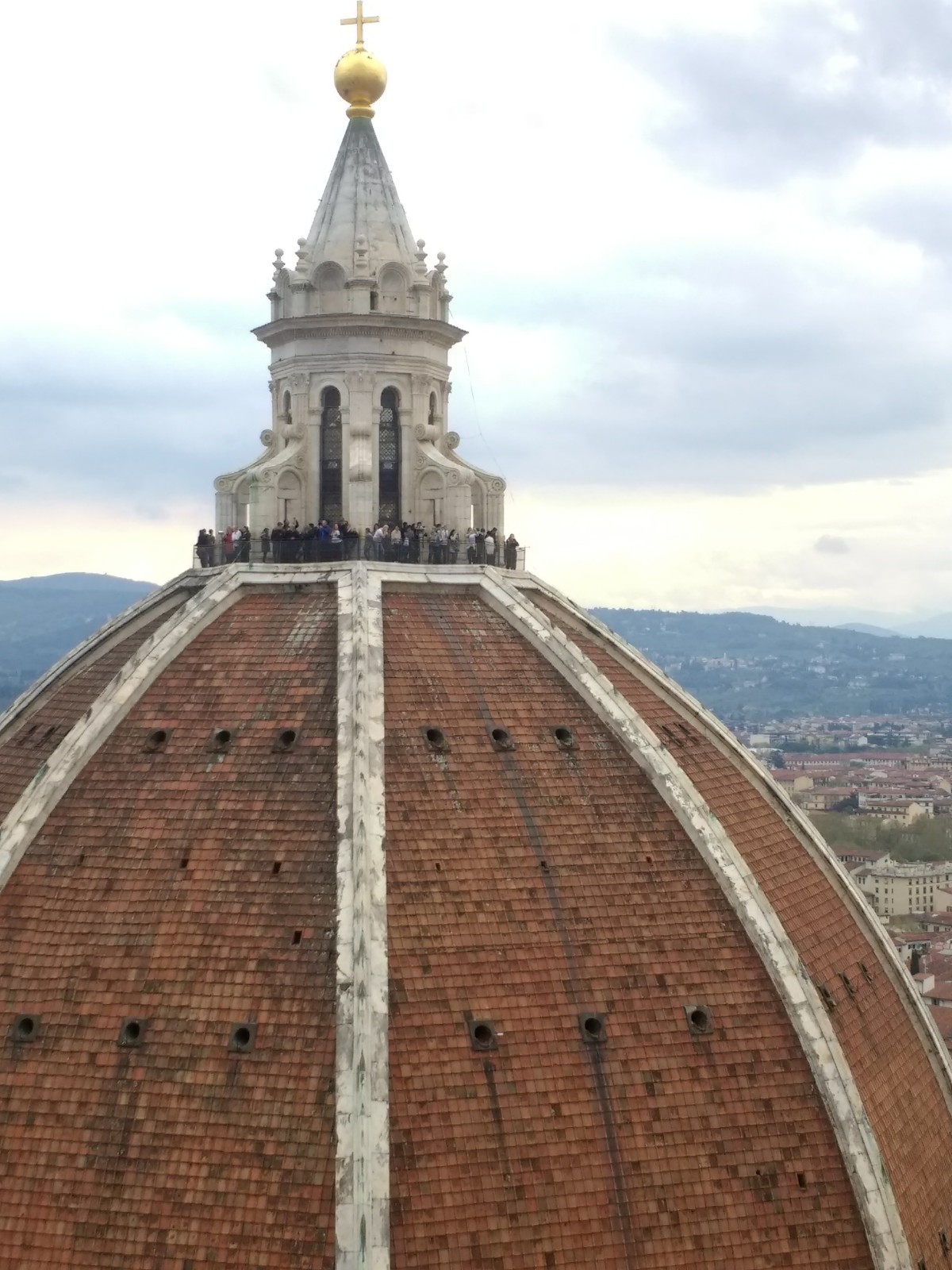
The Dome from the bell tower.

The viewing platform on the dome.
Close-up of the Cathedral
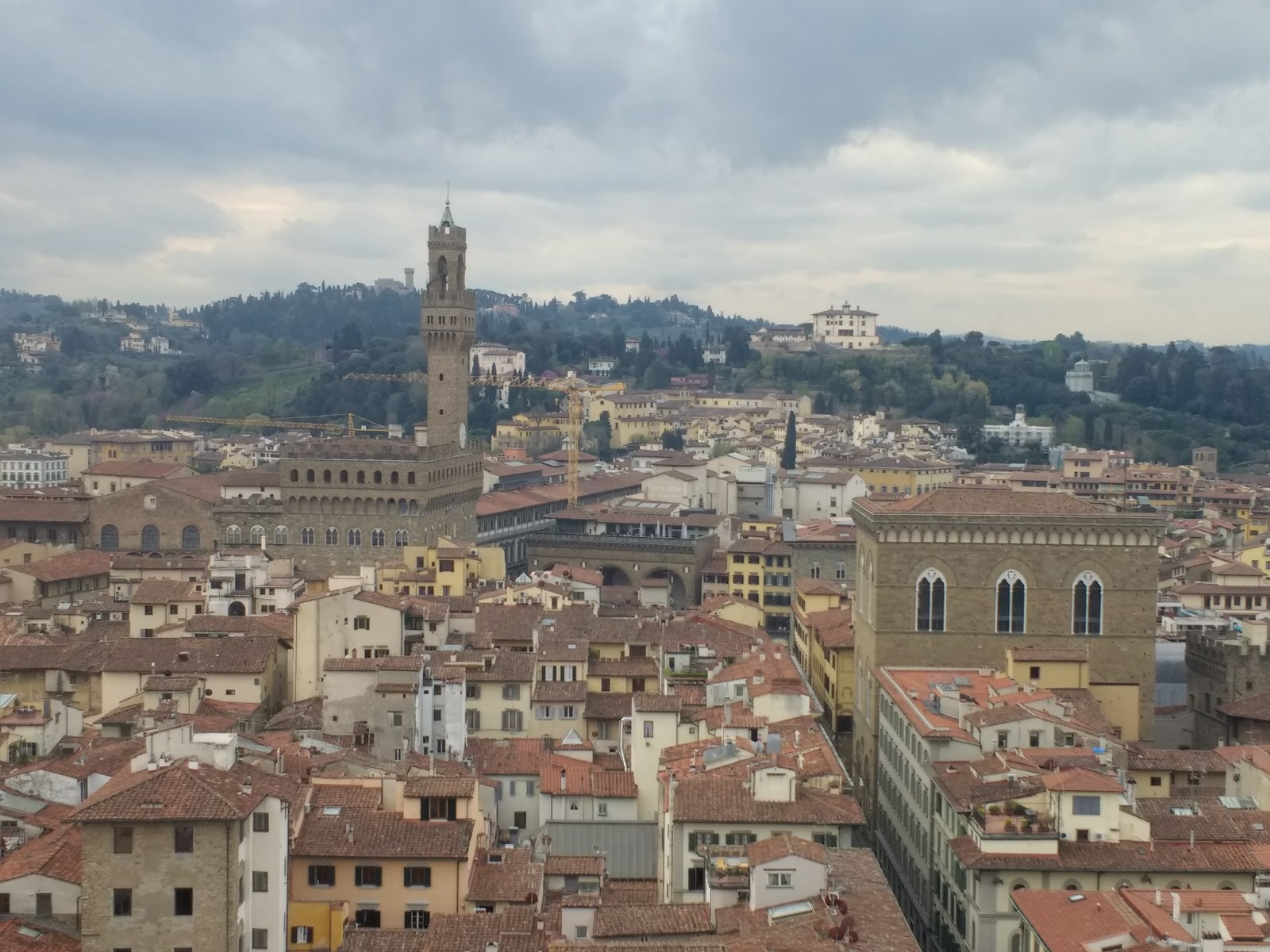
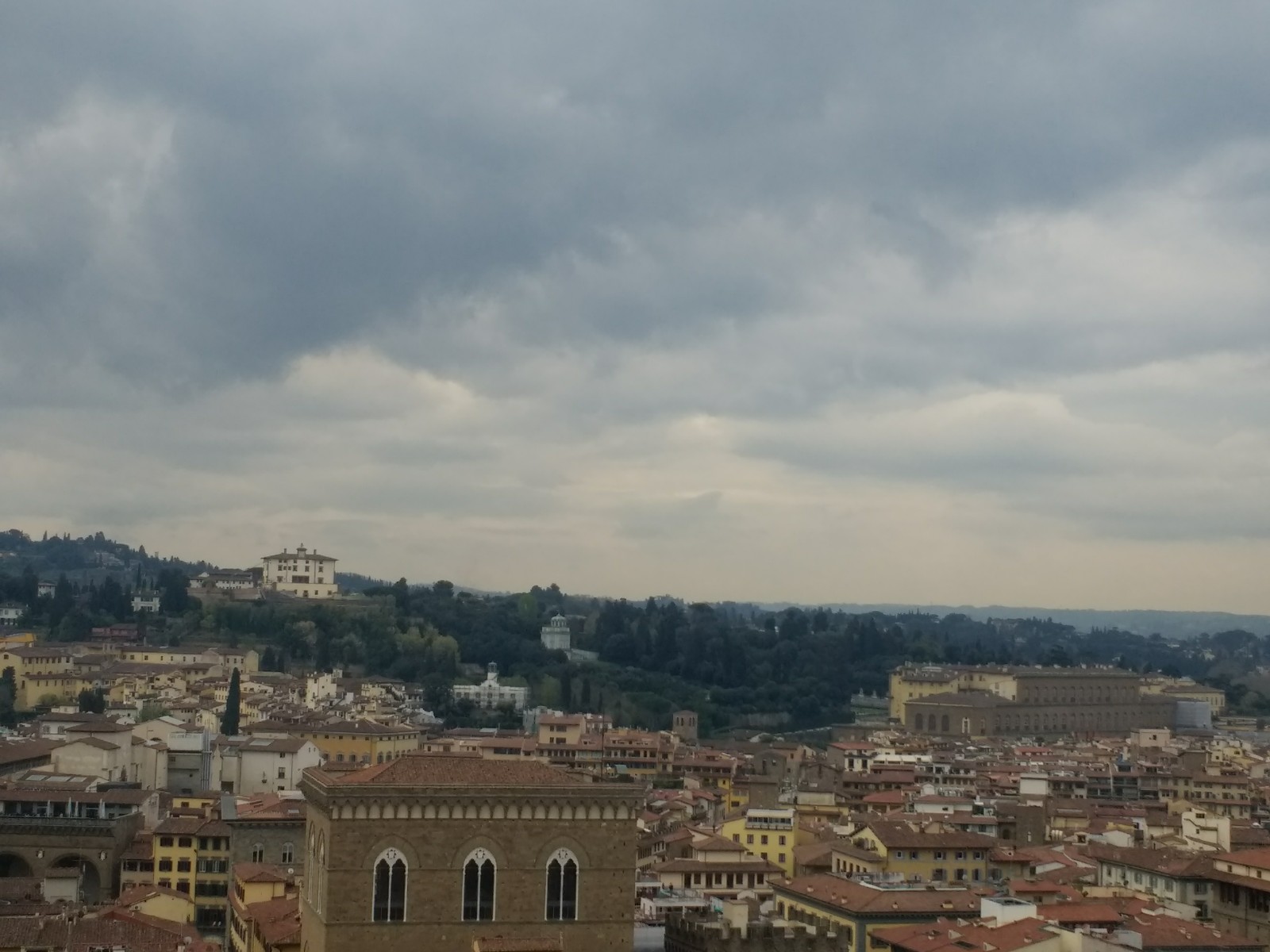
The building with the tall tower is Palazzo Vecchio
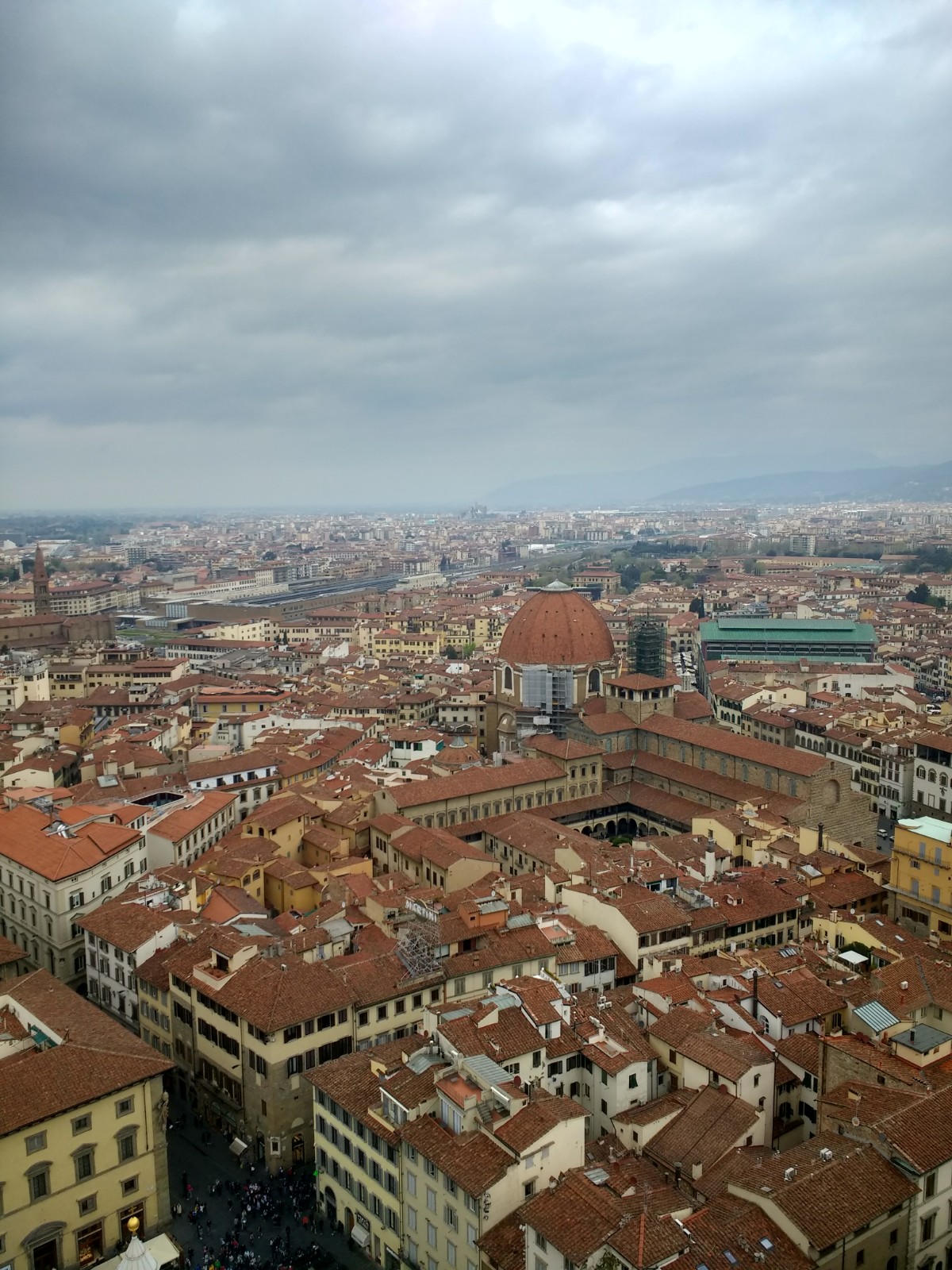
The large red dome belongs to the Medici Chapel.
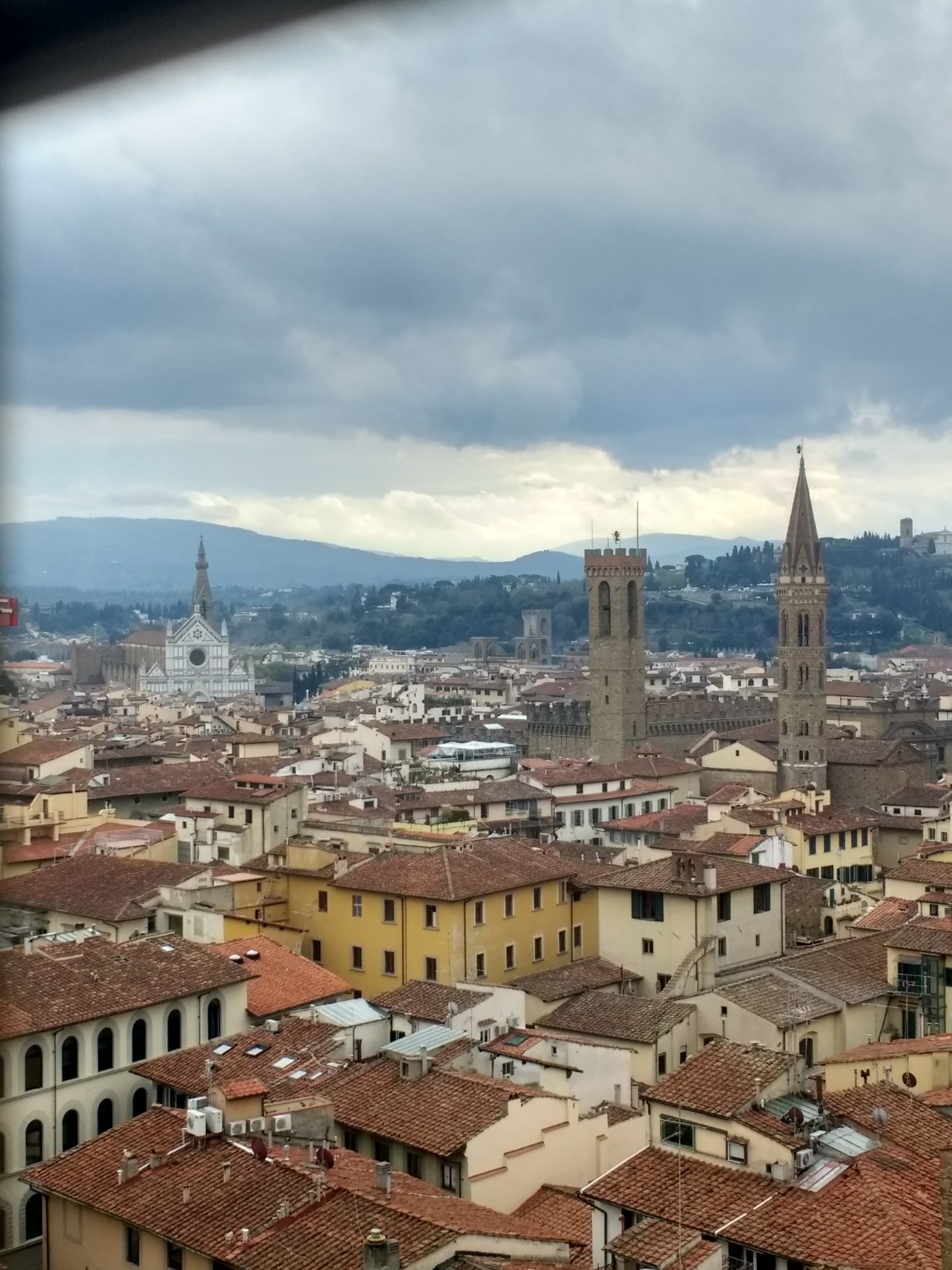
Santa Croce church is the one with the white front on the left.
The greenery belongs to the Boboli Gardens. The big building on the right, to the front of the Boboli Gardens, is the Pitti Palace.

The baptistry, built between 1059 and 1128, is one of the oldest buildings in the city. It used to be rumoured that it was Roman in origin, but this has been found not to be the case, although some of the stones were taken from earlier buildings.
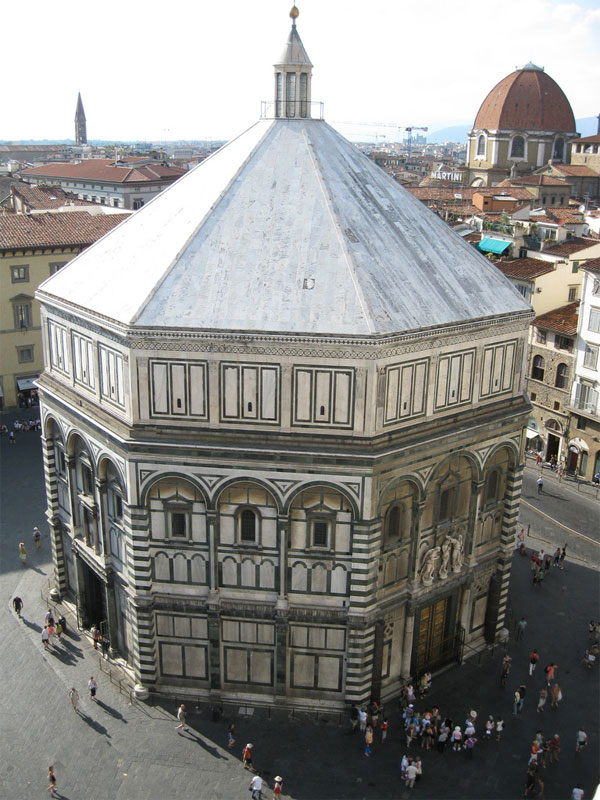
Baptistry – not my photo, snaffled from the internet

The baptistry is best known for its bronze doors, in particular a set by Lorenzo Ghiberti, based on stories from the Old Testament and referred to by Michelangelo as ‘Gates of Paradise.’
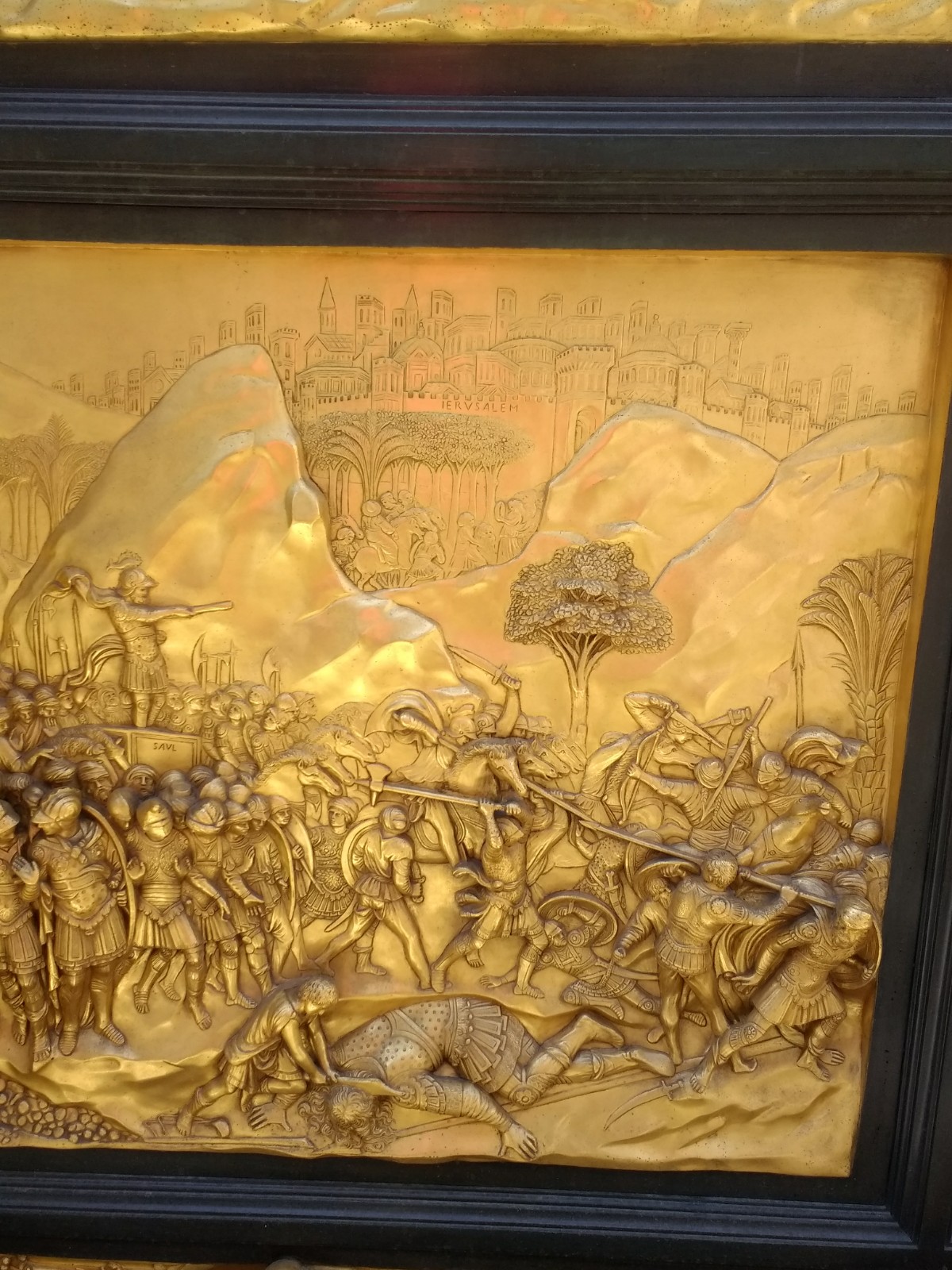
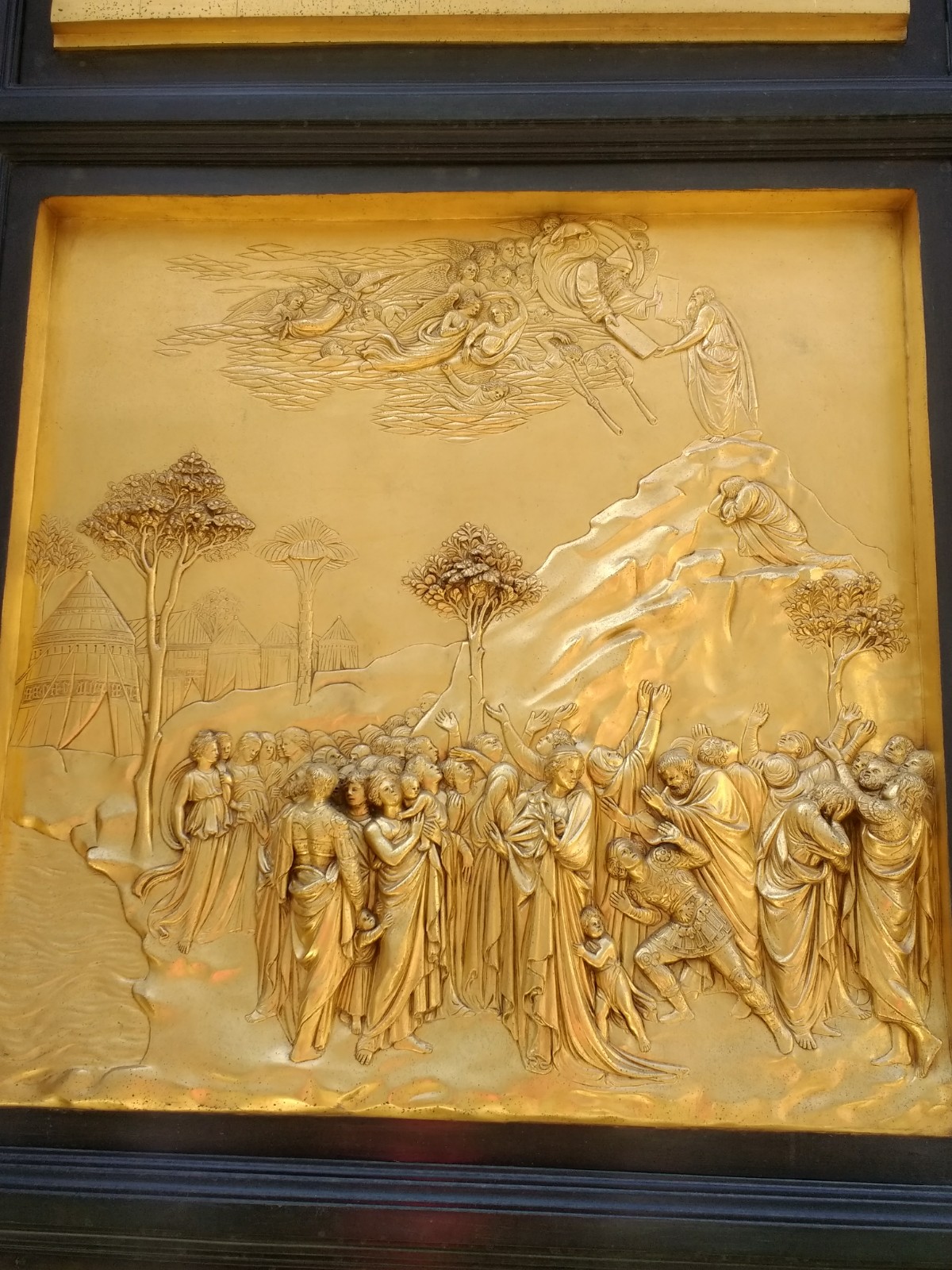
David and Goliath by Lorenzo Ghiberti

Moses by Lorenzo Ghiberti

The panels that I photographed today are only copies. The originals were substituted in 1990 and since then have undergone restoration after accumulating at least four centuries’ worth of dirt and grime. Some of the originals are on view in the Duomo Museum, which I am hoping to get along to tomorrow.

The mosaics inside the Baptistry are magnificent, but I would have preferred the mosaic artists from the thirteenth century to have placed them lower down, where they could be viewed more easily.
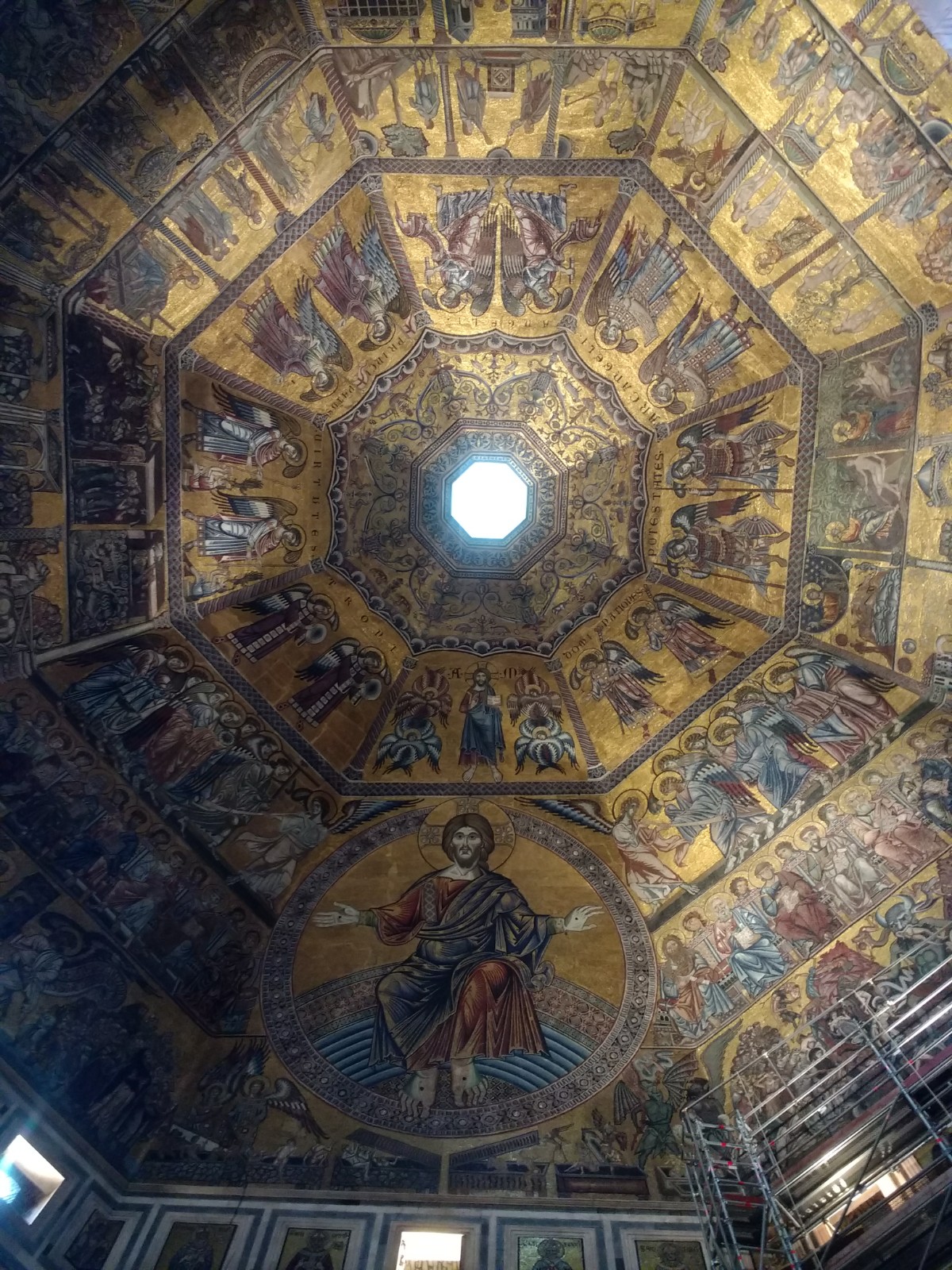
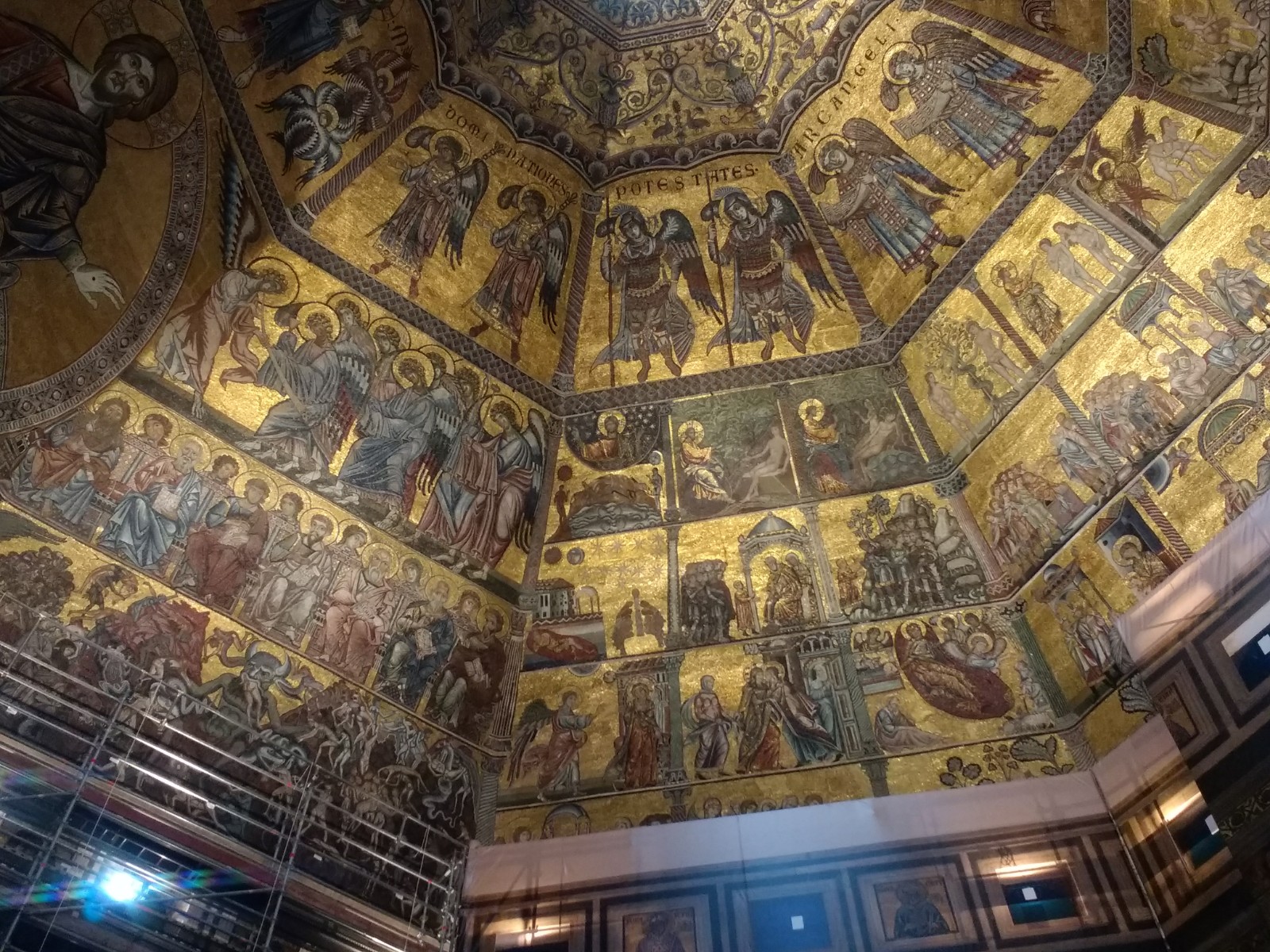
Mosaics in the Vault

A closer view of the vault mosaics

To build an octagonal baptistery was fairly usual at the time. Apparently the eight comes from the six days of creation + one day of rest + a day of re-creation after the act of baptism.

Brunelleschi’s Dome

The Dome, Santa Maria del Fiore (Saint Mary of the Flower)

Such was the faith thirteenth century Florence had in the future, that its new Cathedral was designed with a hole in the roof, in the belief that the knowledge to build a dome to cap the building would be become available at a later date.

While work on the Cathedral was started in 1296, work on the dome by one Filippo Brunelleschi was only begun in 142o. The brief was to build a free-standing dome (flying buttresses were seen as Gothic and unattractive) higher and wider than anyone had built one before.

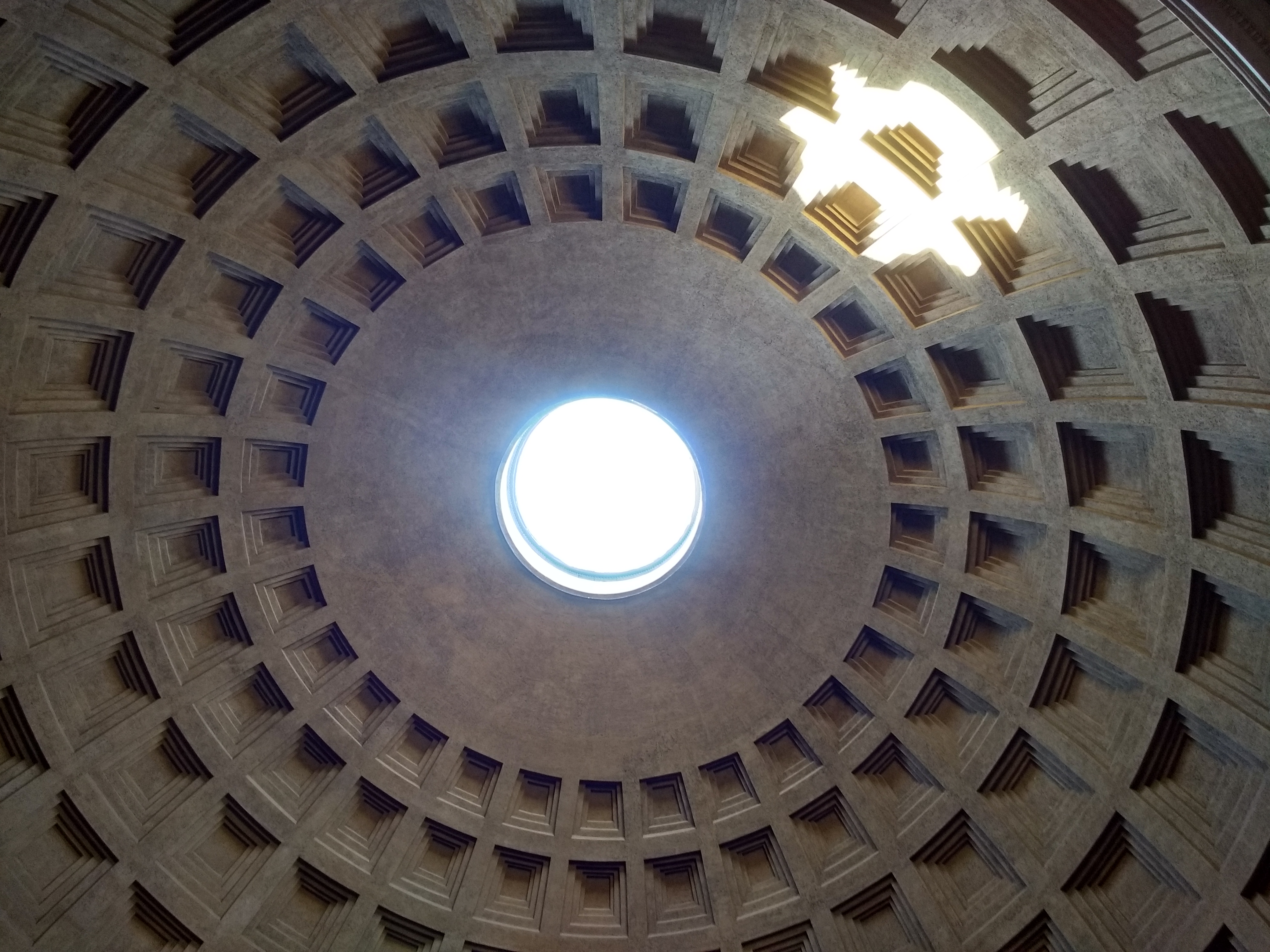
To gain inspiration, Brunelleschi travelled to the Pantheon in Rome to see how the ancients had tackled dome building.

The dome of the Pantheon from inside

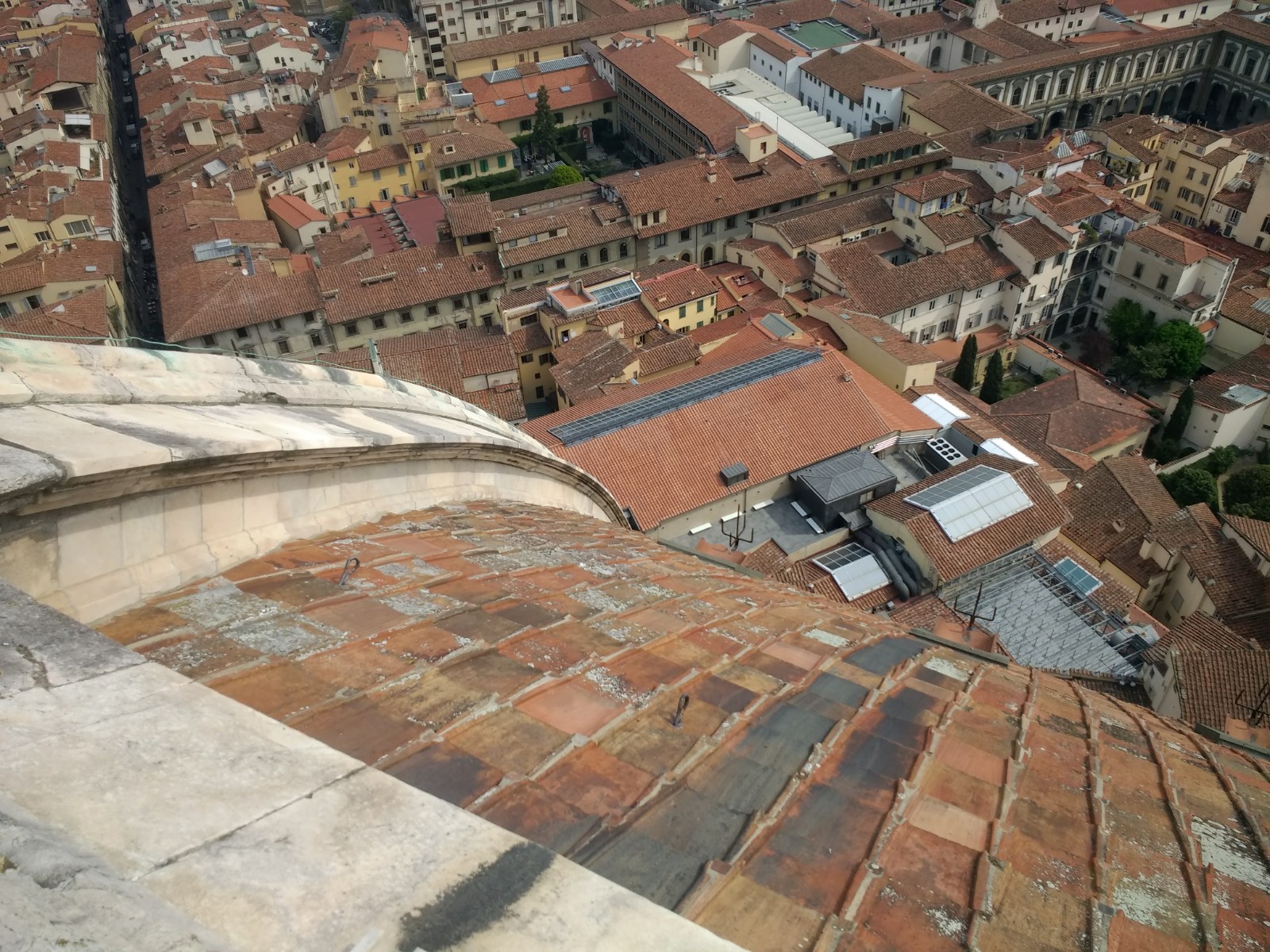
Brunelleschi’s plan was to build the white ‘ribs’ of the dome first, and infill with overlapping bricks, starting at the bottom, the erection supporting itself as it went.

A white ‘rib’ and the overlapping tiles

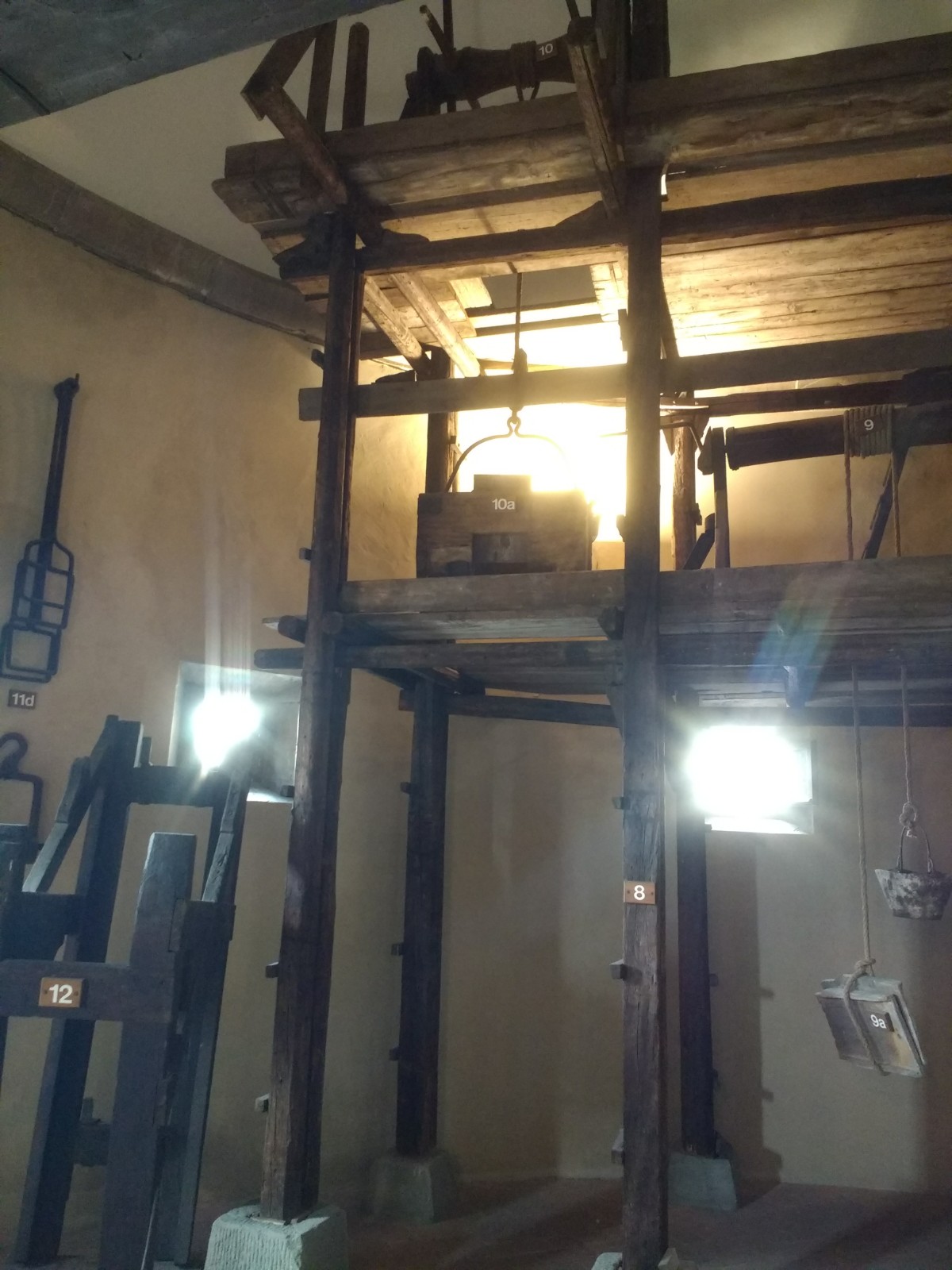
Brunelleschi designed appropriate tools as they were needed.

Hoist, either original or a ‘perfect copy’

He then built an inner dome, which would provide stability. Lastly, the white ribs were fixed in place with a lantern.

The dome became the inspiration for Michelangelo’s St Peter’s in Rome, and also the Capitol in Washington DC.

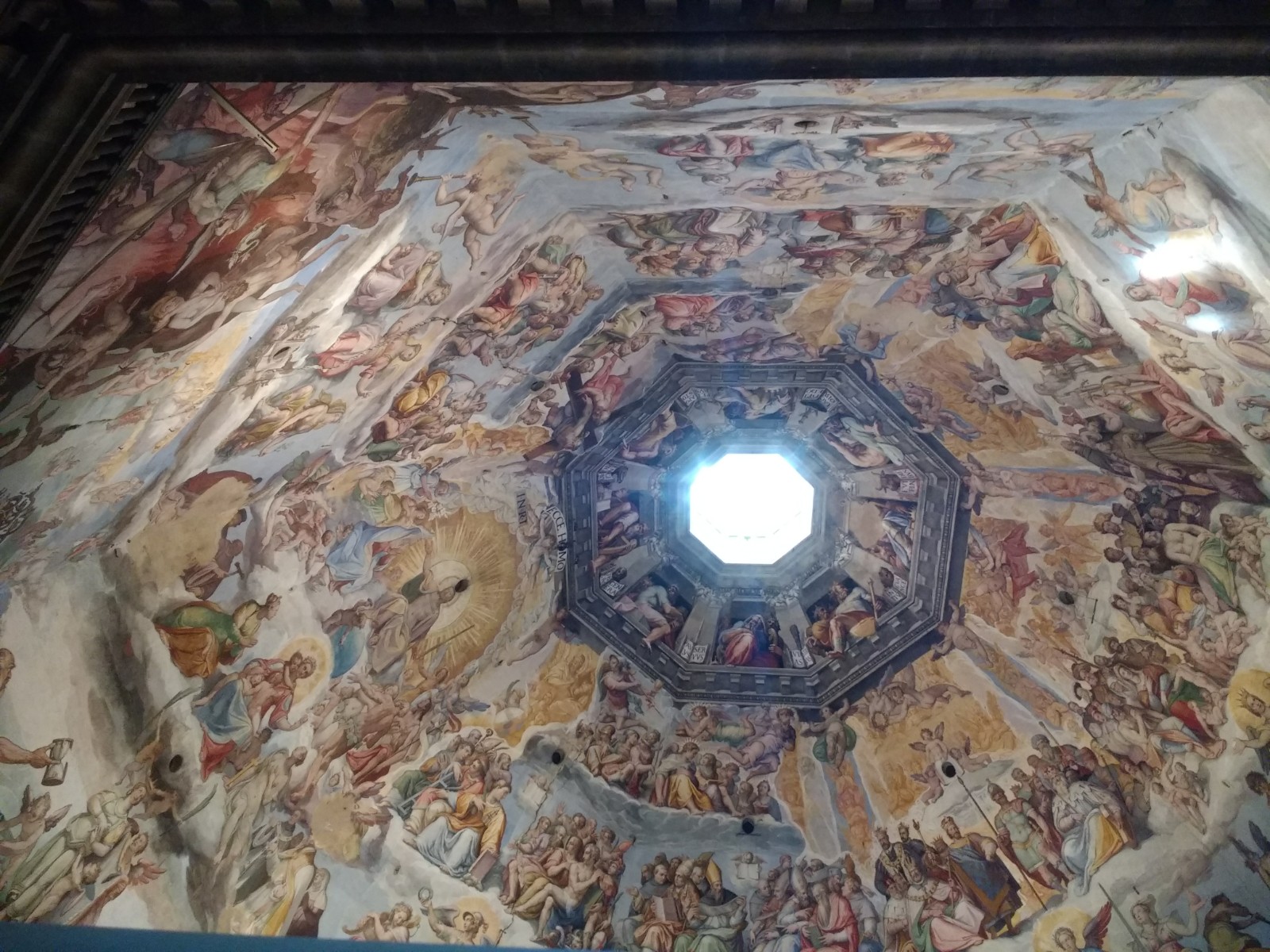
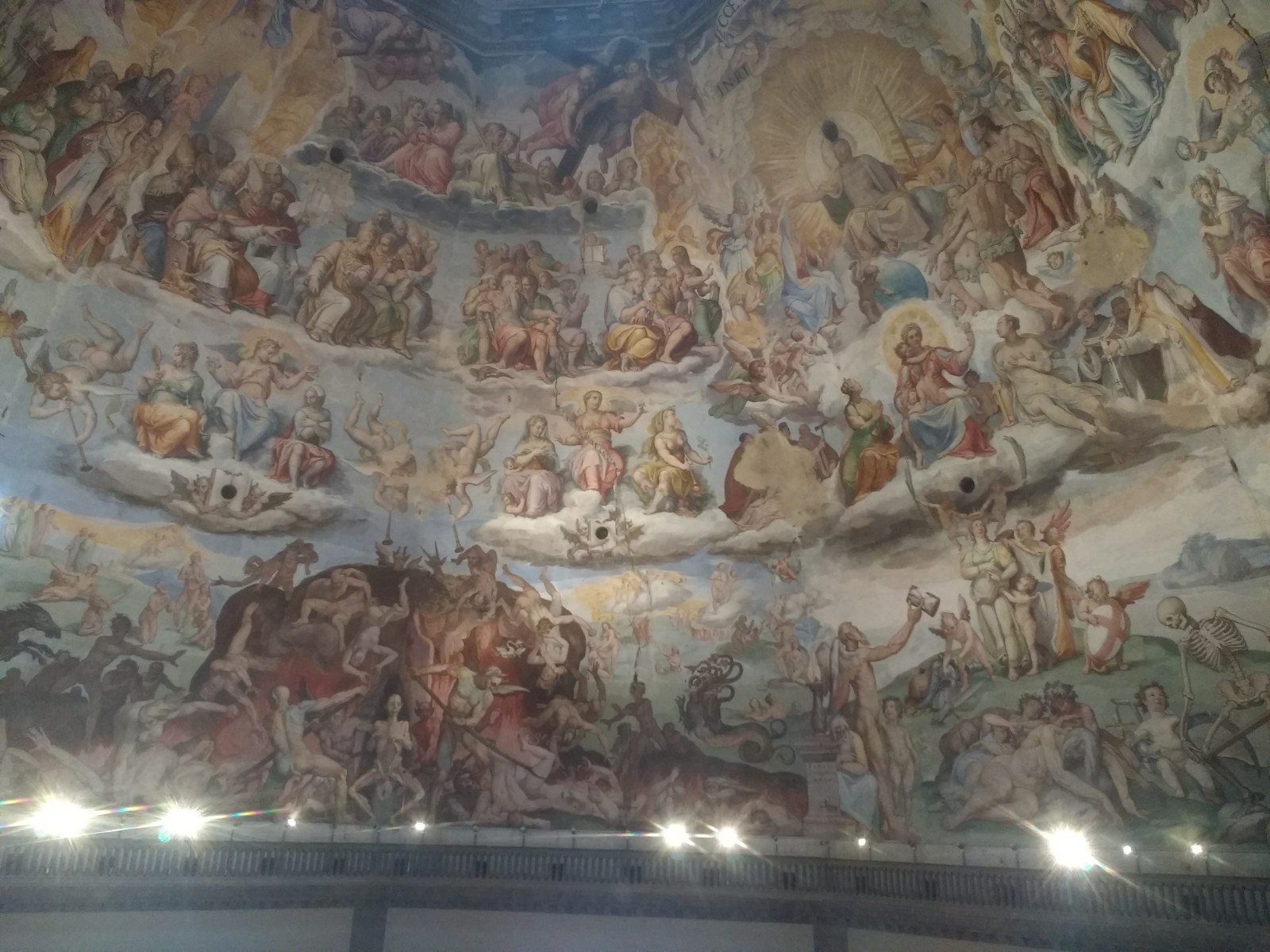
I left Mark, suffering from a heavy cold, at home today, and climbed up to the top of the dome on my own. Was it worth it? The views were good, but I think they are better from the Boboli Gardens. However, if you like towers, do it. You also get good and close to the ‘Last Judgment’ by Georgio Vasari.

The Last Judgment

We were able to walk round the inside of the dome on two levels, but were constantly told to ‘move on’. This is the upper level that you can see.
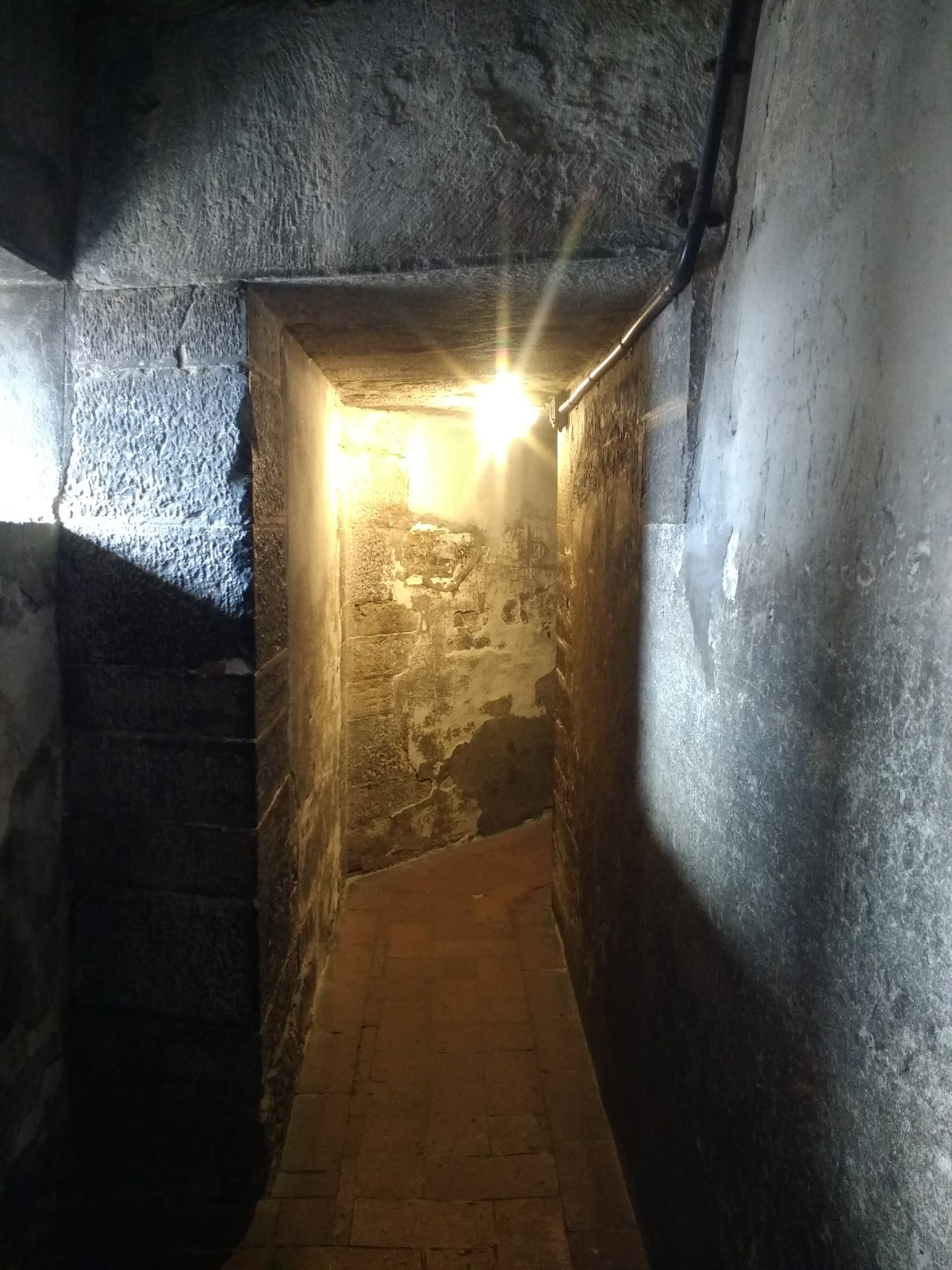
Narrow passageways on the way up
Looking down from the top
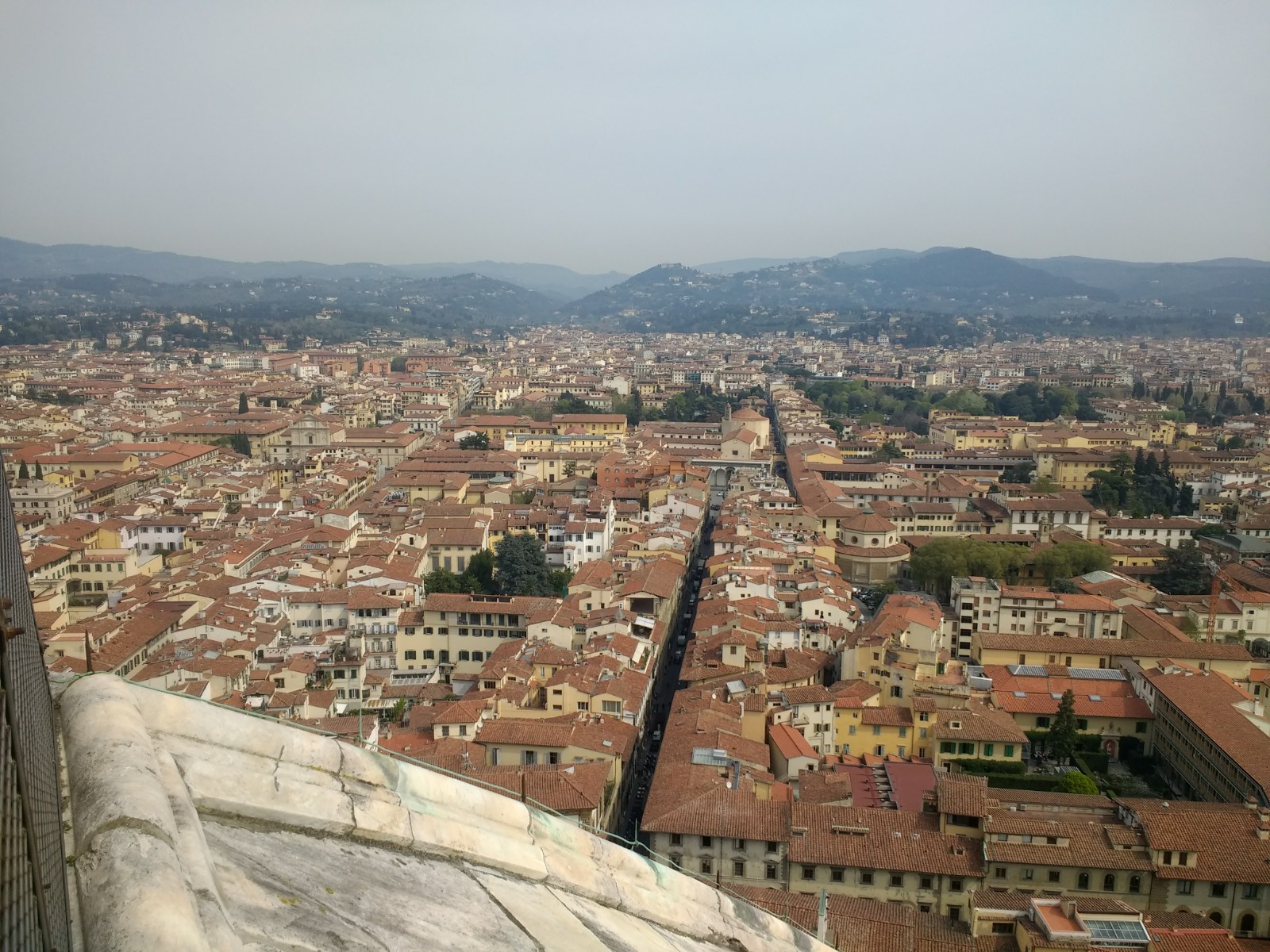
View of Florence

A Renaissance Walk In Florence

The sunshine yesterday made a gentle amble round the centre following Rick Steves’ Renaissance walk very pleasant.

We started at the dome of the Cathedral, or Duomo.

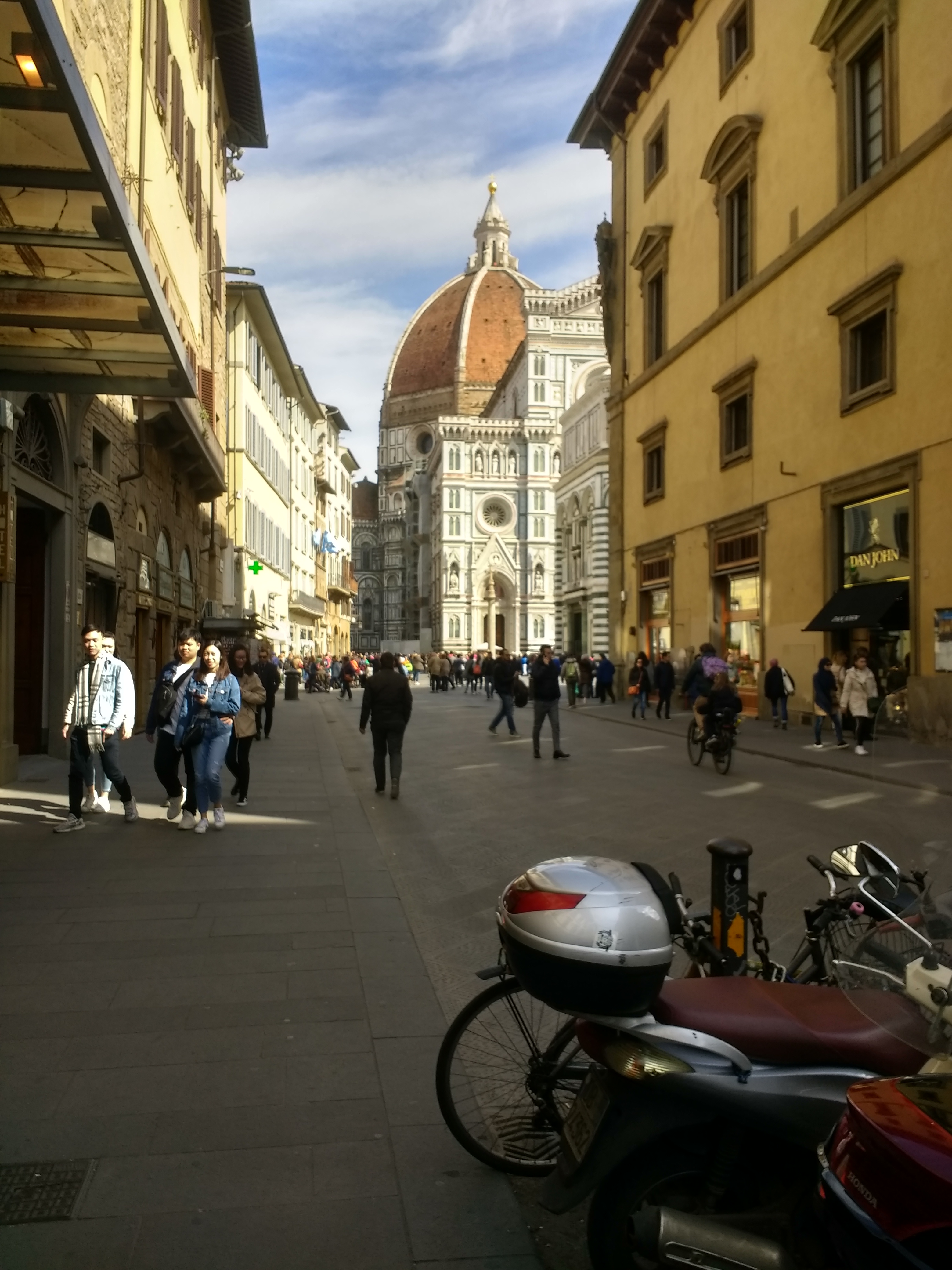
An iconic view of the Cathedral, with its red-brick dome

However, more on that tomorrow as we have a timed slot to climb up inside the dome, and then 72 hours to visit the campanile, baptistry, crypt and Museum (All for €18 each seems not bad value).

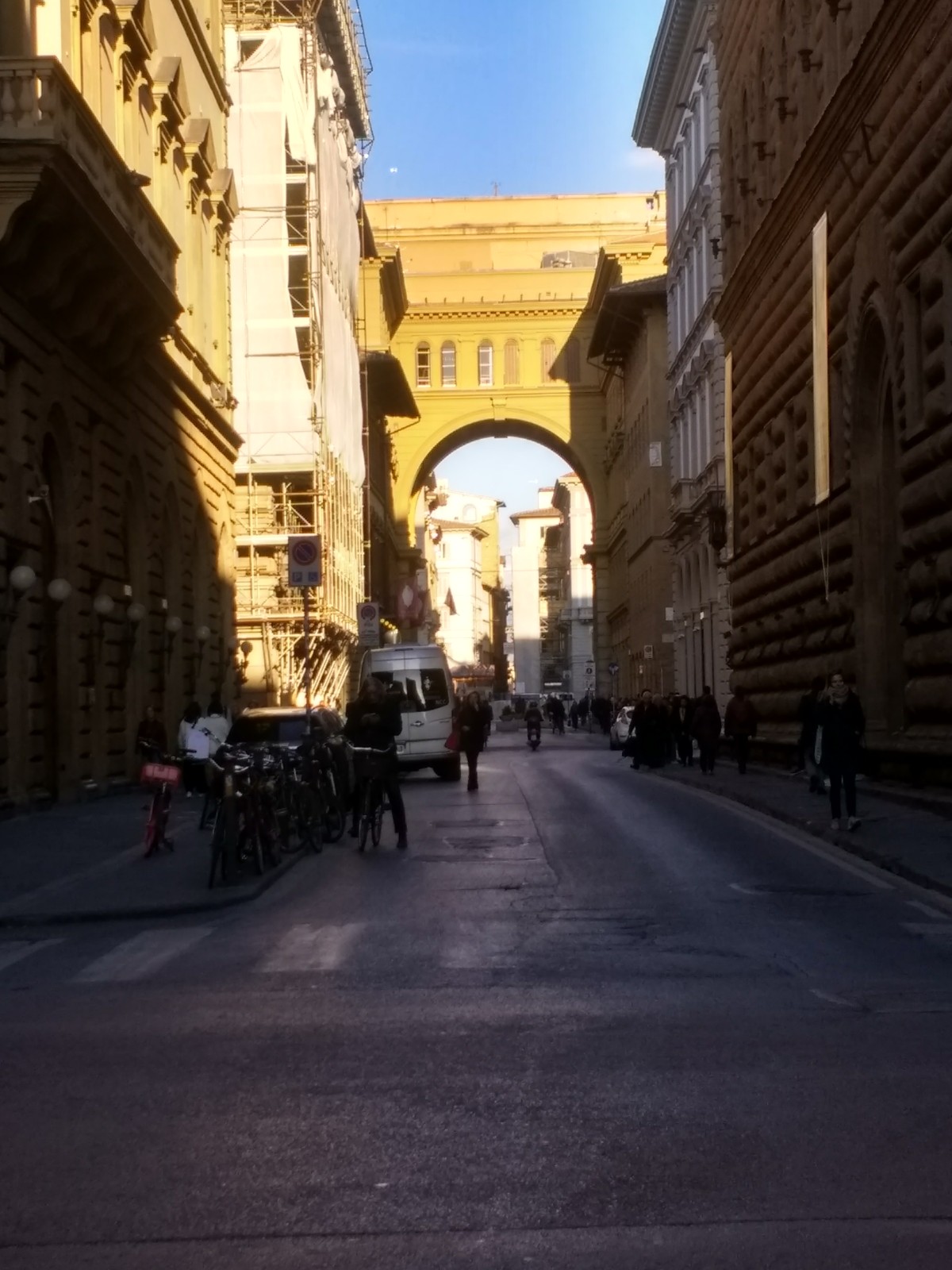
The Triumphal Arch, built to celebrate the unification of Italy when, for just five years, Florence was the new country’s capital.

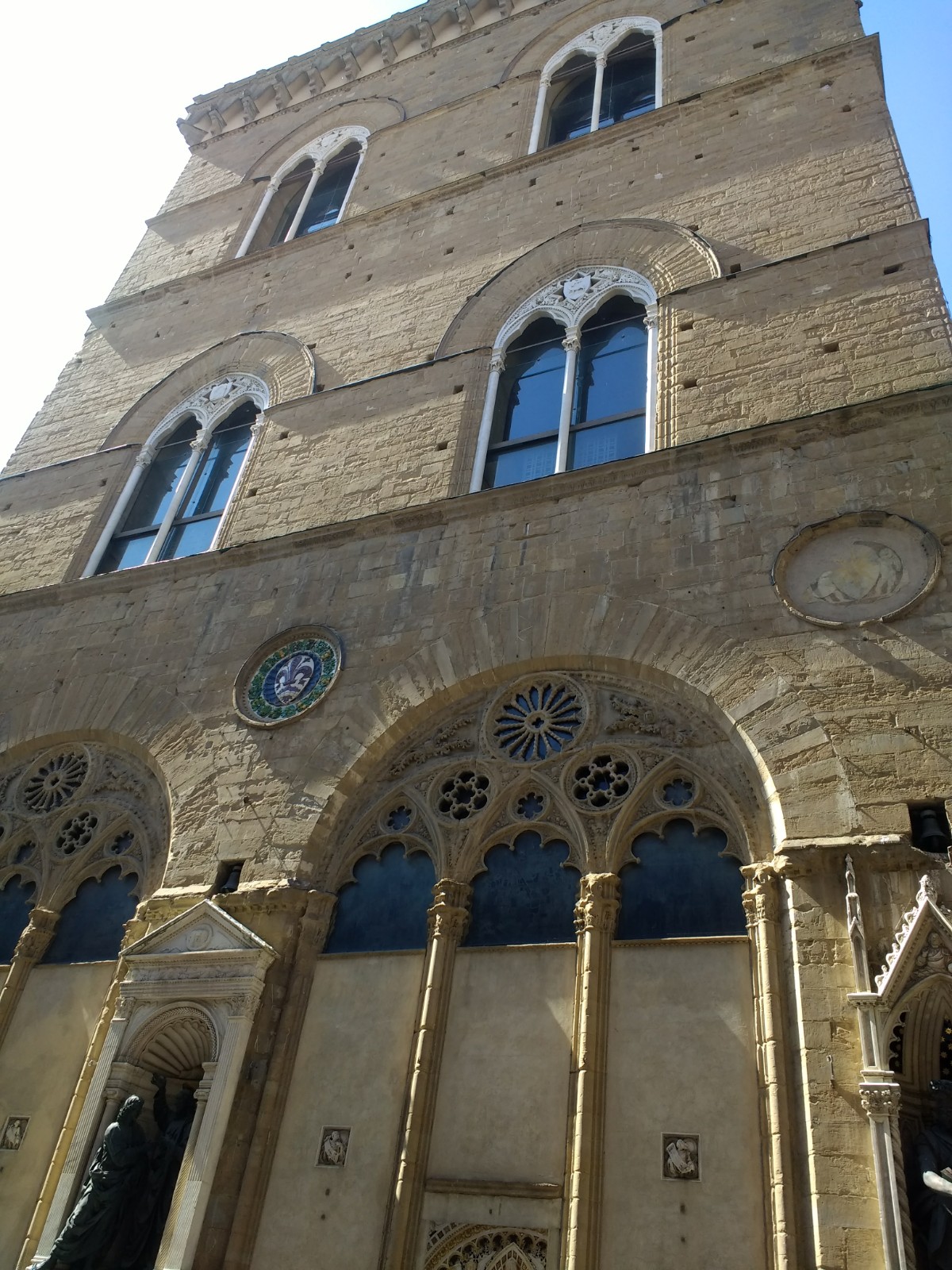
Next stop was Orsanmichele church, initially built as a granary and grain shop, but converted to a church in the fourteenth century.

Orsanmichele.
The arches were filled in during the 1300’s when it was made into a church.
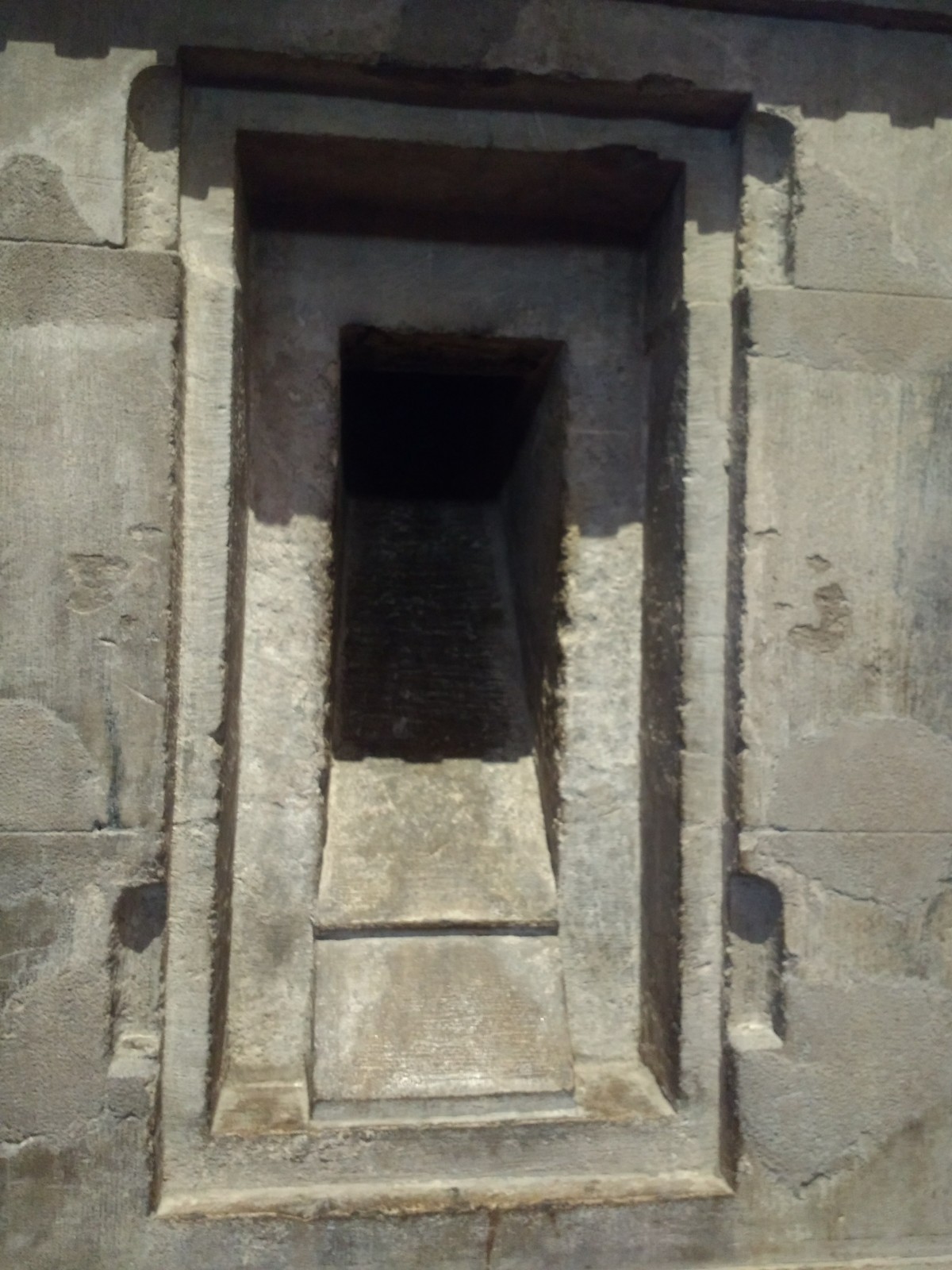
Some of the original features can still be seen inside the church. This is a grain chute.

Hooks on the ceiling for looping rope through, to help move the sacks of grain.
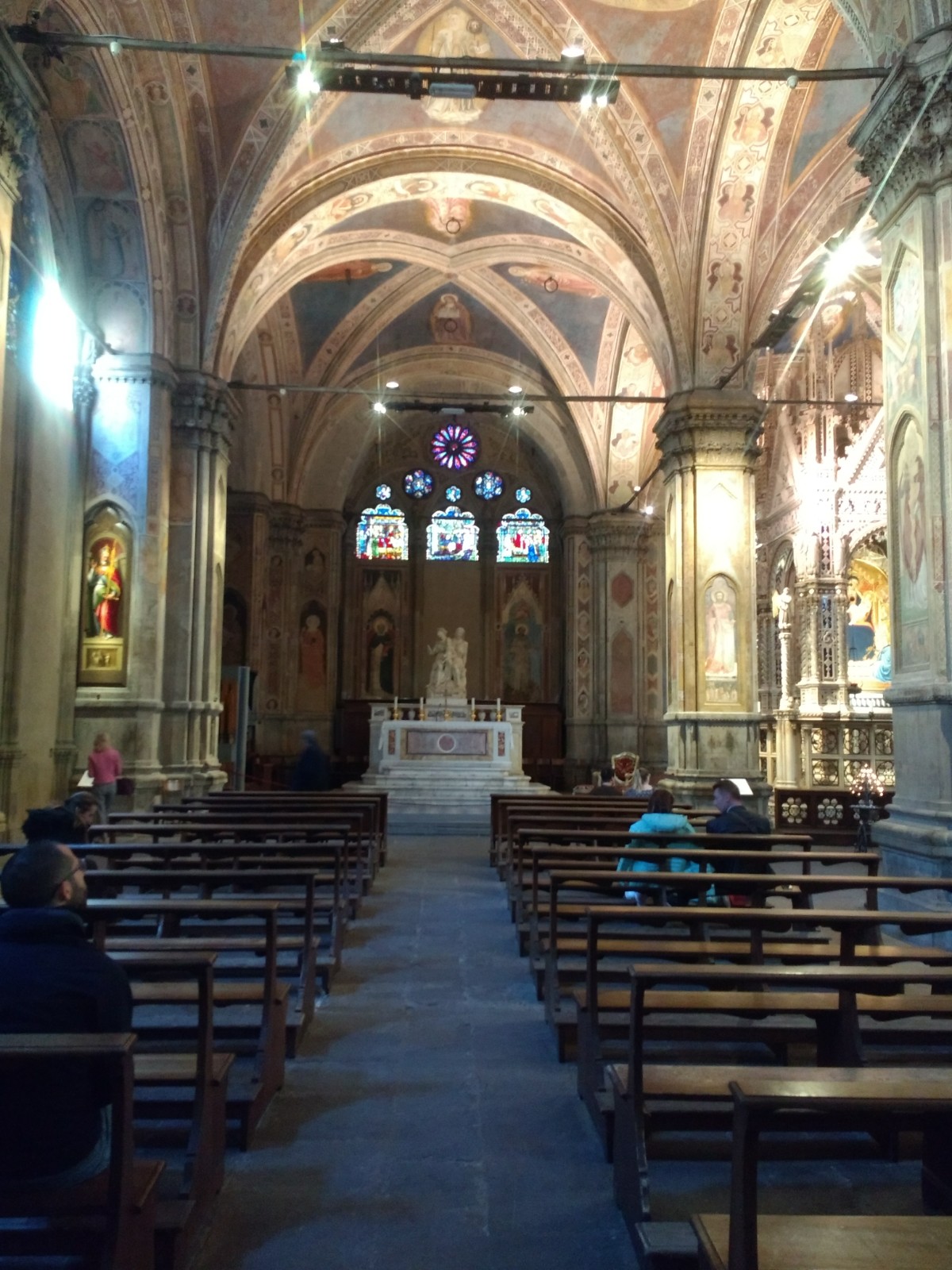
As the building was never designed as a church, the internal layout is unusual. This is the first of two naves.

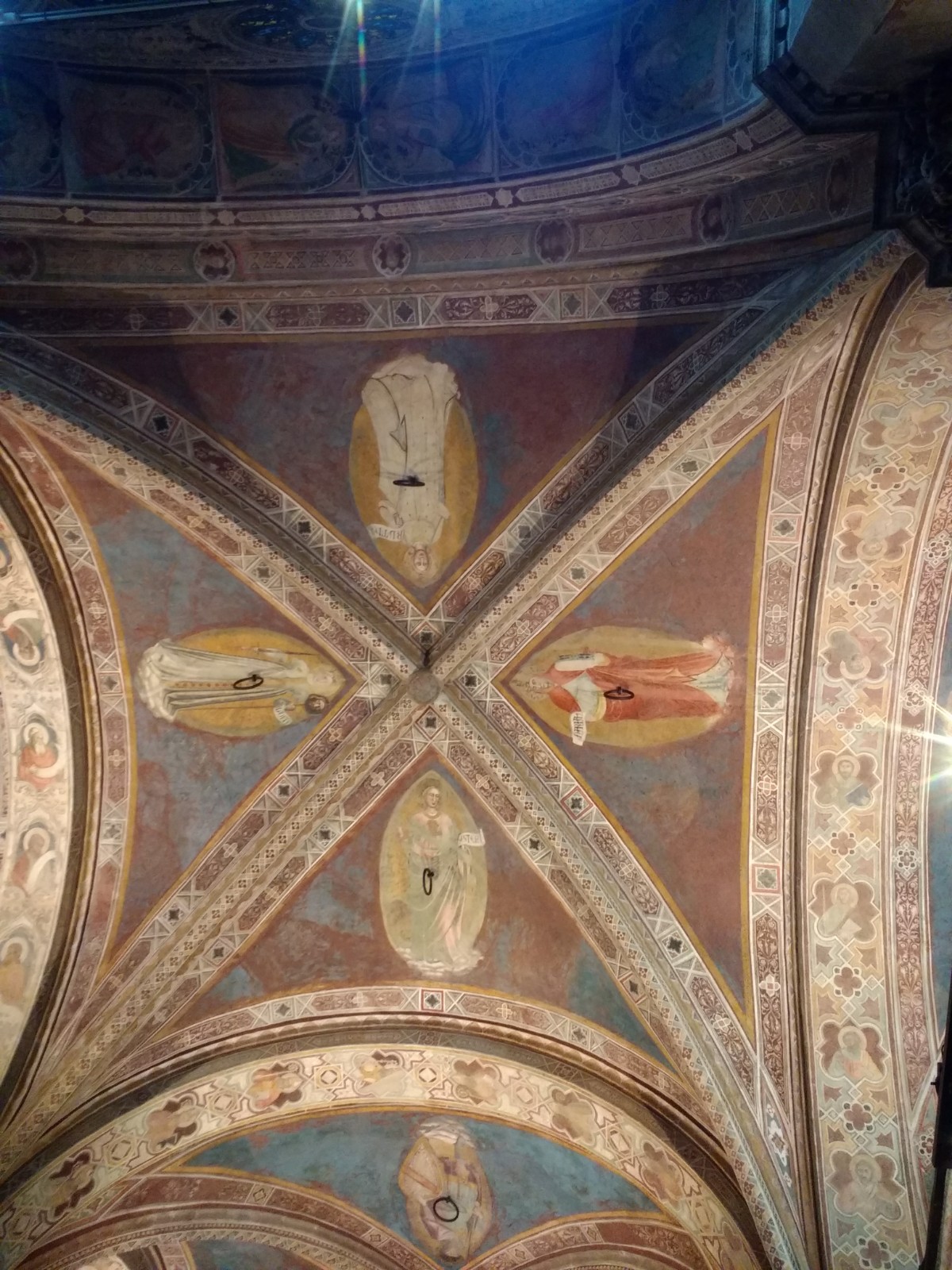
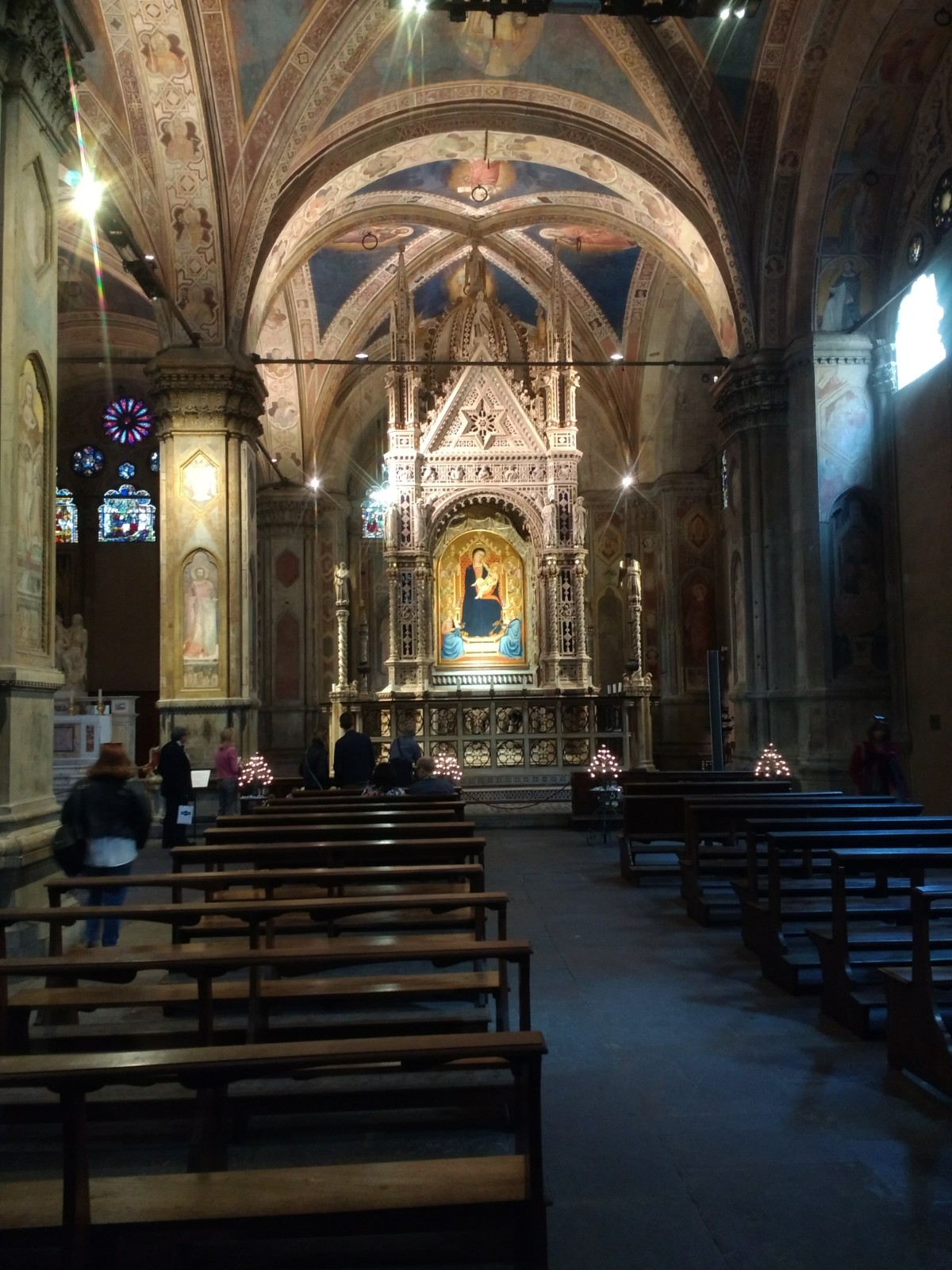
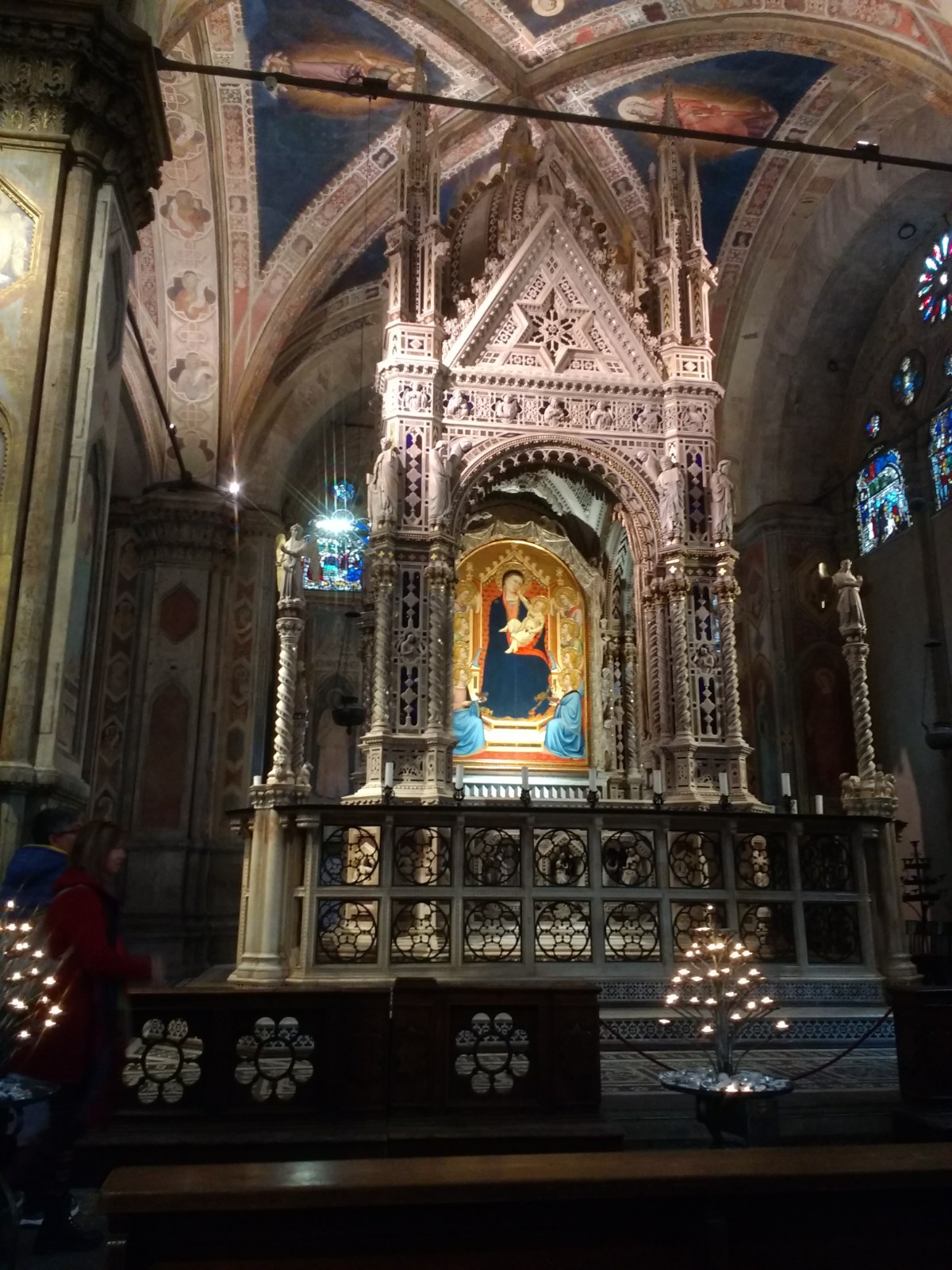
Second nave with huge tabernacle designed for Bernardo Daddi’s painting of the Virgin Mary.

After a devastating outbreak of plague in 1348, when half the city population died, survivors would come into the church and give thanks to the Virgin for their survival.

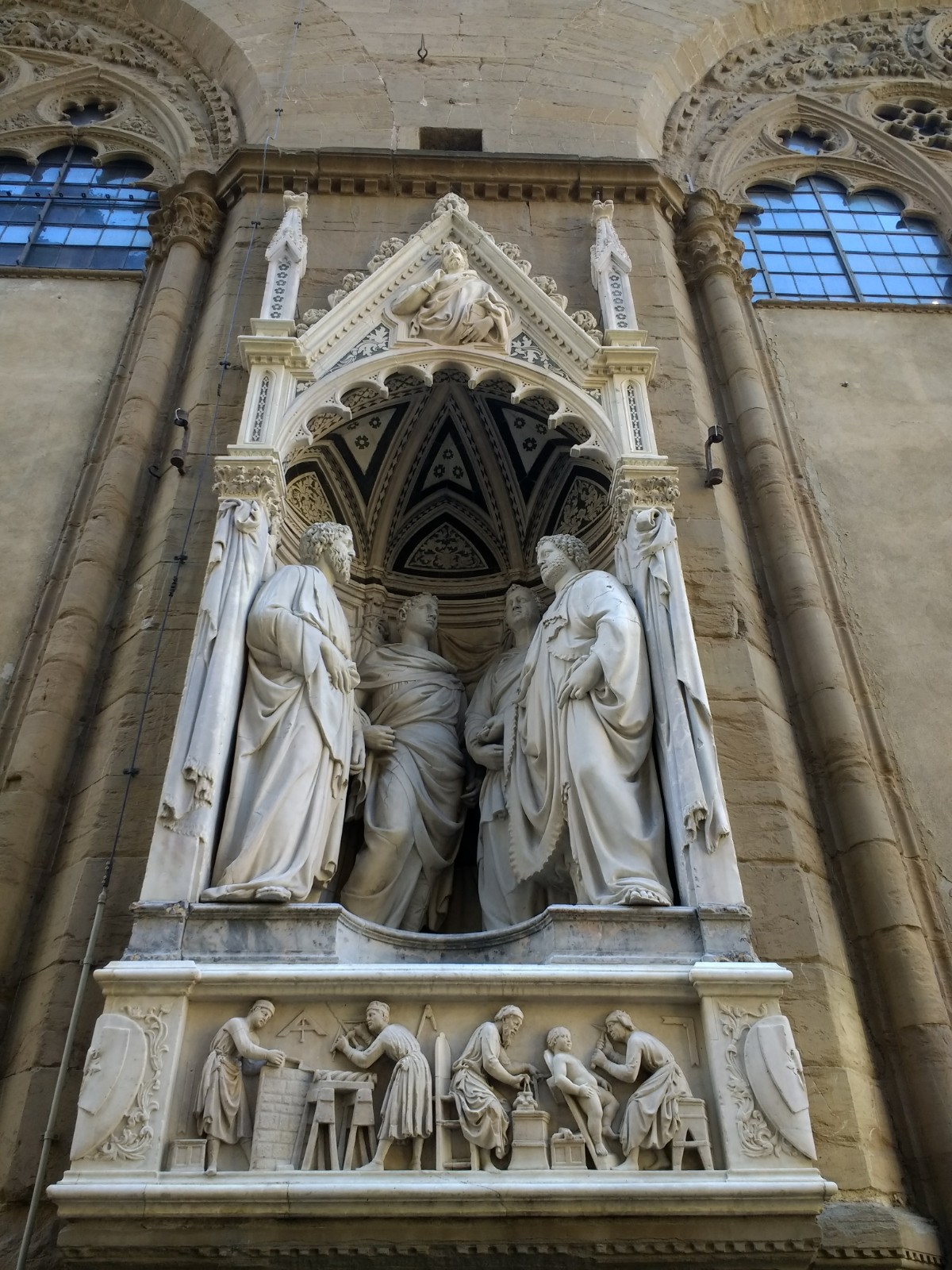
Outside the church, copies of fourteenth century statues (the originals are mainly scattered throughout the city museums) stand in niches.

The Four Saints by Nanni di Branco. They were martyred by the Romans for refusing to sculpt pagan gods.

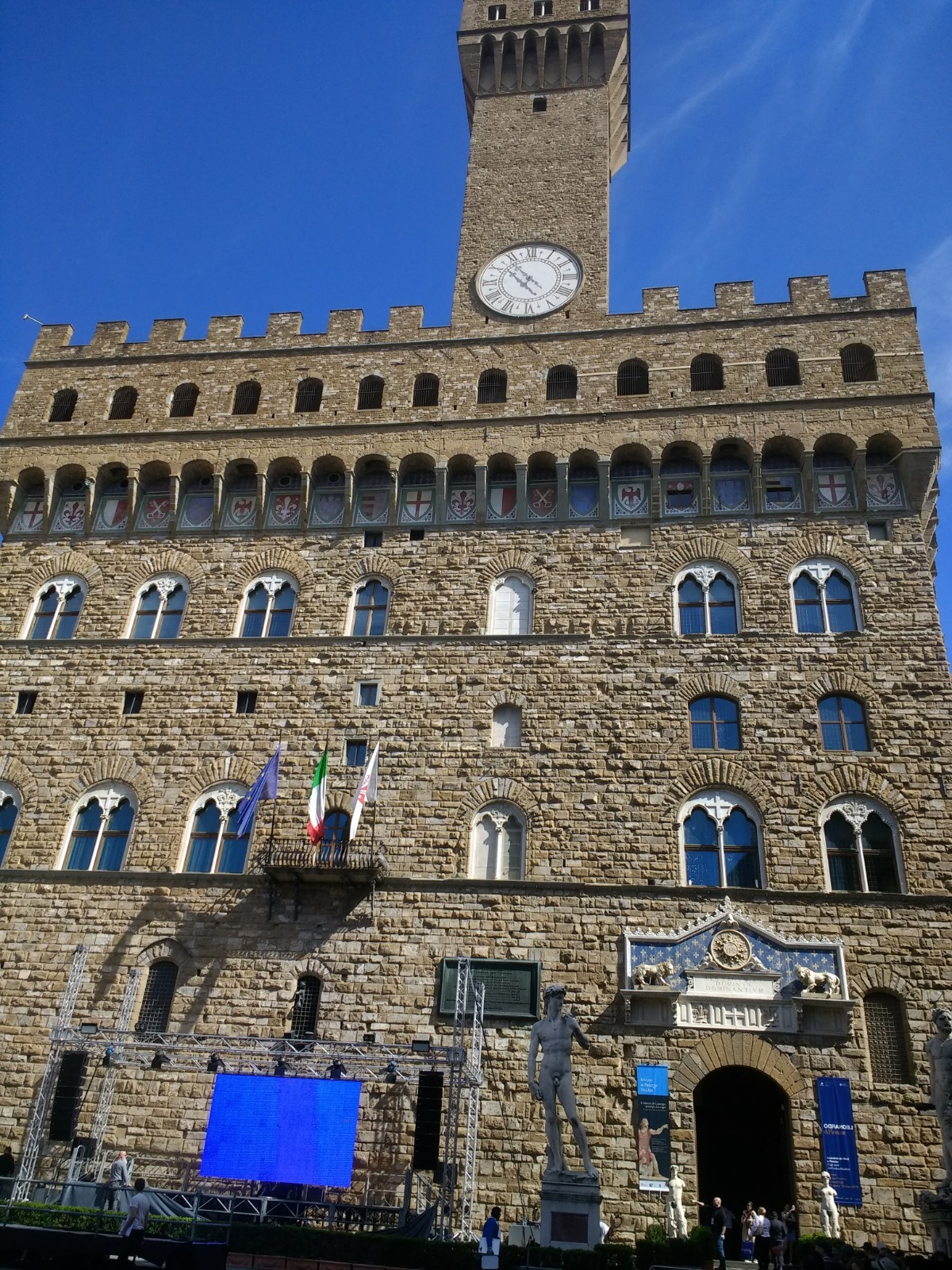
Next stop Palazzo Vecchio and the square in front of it, Piazza Signoria.

Palazzo Vecchio, Florence’s City Hall
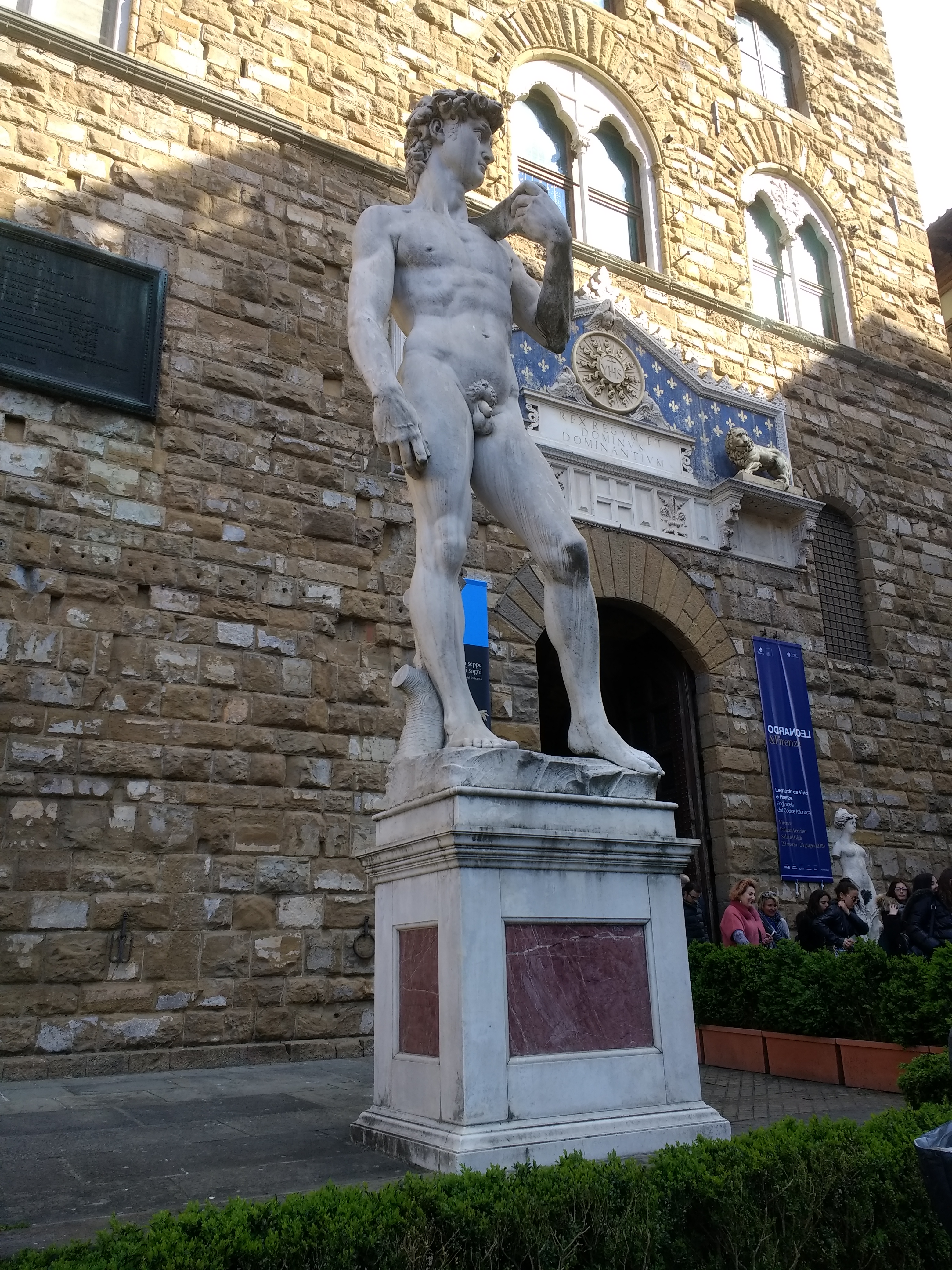
A copy of Michelangelo’s David stands outside the Palazzo. To me, his hands seem over-sized. There is probably an explanation for why this is, but I can’t find one. The original, now in the Accademia, was damaged in a 1527 riot, when a bench was tossed out of a palace window and knocked David’s left arm off.

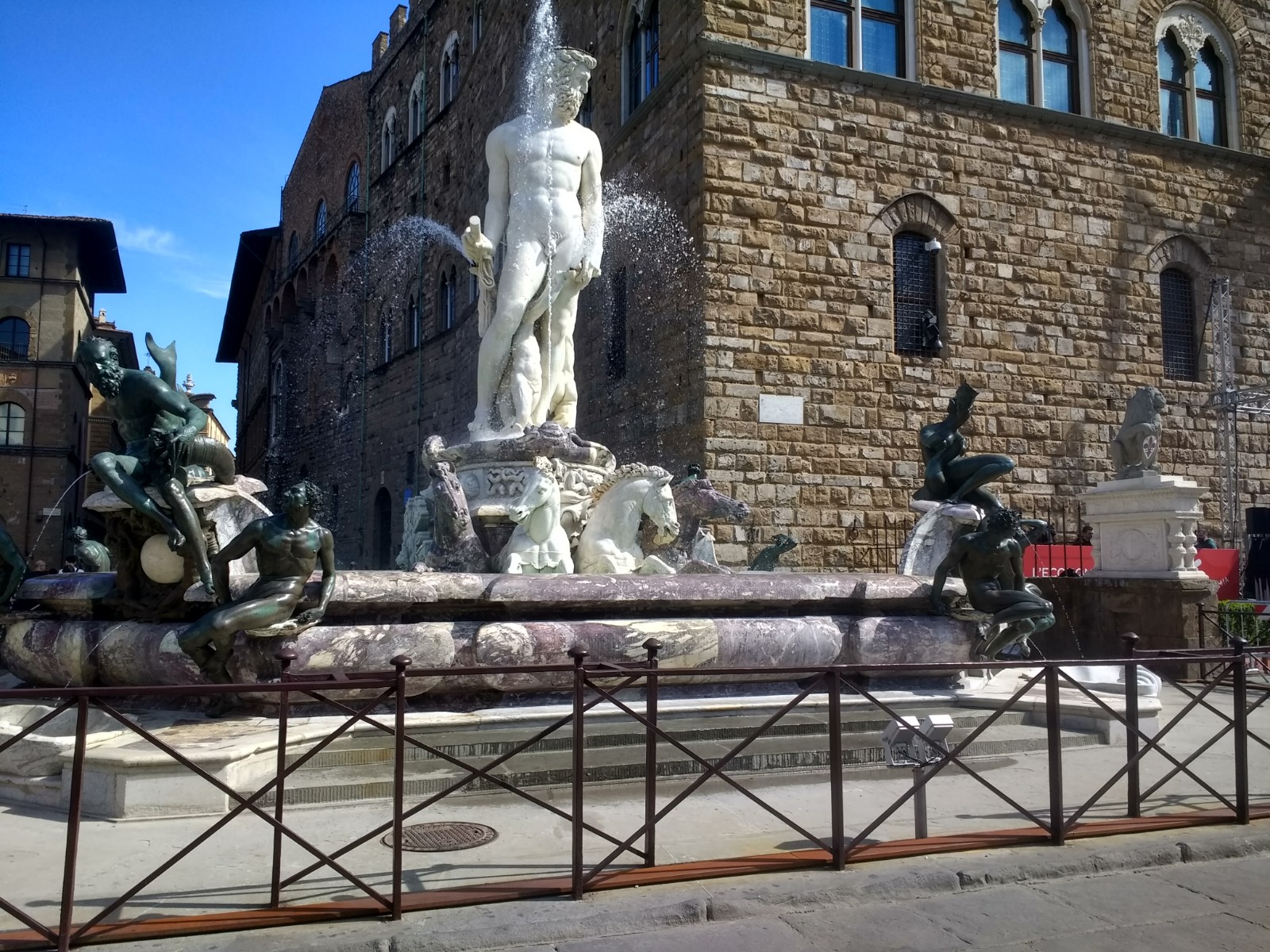
The God of the Sea by Bartolomeo Ammanati.
Michelangelo apparently considered this a waste of marble.

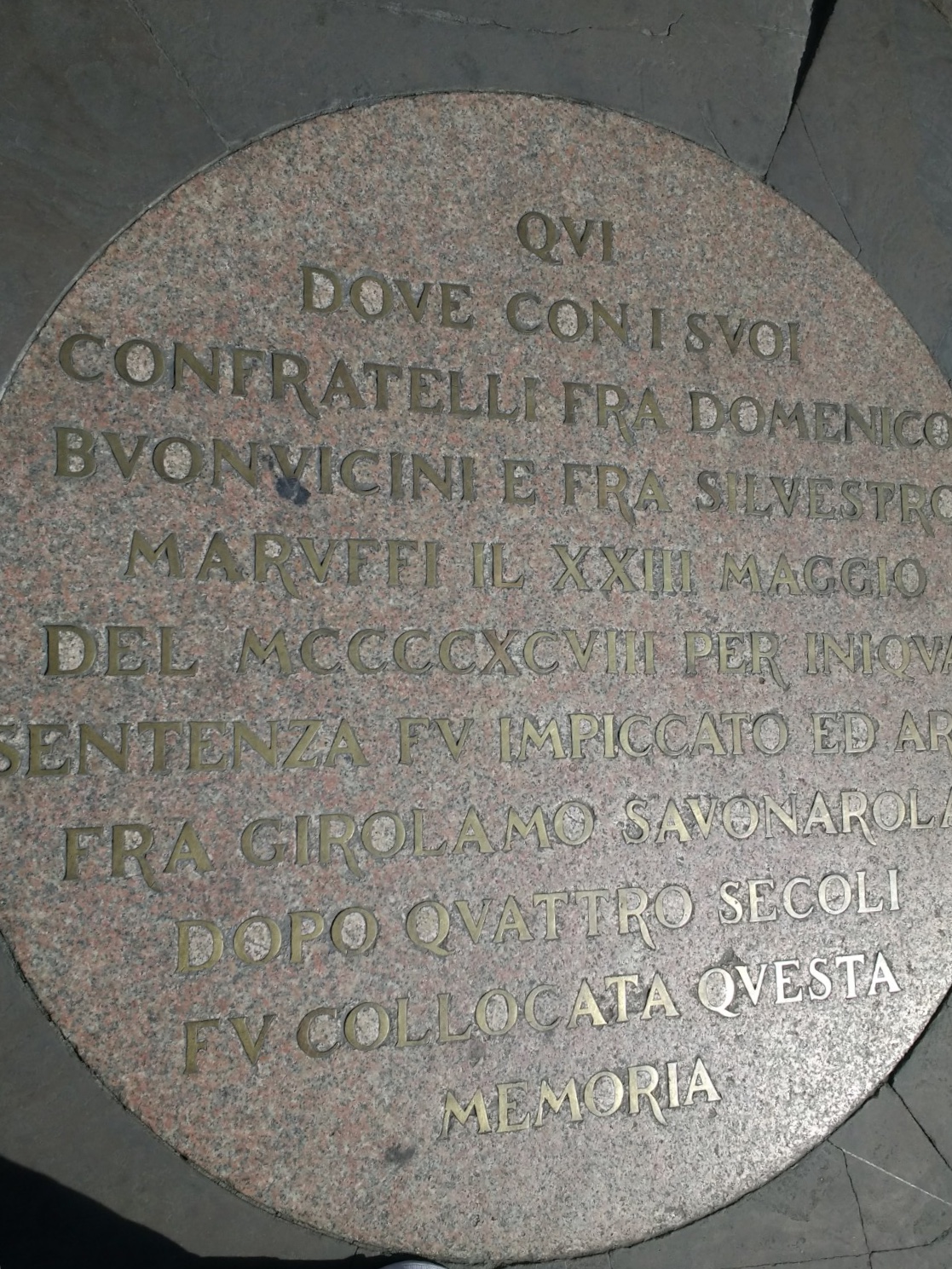
Finally, although this wasn’t the end of the walk, a plaque in the ground.

The plaque marks the spot where a puritanical monk, named Savonarola, was hanged and burnt in 1498. After the excesses of the Medicis, he preached a return to a plainer way of life and encouraged the destruction of paintings and books produced during the Renaissance.

The Florentines, supported by the Pope and the exiled Medicis, fought back and arrested Savonarola, before dispatching him in a grisly manner.

It’s wonderful having time to watch …

While having lunch, in a corner of the Palazzo Vecchio, we watched a dozen men we took to be film crew (the blue rectangle in front of the Palazzo is a film screen) dragging, and arranging, a set of crush barriers to keep a crowd at bay. As soon as one arrangement was finished, some barriers would be undone, and carted off in another direction.

When we had finished lunch, and were standing in the Piazza looking at the statues, a gang of men in high-vis yellow arrived. They drove their van onto the Piazza, manhandled some of the arranged crush barriers into the van, drove the van to the other side of the square, unloaded the barriers and put them down into another configuration.

We have no idea what all this was in aid of, other than practice for some event. We thought we might just have to wait a bit too long to find out.

Views From the Boboli Gardens

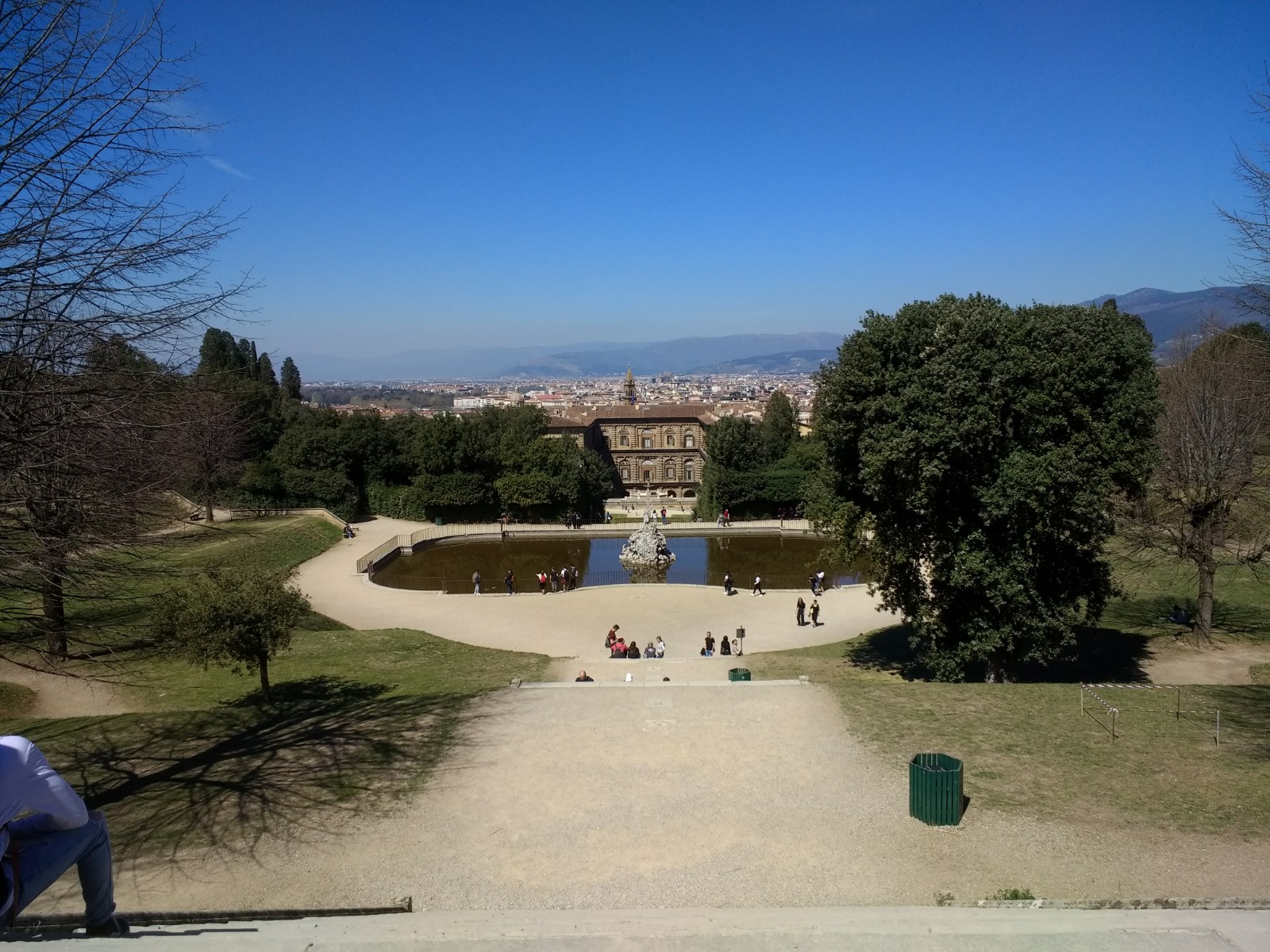
When the Medici family bought the Pitti Palace in the sixteenth century, they also purchased a parcel of land (from a family called ‘Bogoli’) in order to create a garden.

Looking down towards the Pitti Palace

All thoughts of manicured lawns and magnificent flower beds must be driven from your mind if you are not to be disappointed. This is a formal Italian Garden made up of geometric shapes filled with grass, marble statues, ponds and fountains.

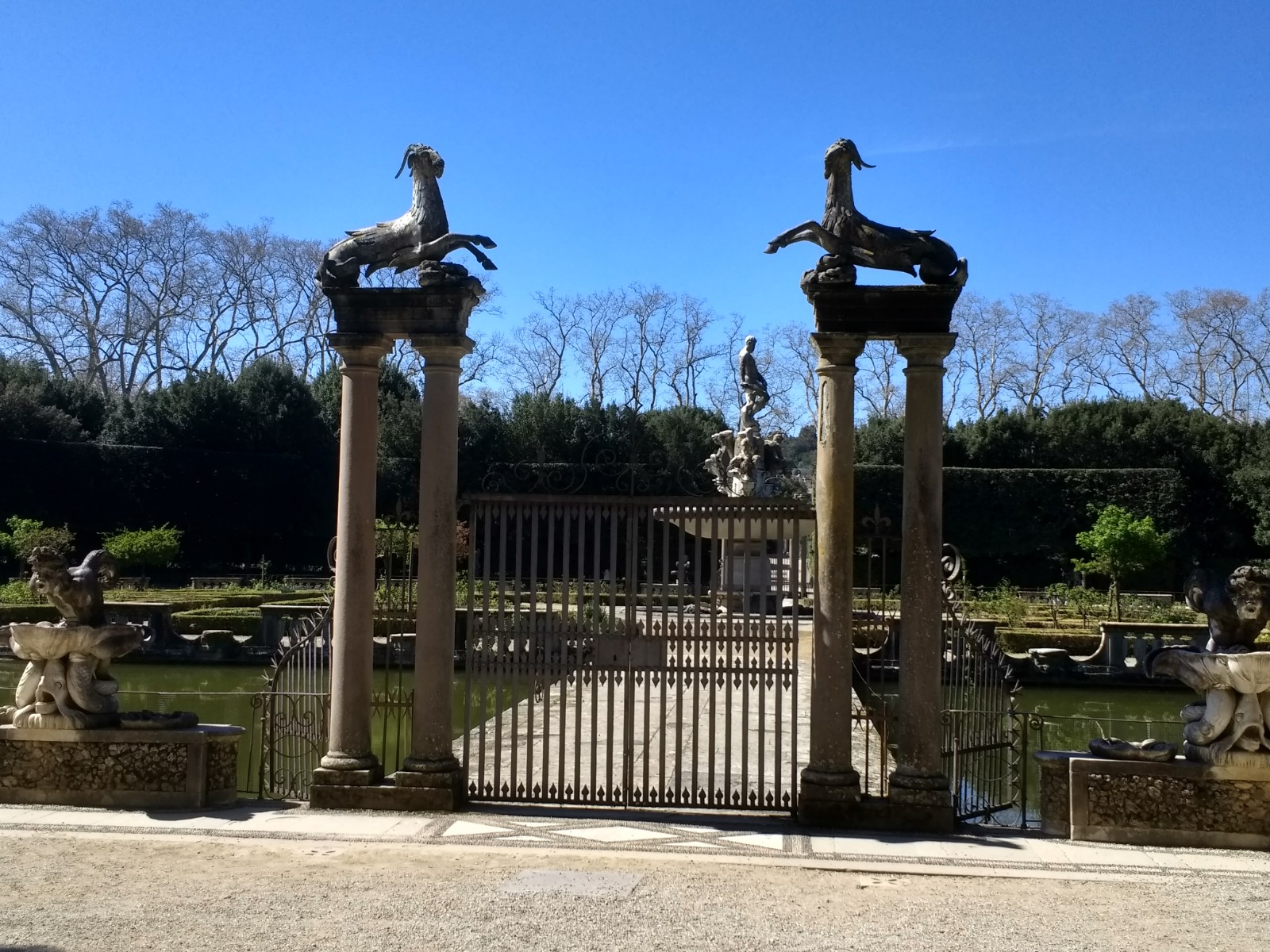
The magnificent gates to ‘Little Island’. This was as close as we could get.

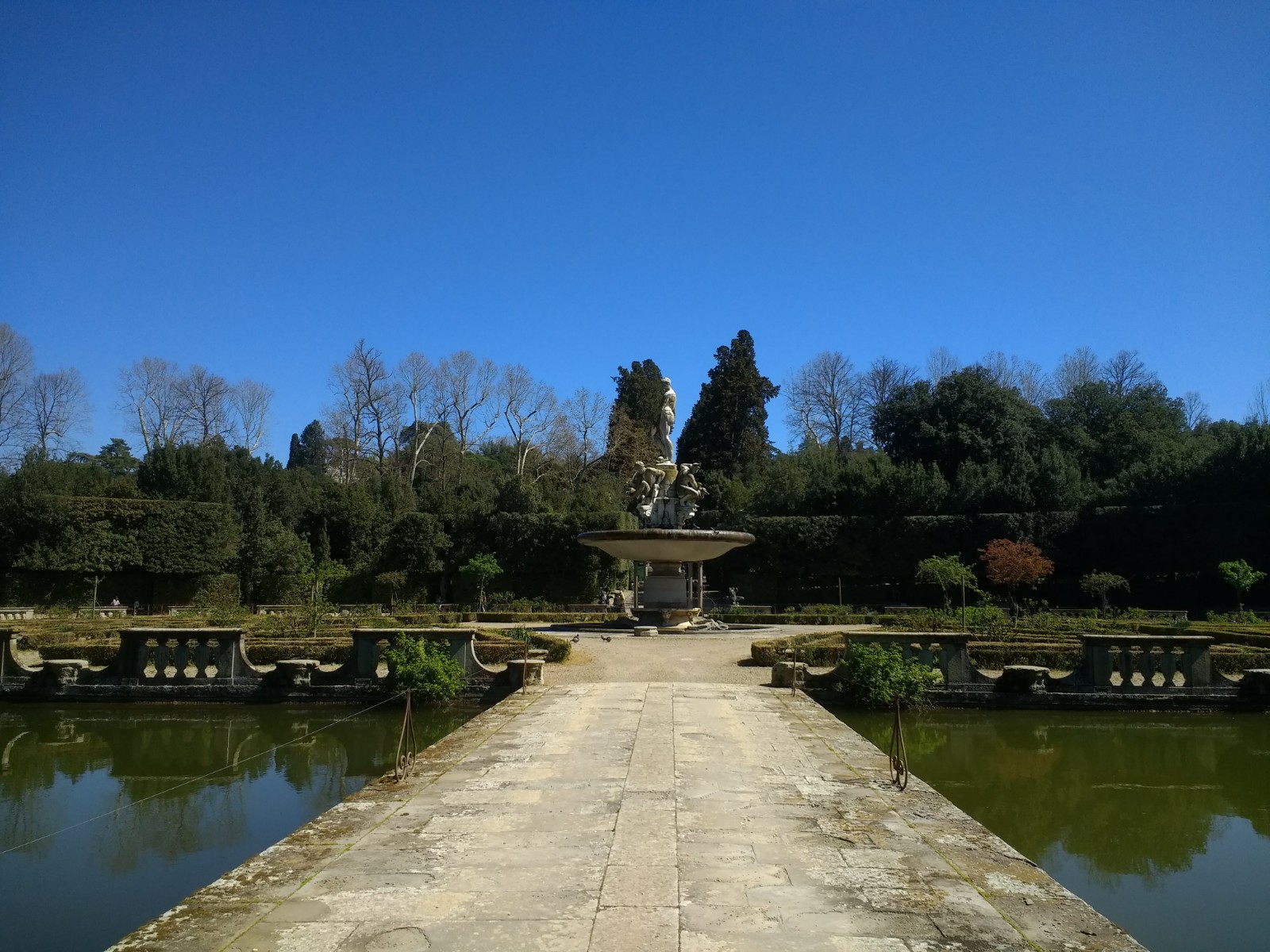
Little Island
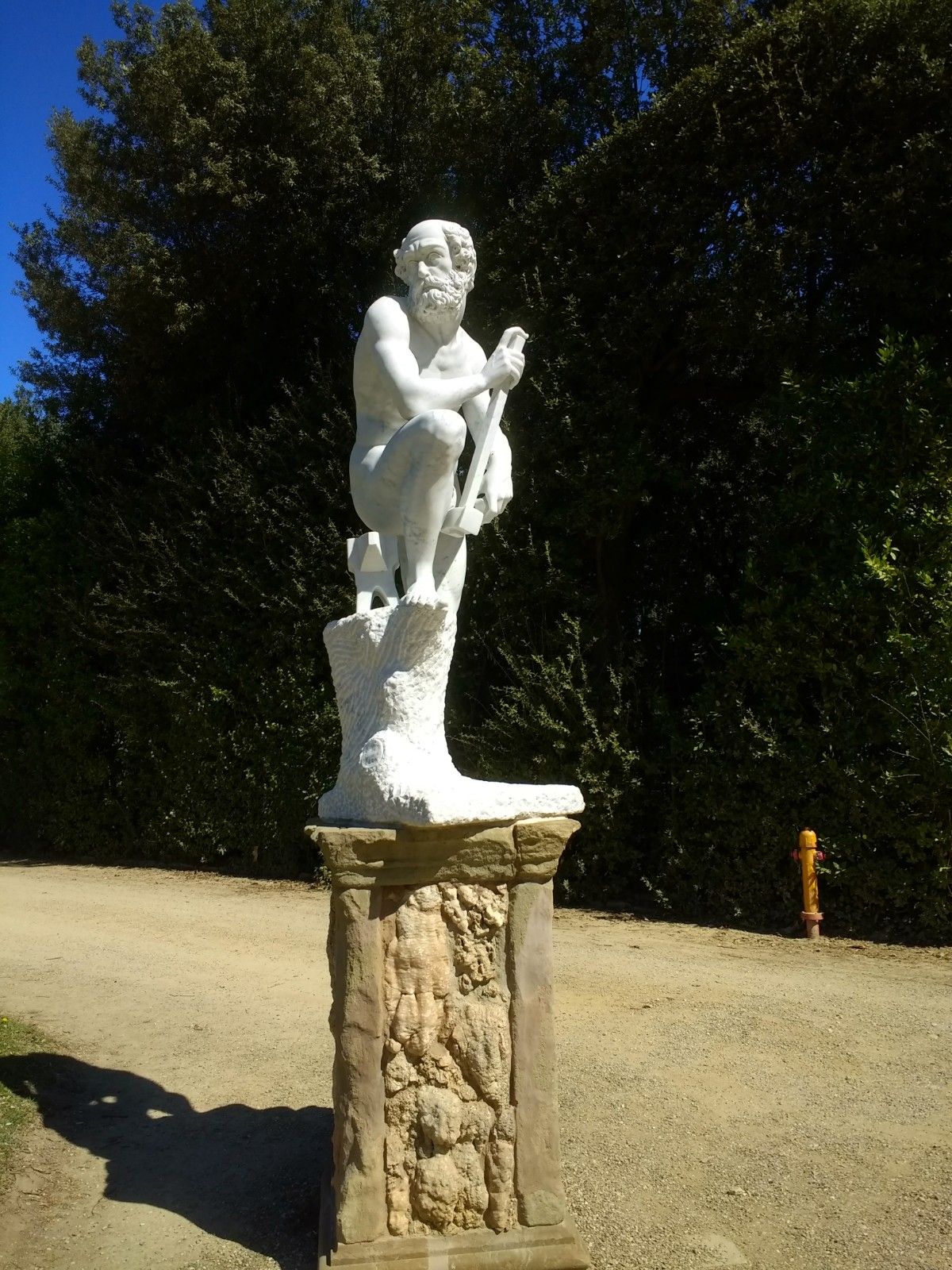
Unknown statue
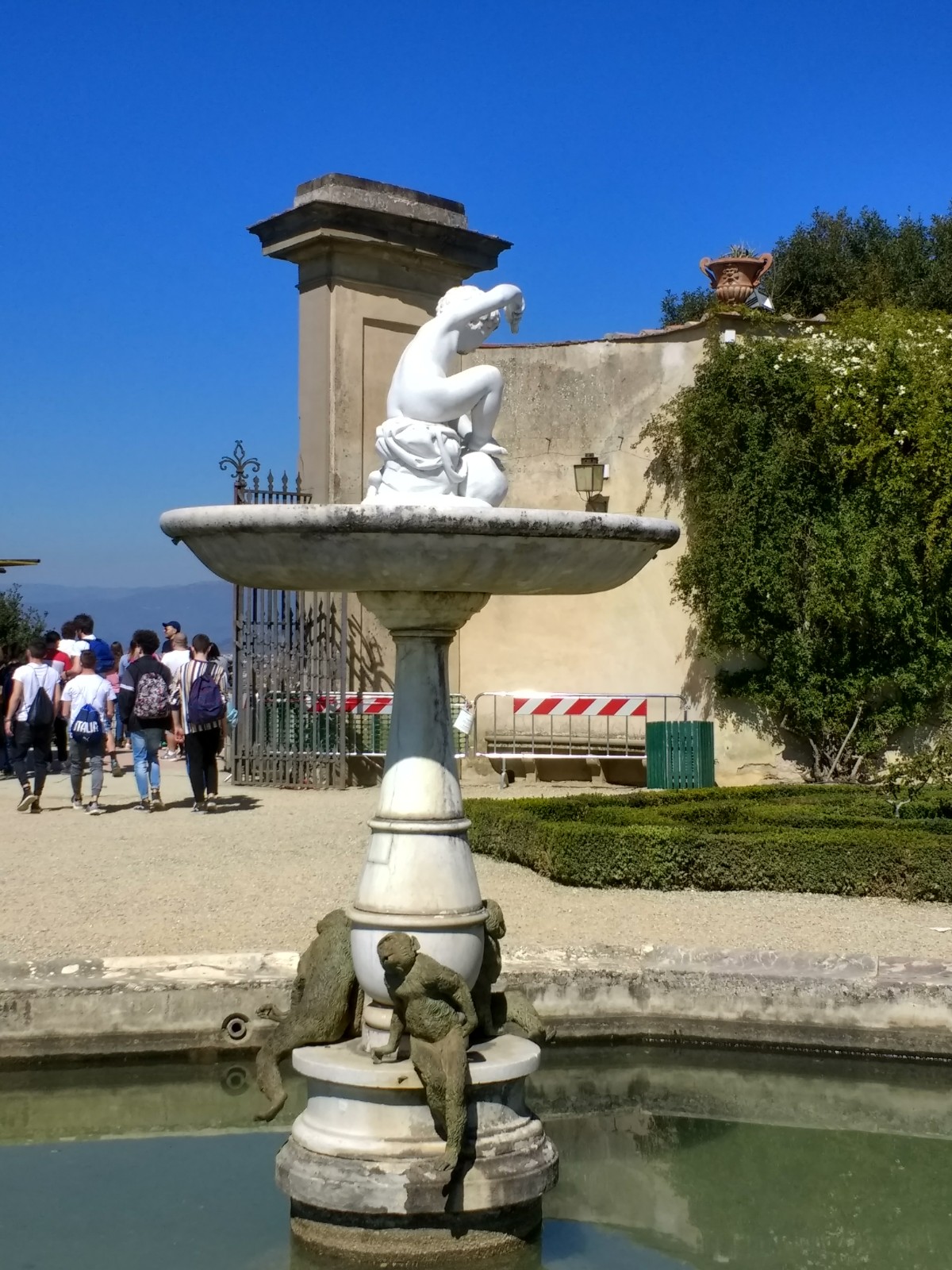
Monkey Fountain
There is a lot of red and white tape in the gardens (some can be seen behind the fountain) preventing access down steps, or beside walls, that are in danger of collapsing.

It is a lovely place to walk, though, and sit, although benches are pretty few, and admire the views.

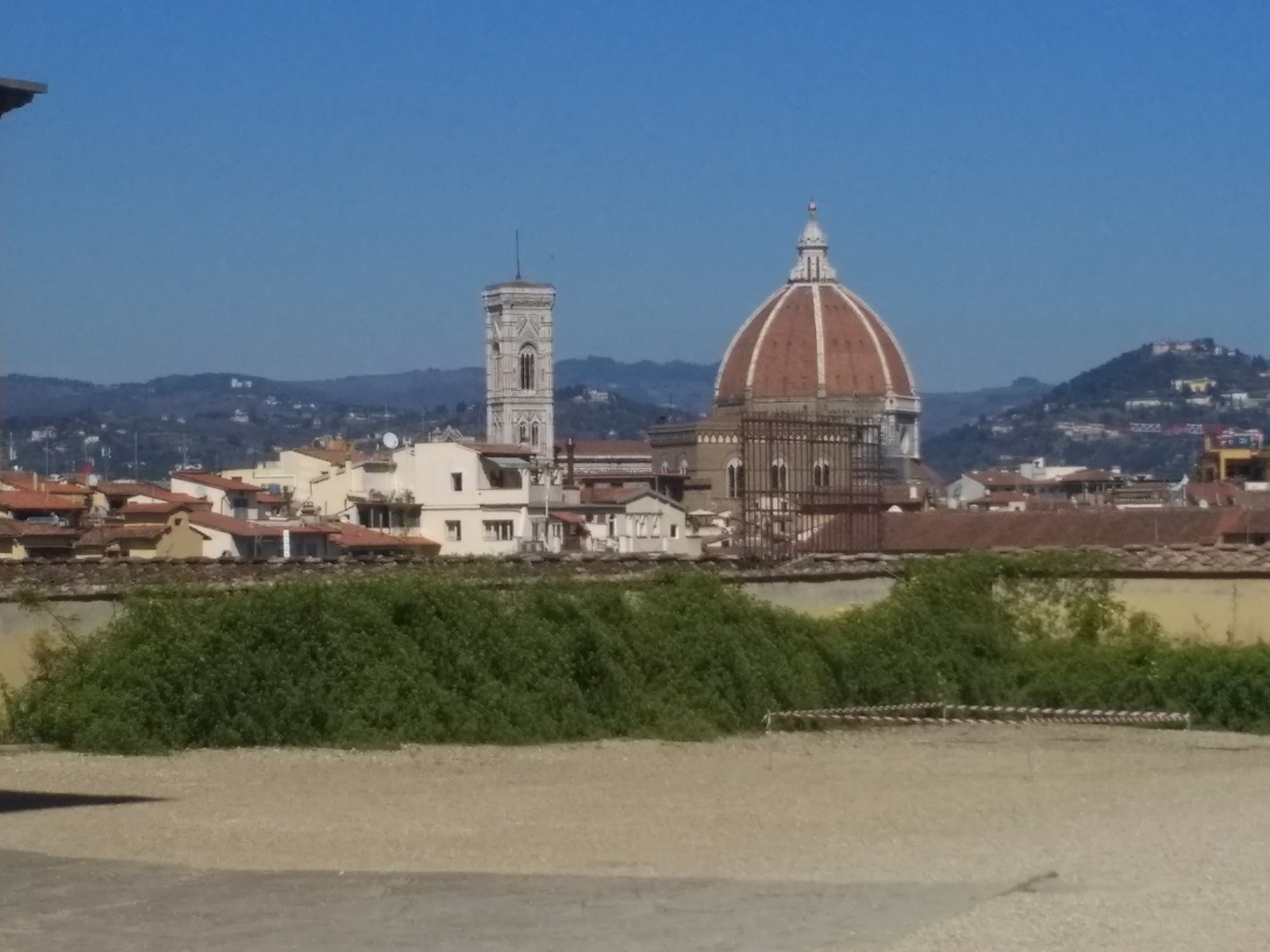
View of the Cathedral and bell tower

Apparently, the open aspect of the garden and the expansive view of the city was unconventional at the time.

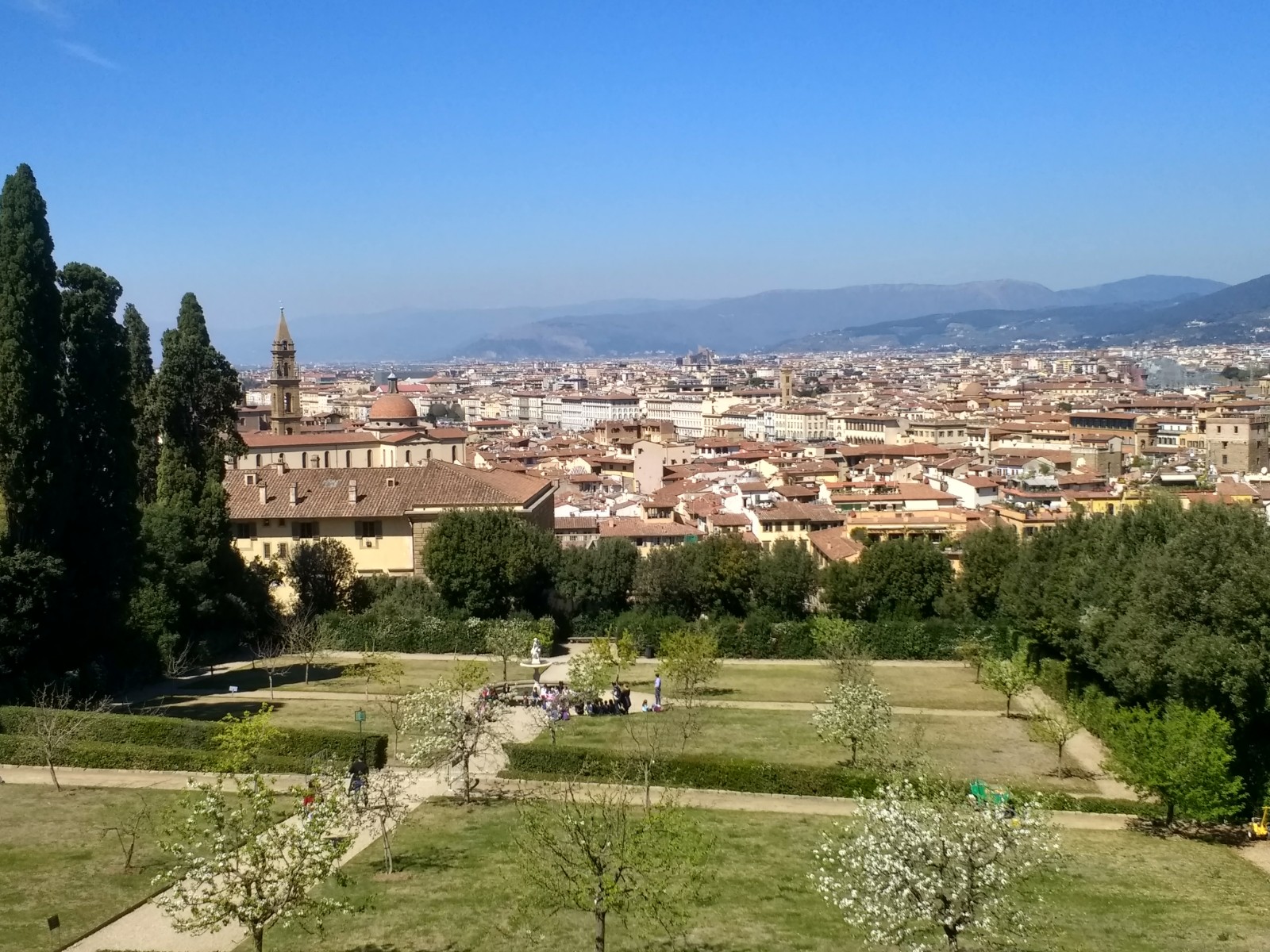
Florence

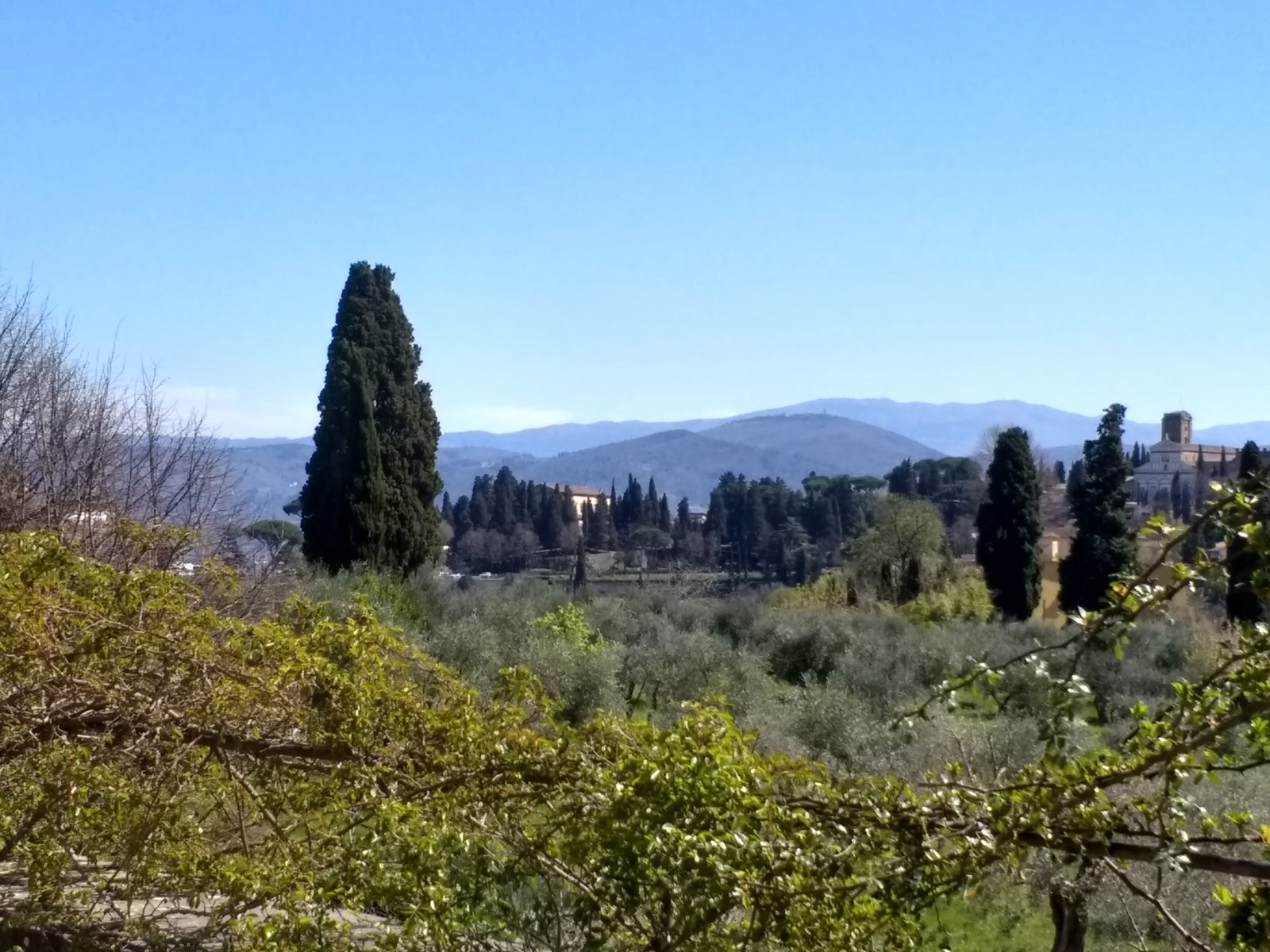
View to the hills.
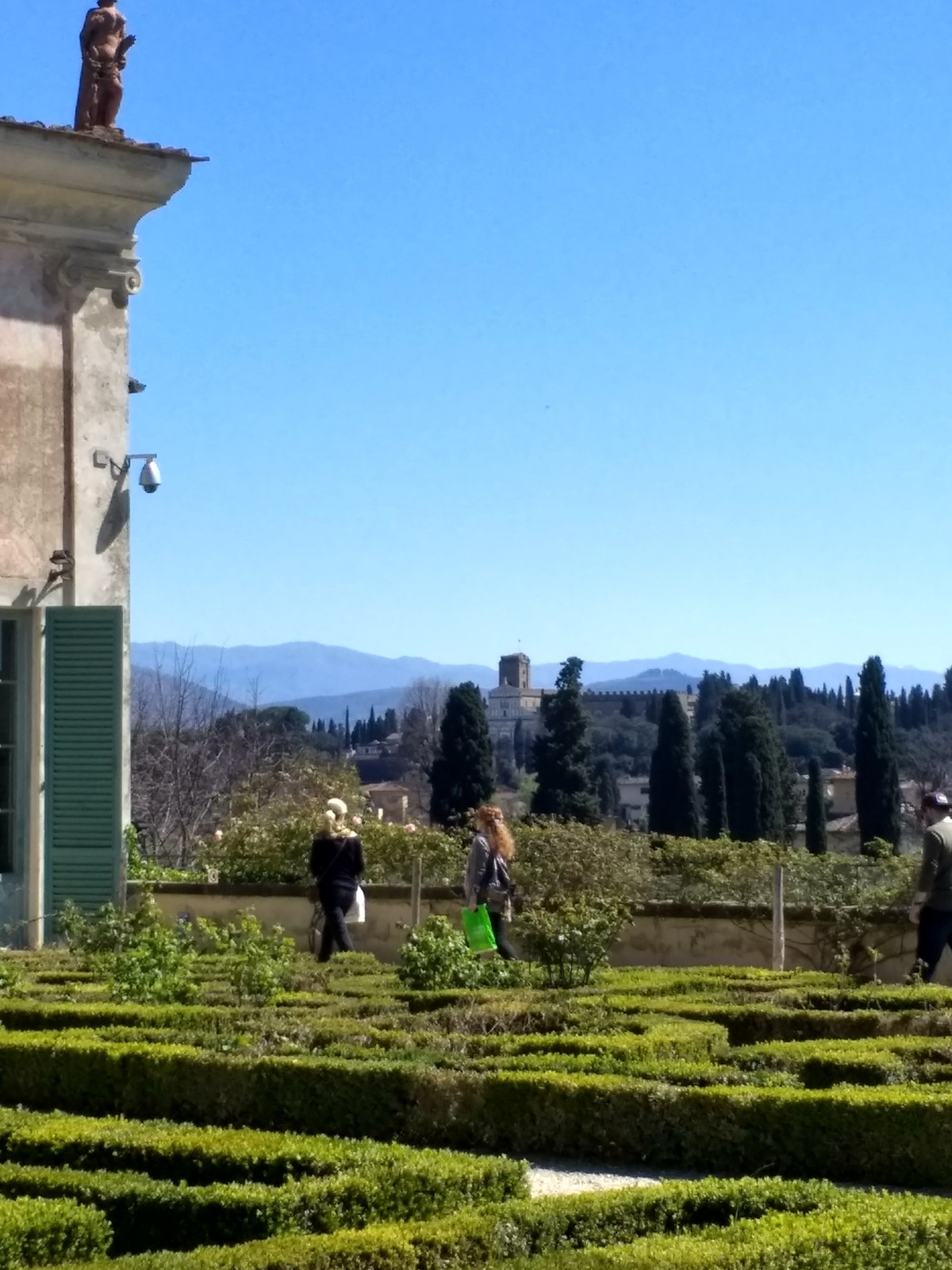
This is one of the things I love about this city – a lot of the views are framed by the surrounding hills.
Box hedges and a view

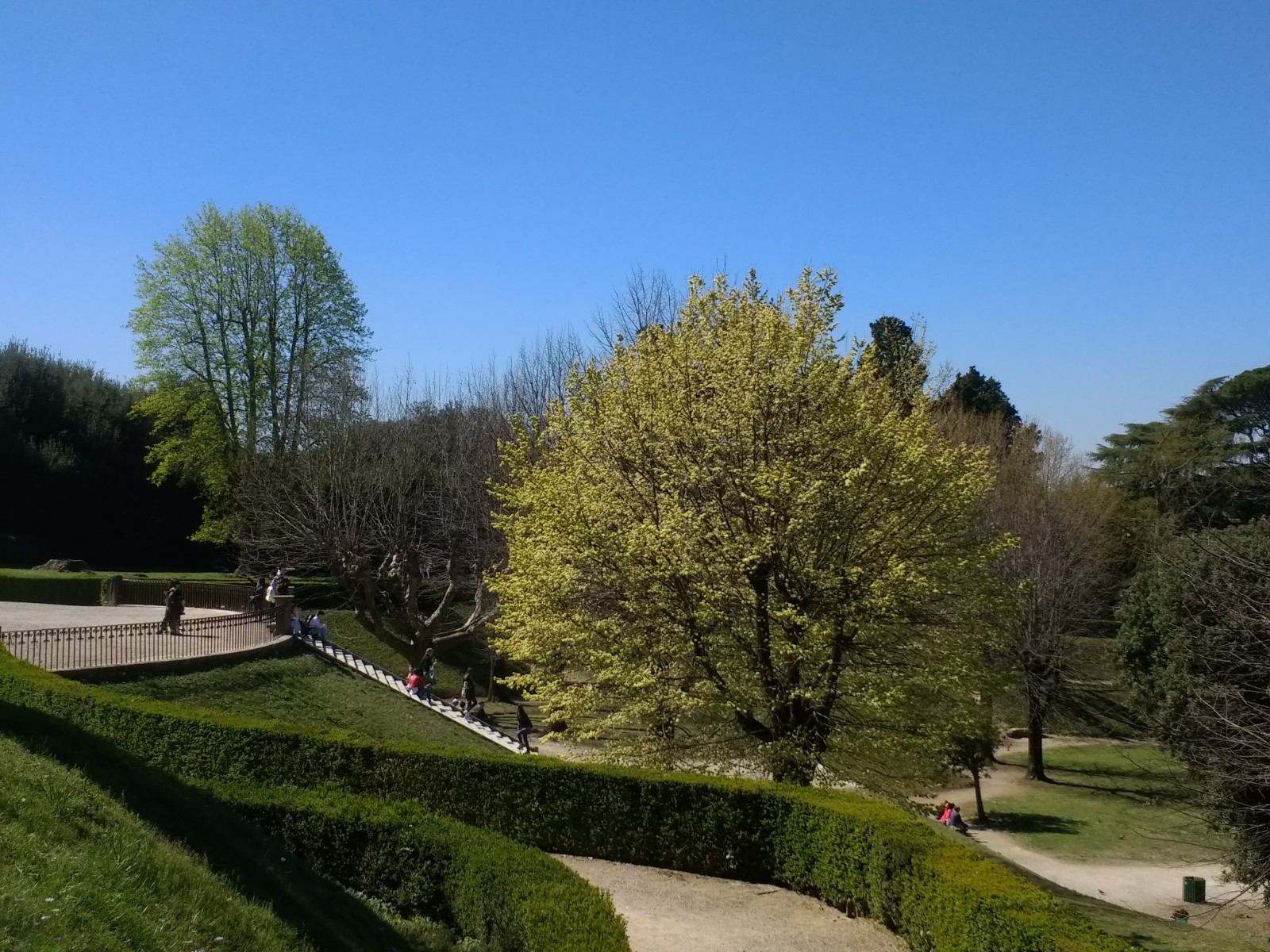
Trees are bursting forth. Hooray spring is here!
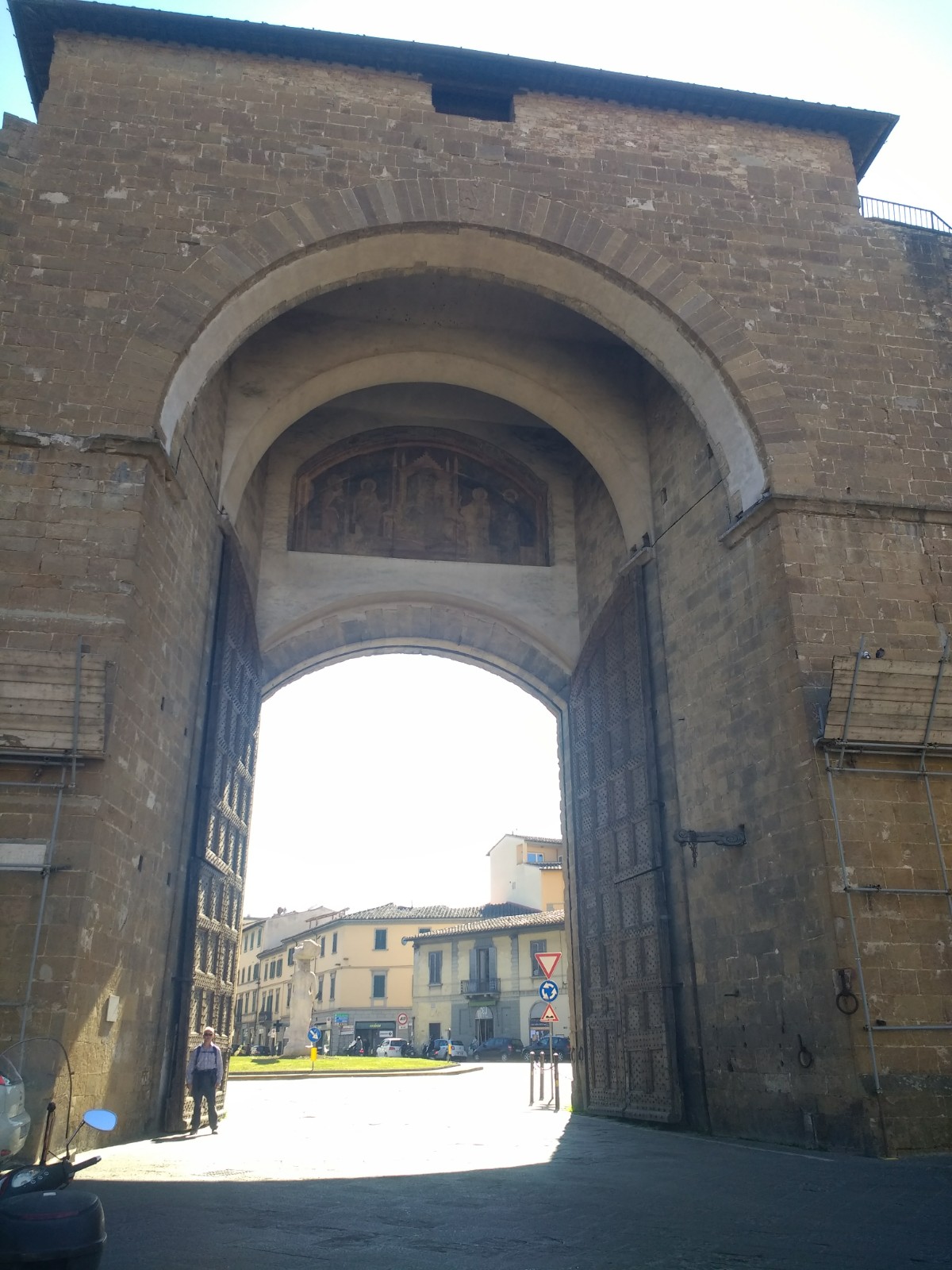
The entrance we used to get into the gardens is close to this absolutely enormous thirteenth century city gate, Porta Romana. That is Mark standing to one side.

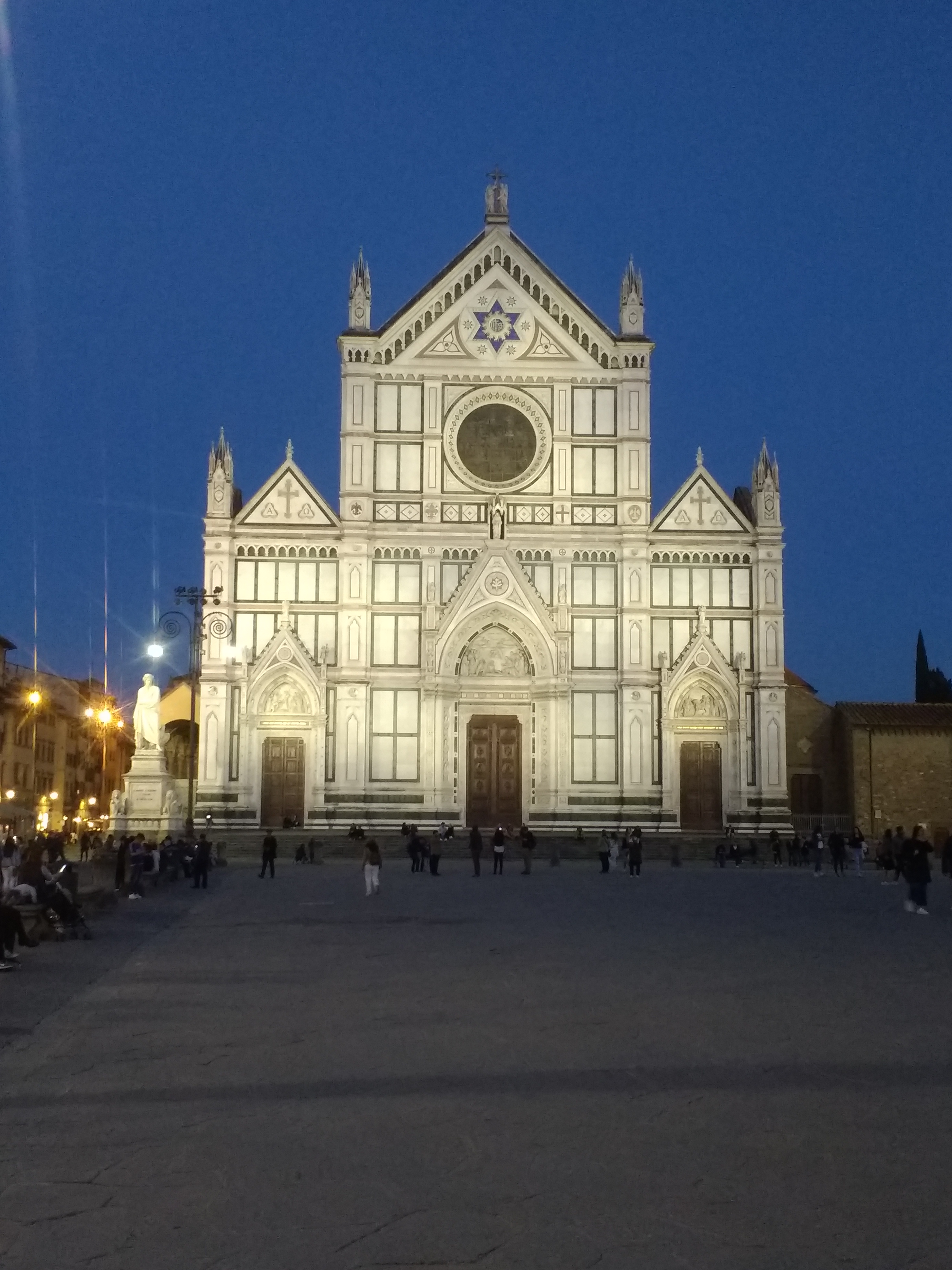
This evening we ventured out for a passeggiata, or evening stroll, and ended up in having a drink in the piazza in front of Santa Croce.

Santa Croce

We haven’t been in Santa Croce yet, but it is where Michelangelo and Galileo are buried. There is also a monument to Florence Nightingale in the cloister, as Florence is the city in which she was born.

An Early Start at the Office

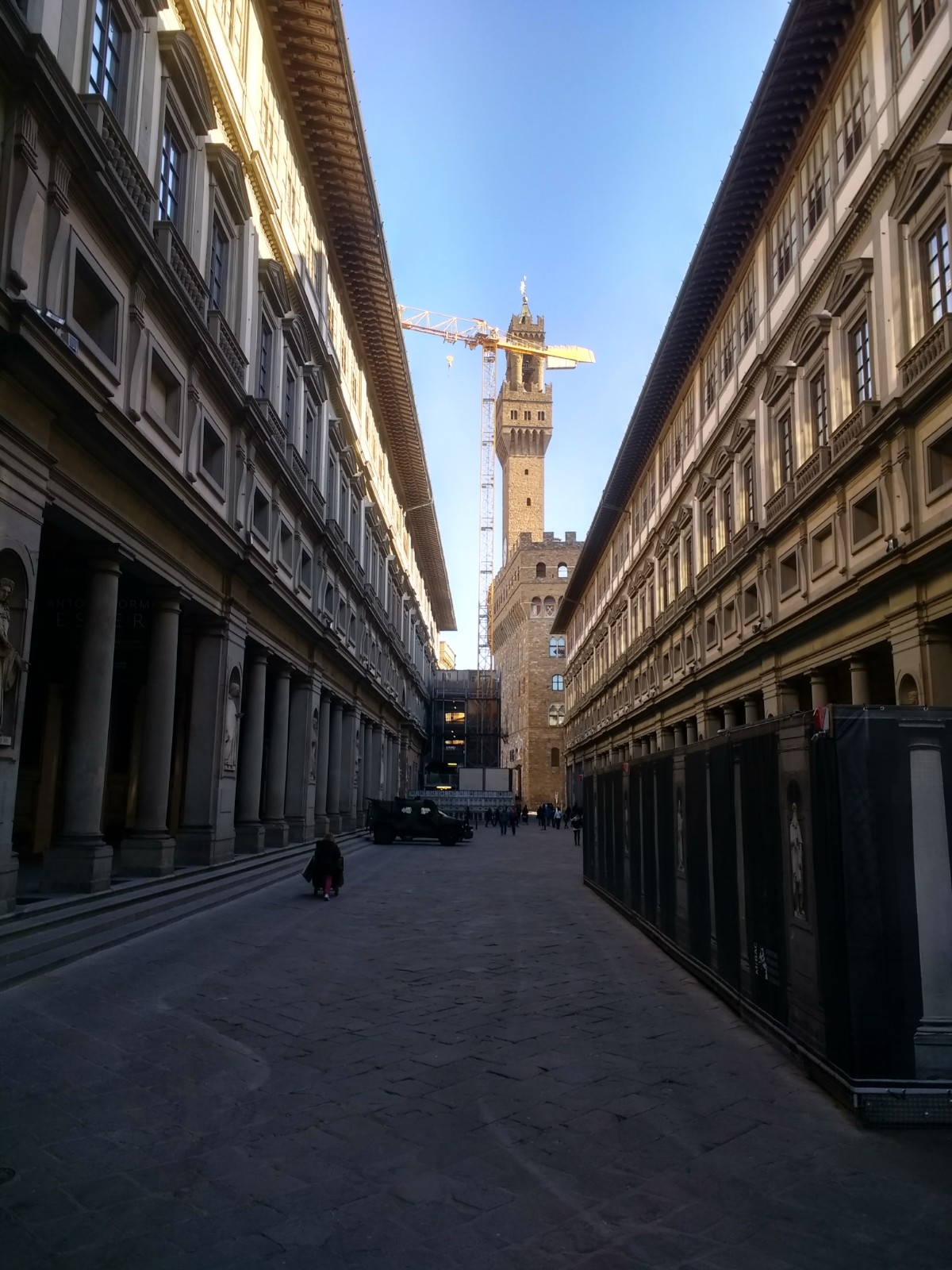
To be precise, perhaps I ought to say ‘Offices’ rather than just ‘Office’ as that is what ‘Uffizi’ means. The building was begun in 1560 to accommodate the offices of the Florentine magistrates. And I used to think that Thames House South, on Millbank, in London, where my father worked for many years, was grand!

The Uffizi Gallery
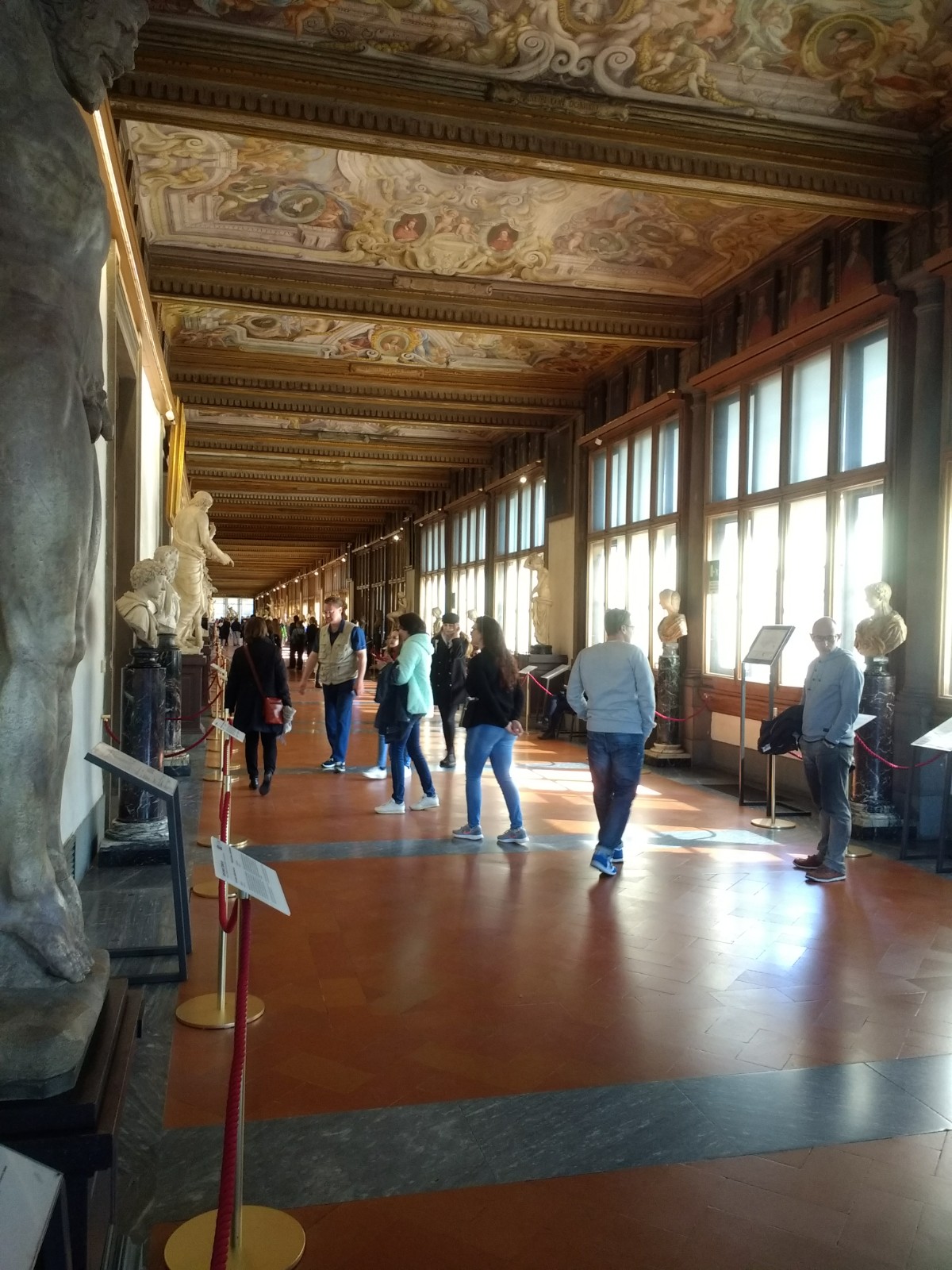
One of the corridors in the Uffizi

Having been warned about huge crowds, we decided to start early yesterday morning, well 8.30, but it seems that everyone else had the same idea, and there were already long queues to buy tickets. Fortunately, with our PassePartout cards, we could ‘jump the line’ and were soon inside.

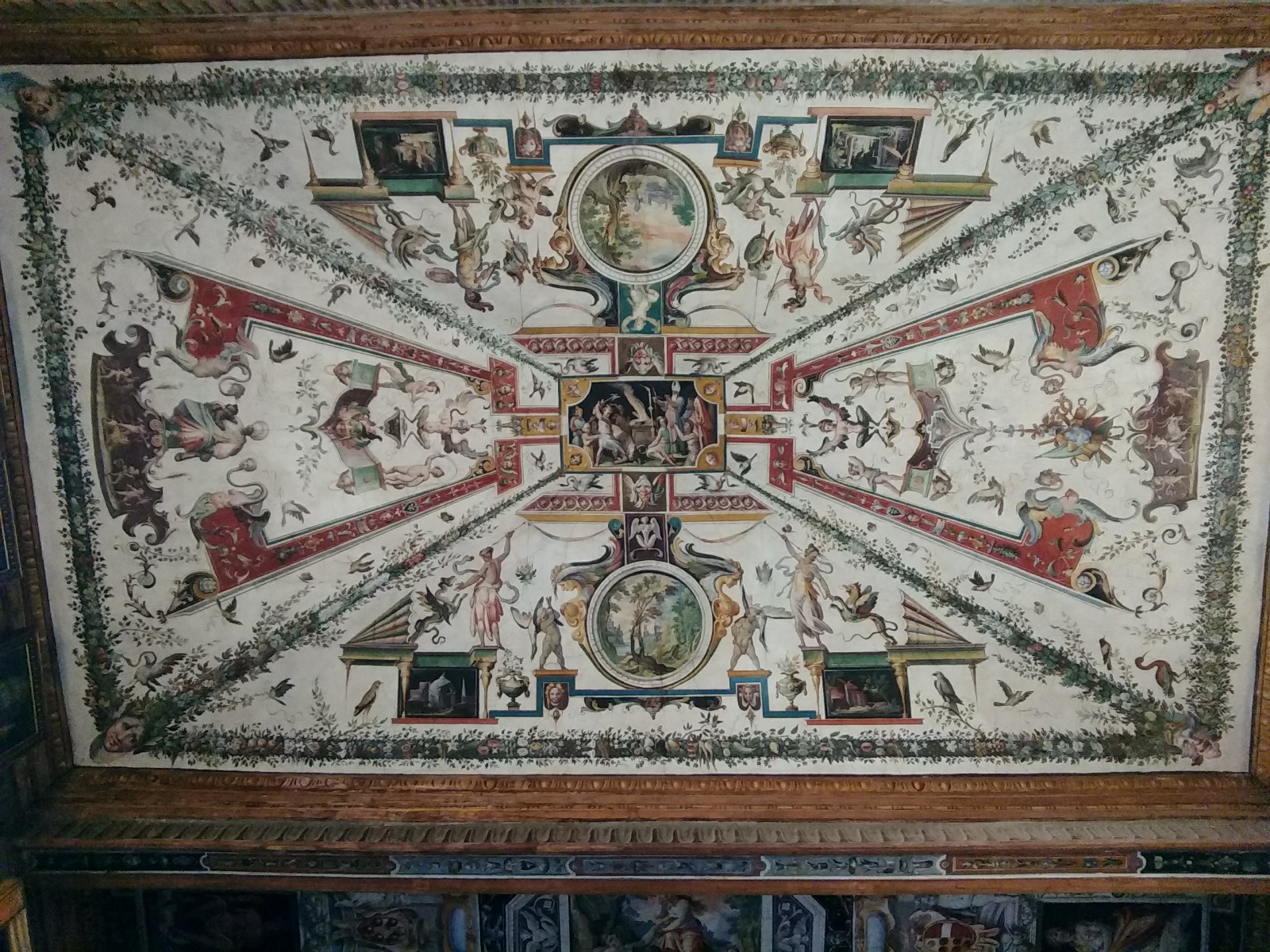
Ceiling inside the Uffizi

We are planning to do a little of the Uffizi at a time and so just followed half of Rick Steves’ tour. Here are just a few favourites.

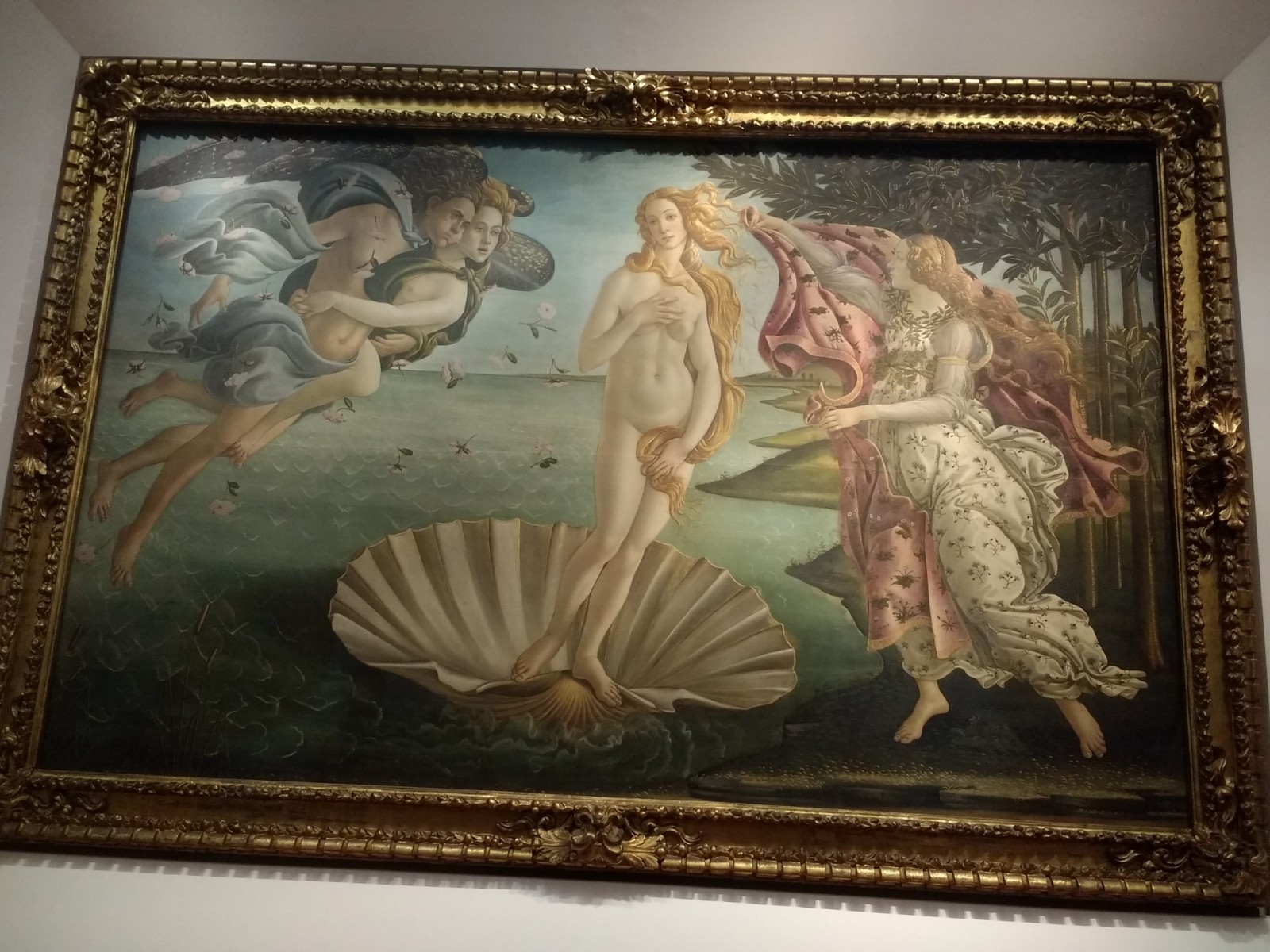
The Birth of Venus by Botticelli, about 1485
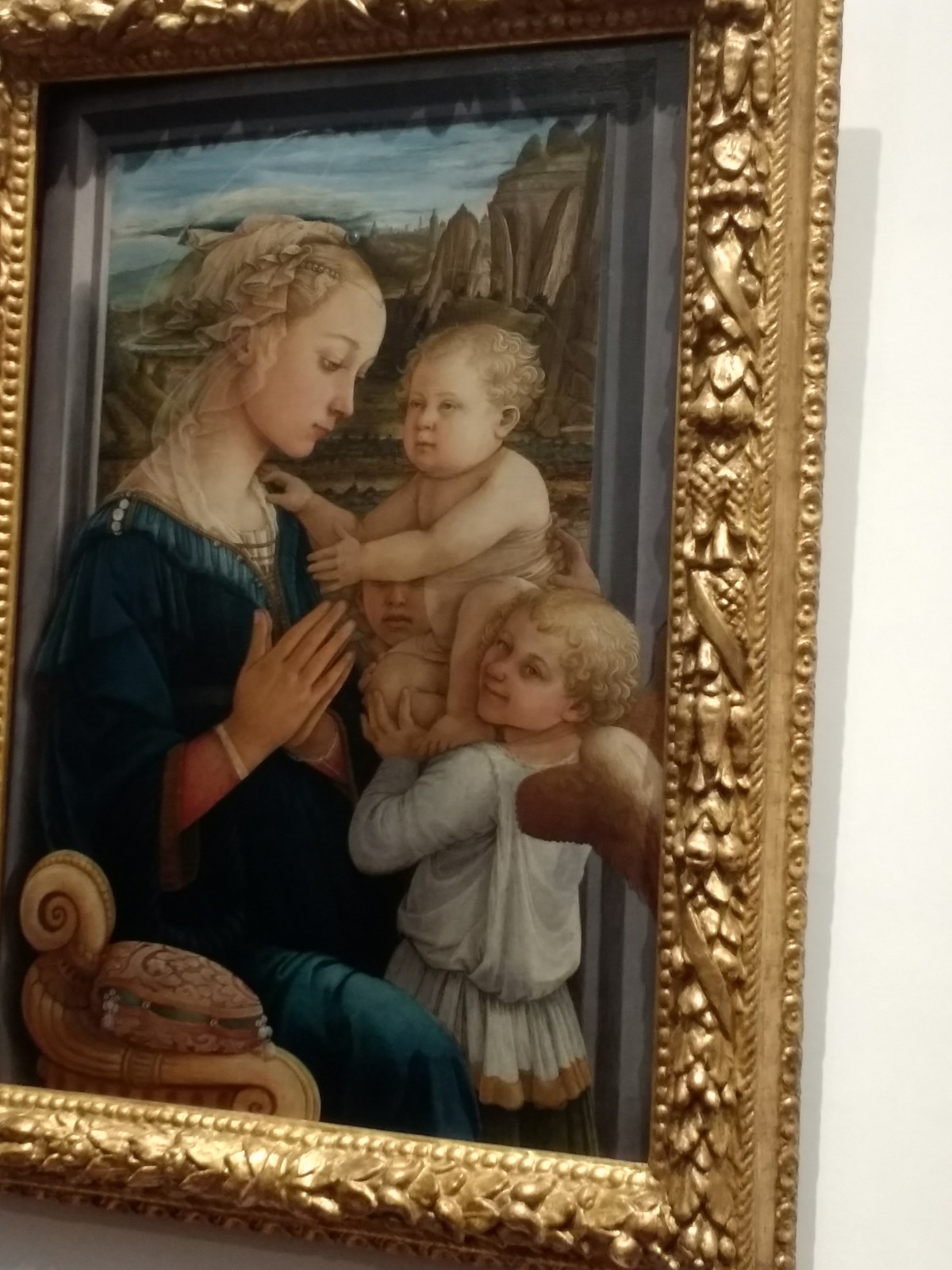
Madonna and Child with Two Angels by Filipino Lippi 1460-5
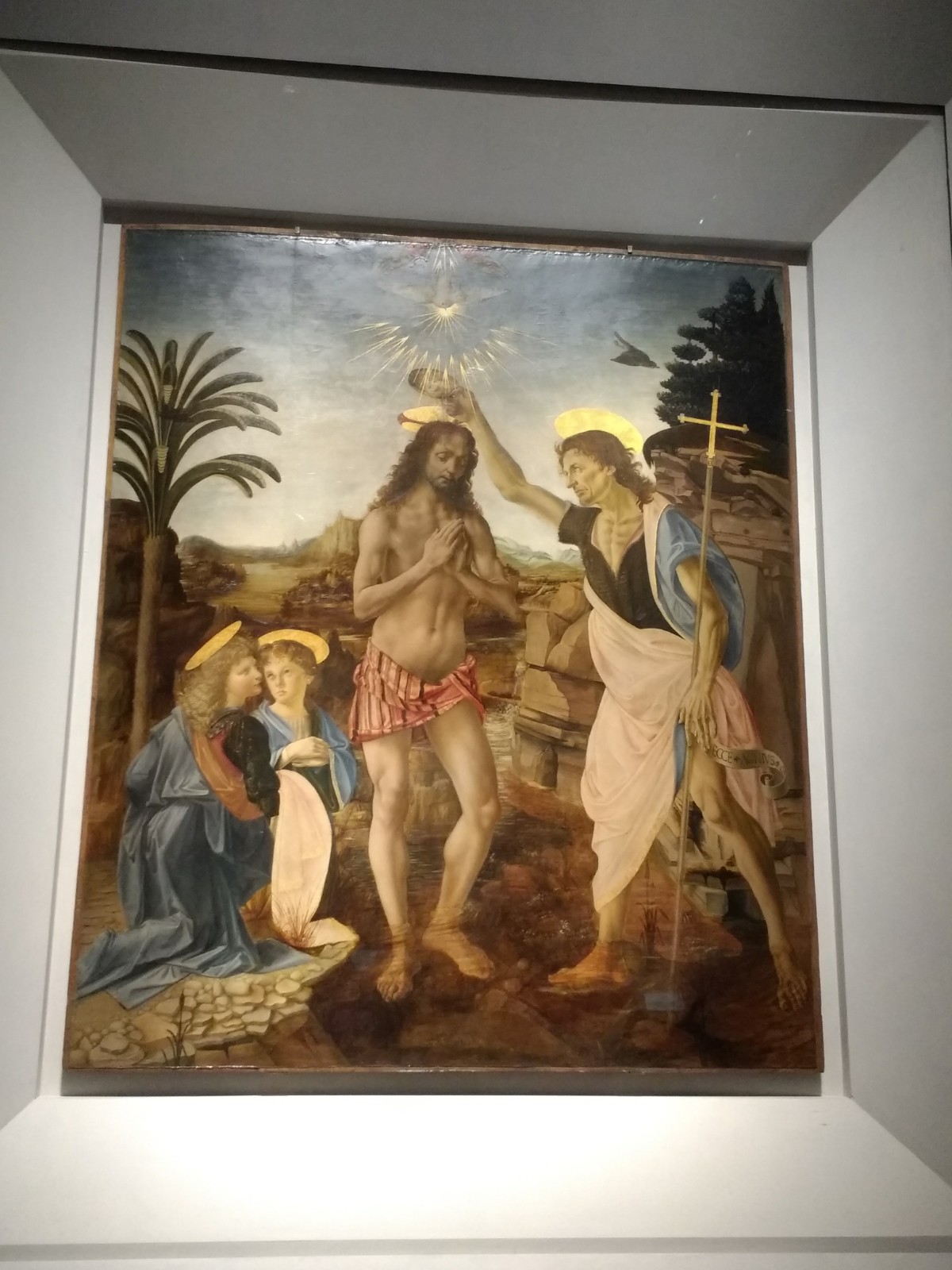
The Baptism of Christ by Andrea del Verrocchio and Leonardo da Vinci about 1475
Verrochio was the teacher and da Vinci one of his students, aged 14 at the time. Da Vinci painted the angel on the far left (in profile). The story goes that when Verrocchio saw the image, he appreciated that this mere boy was already painting far better than he, himself, ever would, so gave up painting for good.
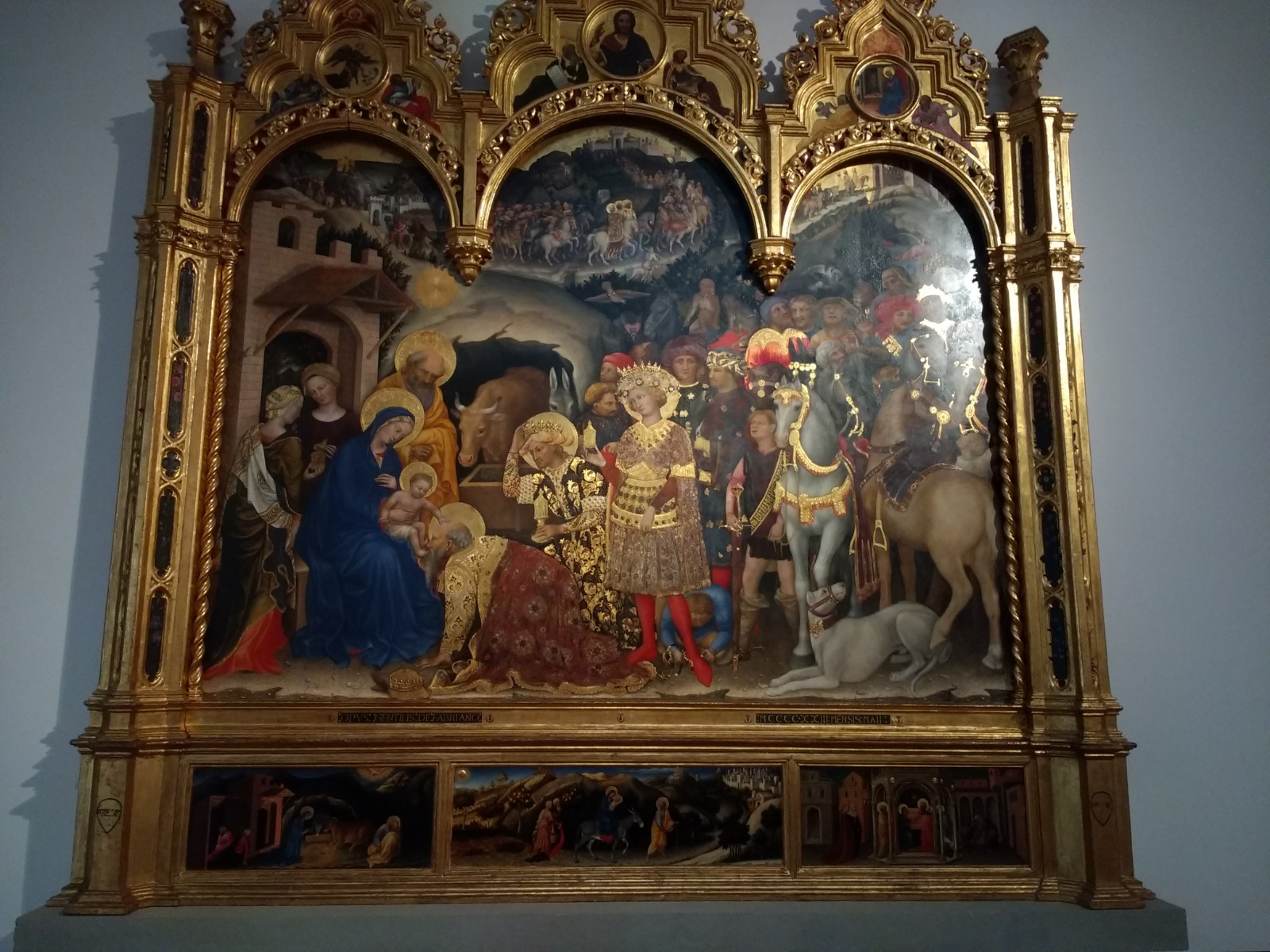
Adoration of the Magi by Gentile da Fabriano
I love the way baby Jesus is patting the bald head of one of the three kings.

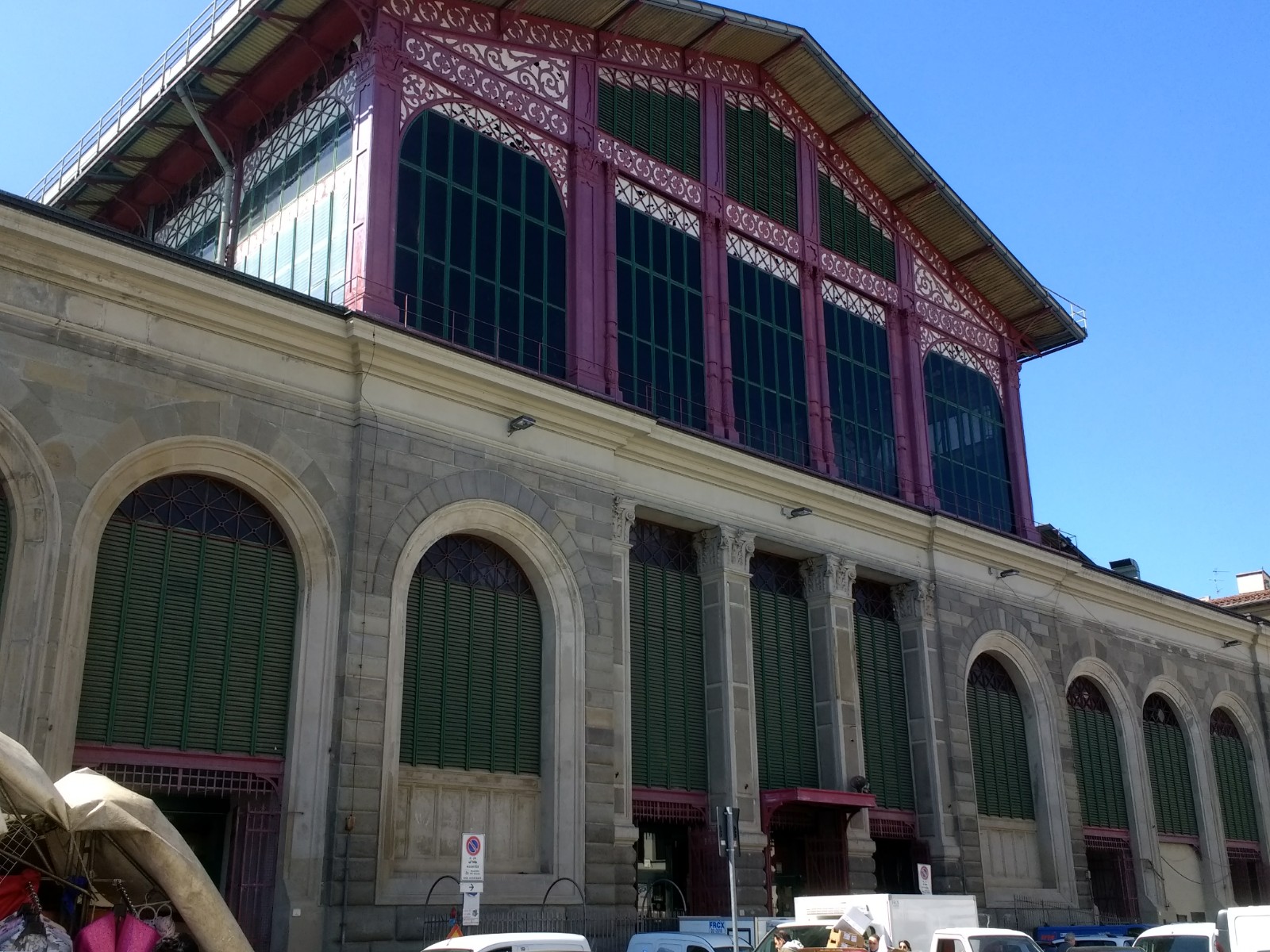
So much art had made us hungry so we headed off for the indoor food market, Mercato Centrale. The building dates from the late nineteenth century at a time when Florence was the capital of Italy and was designed by Giuseppe Mengoni, best known for his cast-iron and glass-vaulted Galleria Vittorio Emanuel II in Milan.

Mercato Centrale

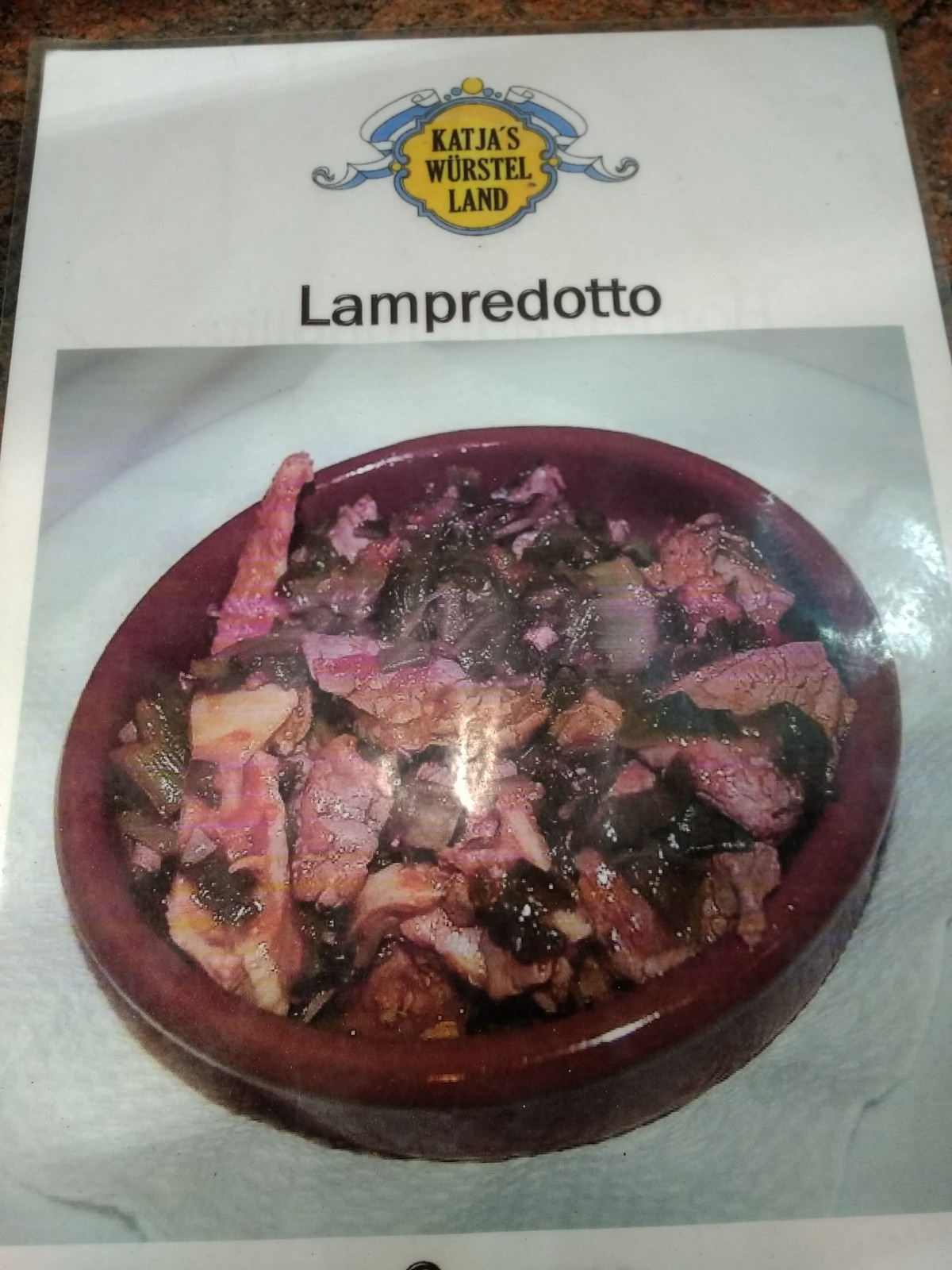
The building was renovated a few years ago and is now a place where local people can do all their food shopping and grab a bite to eat. The ground floor has food stalls and outlets selling local dishes and snacks. Upstairs is more set up for more restaurant-type food. Feeling adventurous, we tried a typical Florentine dish downstairs.

At €6 each this was an economic dish.

The food was all right, we both finished the contents of our bowls, but we decided it wasn’t something we’d rush out and have again.

On our free guided walk round Florence this morning (we are such cheapskates) we learned more about this dish. It is made, apparently, from the fourth and final stomach of a cow (sorry, vegetarians). I don’t think it’s one for the recipe folder.

Three for Free in Florence

Given the chance to visit places that were opening free for the day yesterday there was no stopping us.

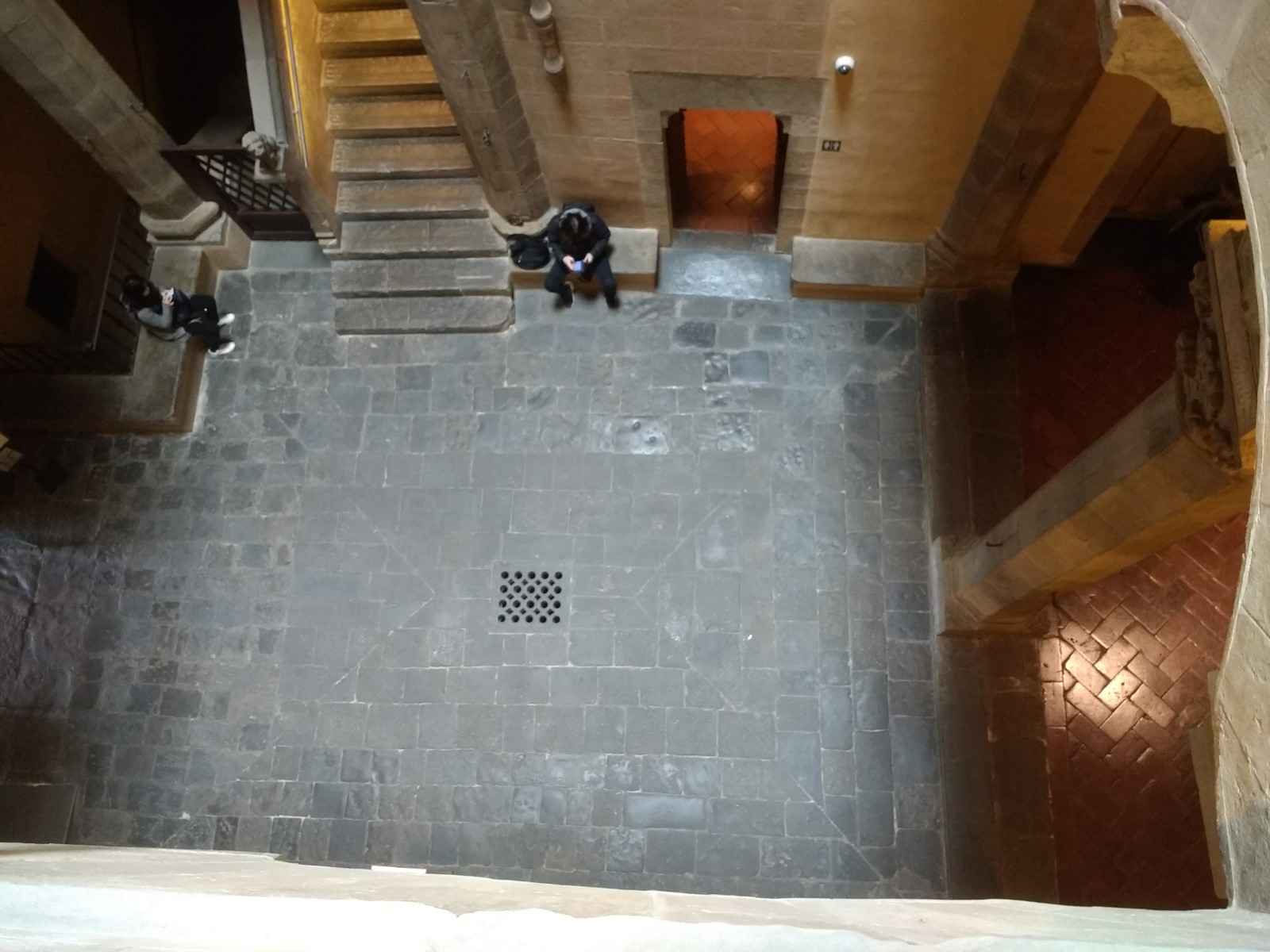
Palazzo Davanzati, dating from the fourteenth century, has been named after the Davanzati family, who lived there for 260 years until the death of the last heir in 1838. The Palace managed to escape the large scale demolition of medieval Florence that was carried out in the nineteenth century, but went on to have a rather chequered history with various owners carrying out dubious restoration work, financed through the sale of Palace contents.

Looking down on the open courtyard. Rainwater was collected and stored underground.

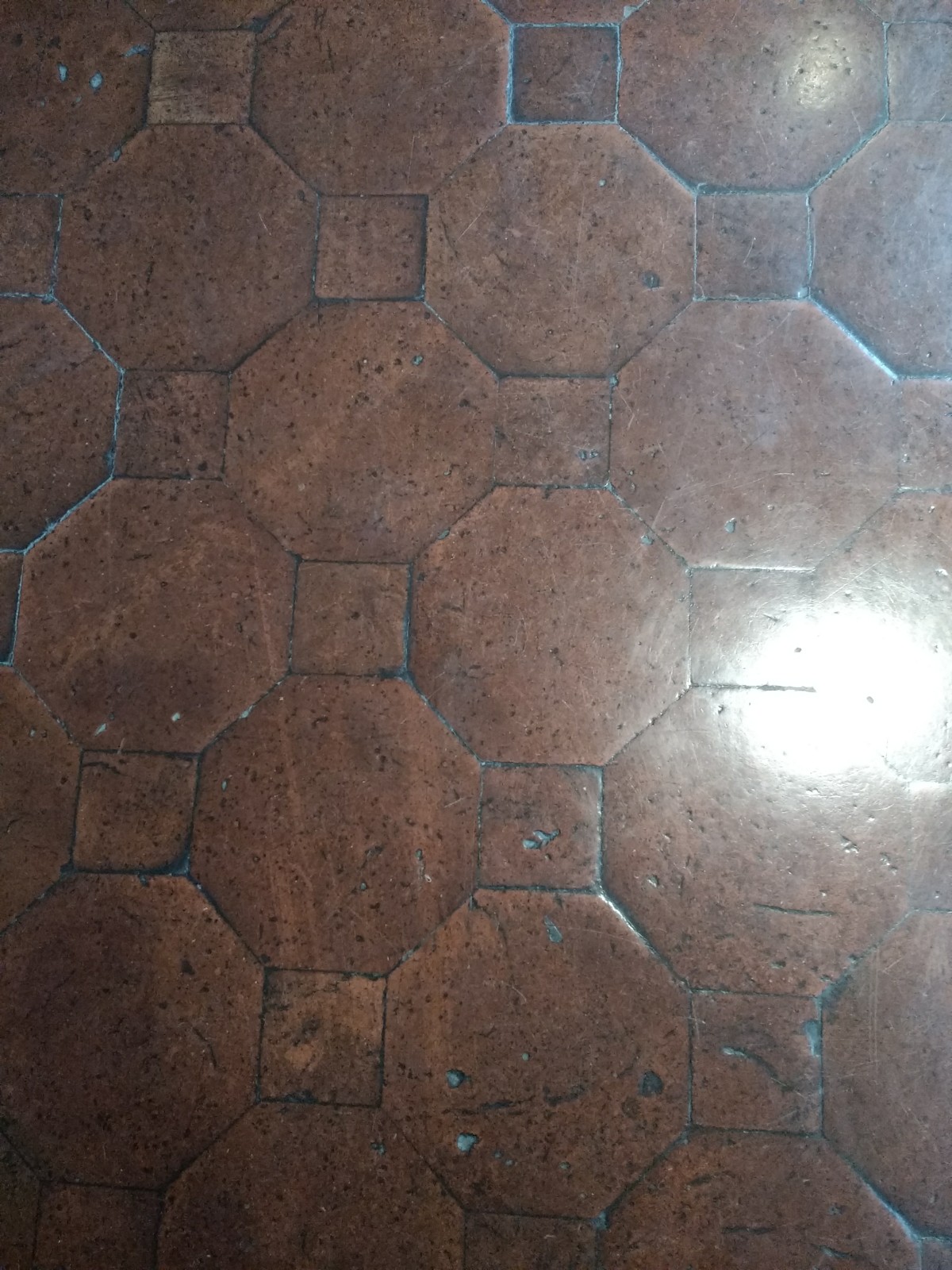
Eventually, the Palace was bought by the Italian state in 1951 and kept open as a museum, closing briefly in 1995 to carry out major restoration work, to prevent the collapse of the building.

Original terracotta floor.

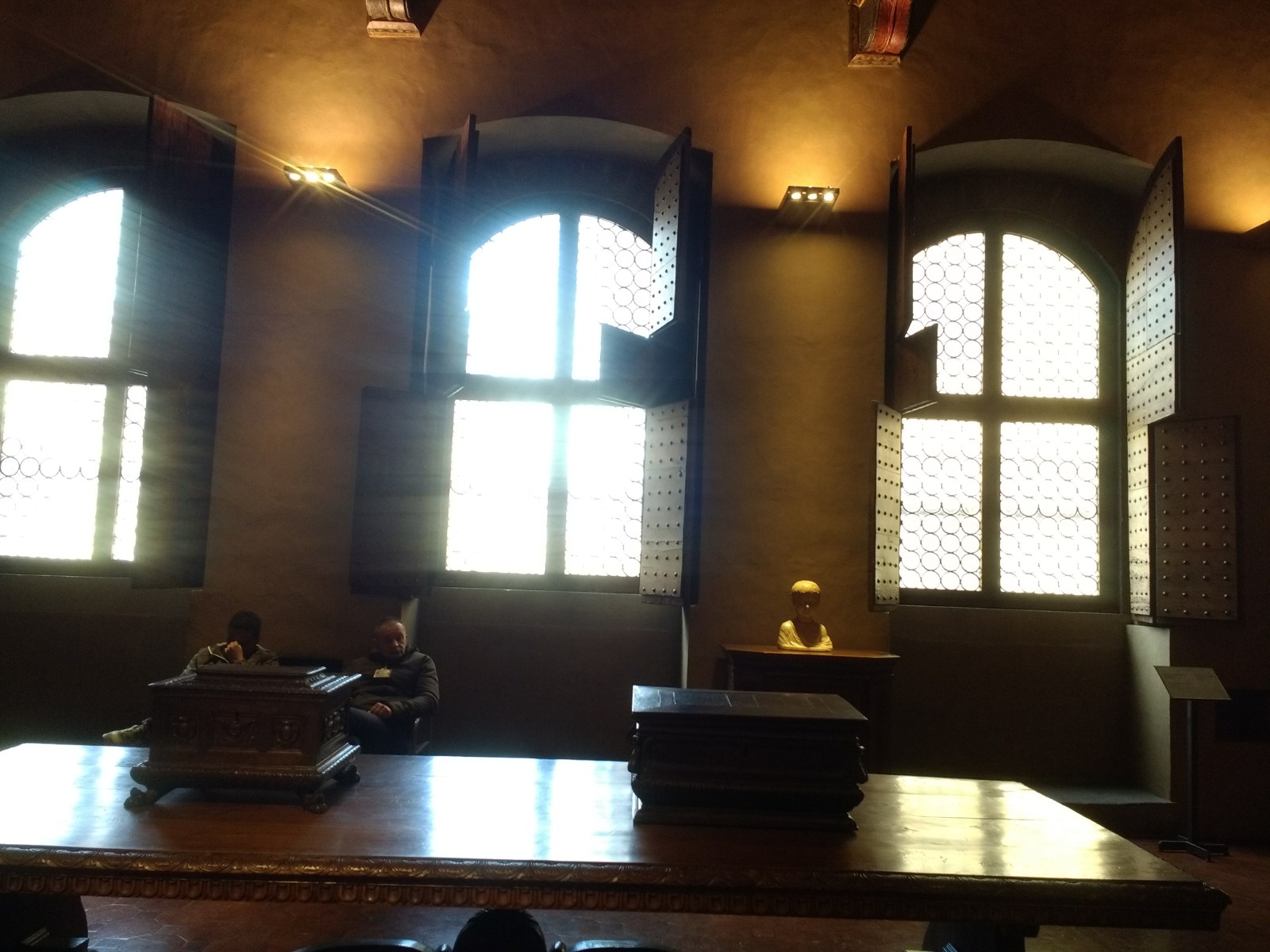
Today the Palace is presented as from the sixteenth century.

Dining room

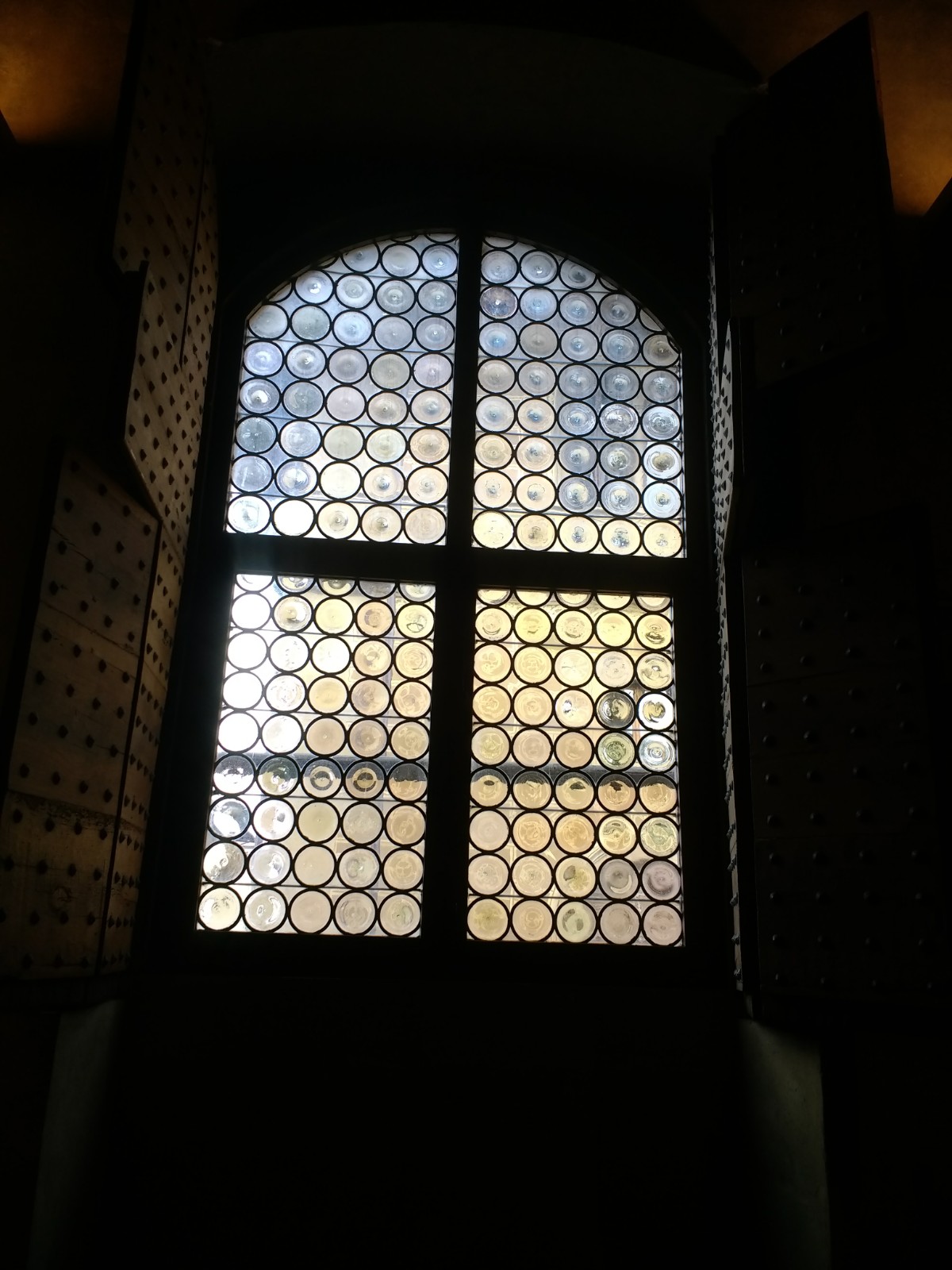
Glass windows, not present in every room. The alternative at the time, as glass was very expensive, was a length of fabric which had been soaked in turpentine, oil or wax, and fixed onto a frame.
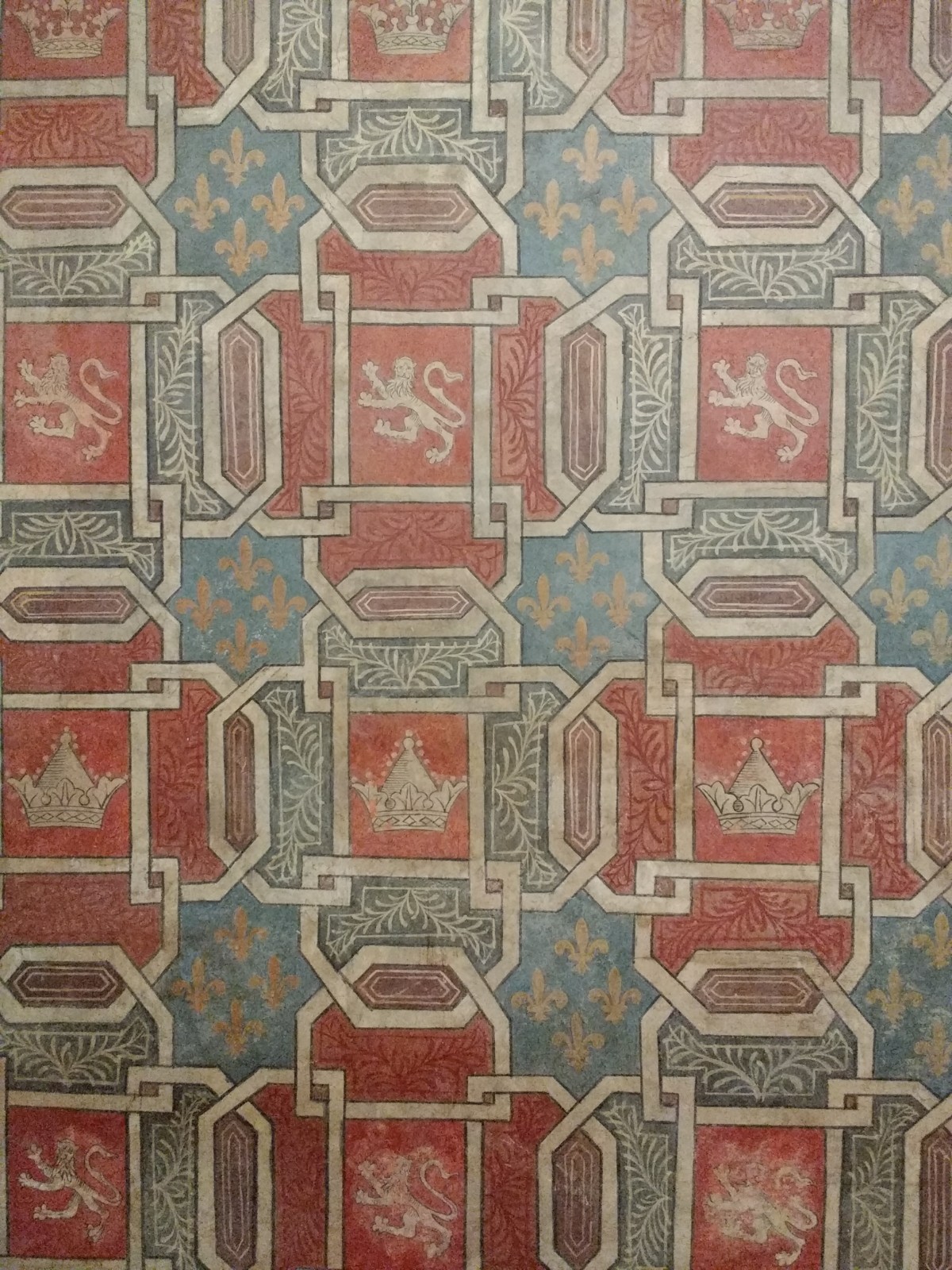
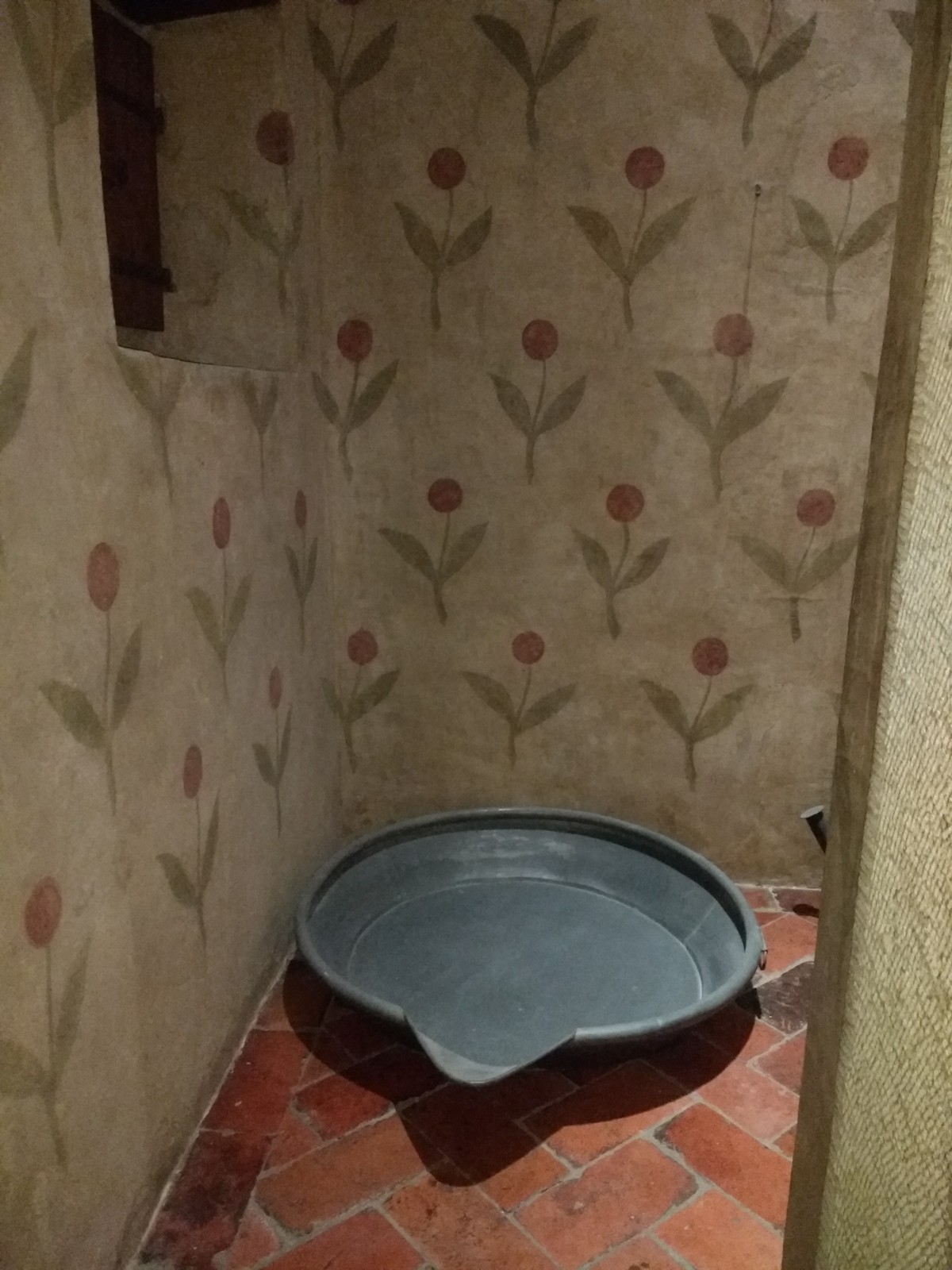
Painted walls

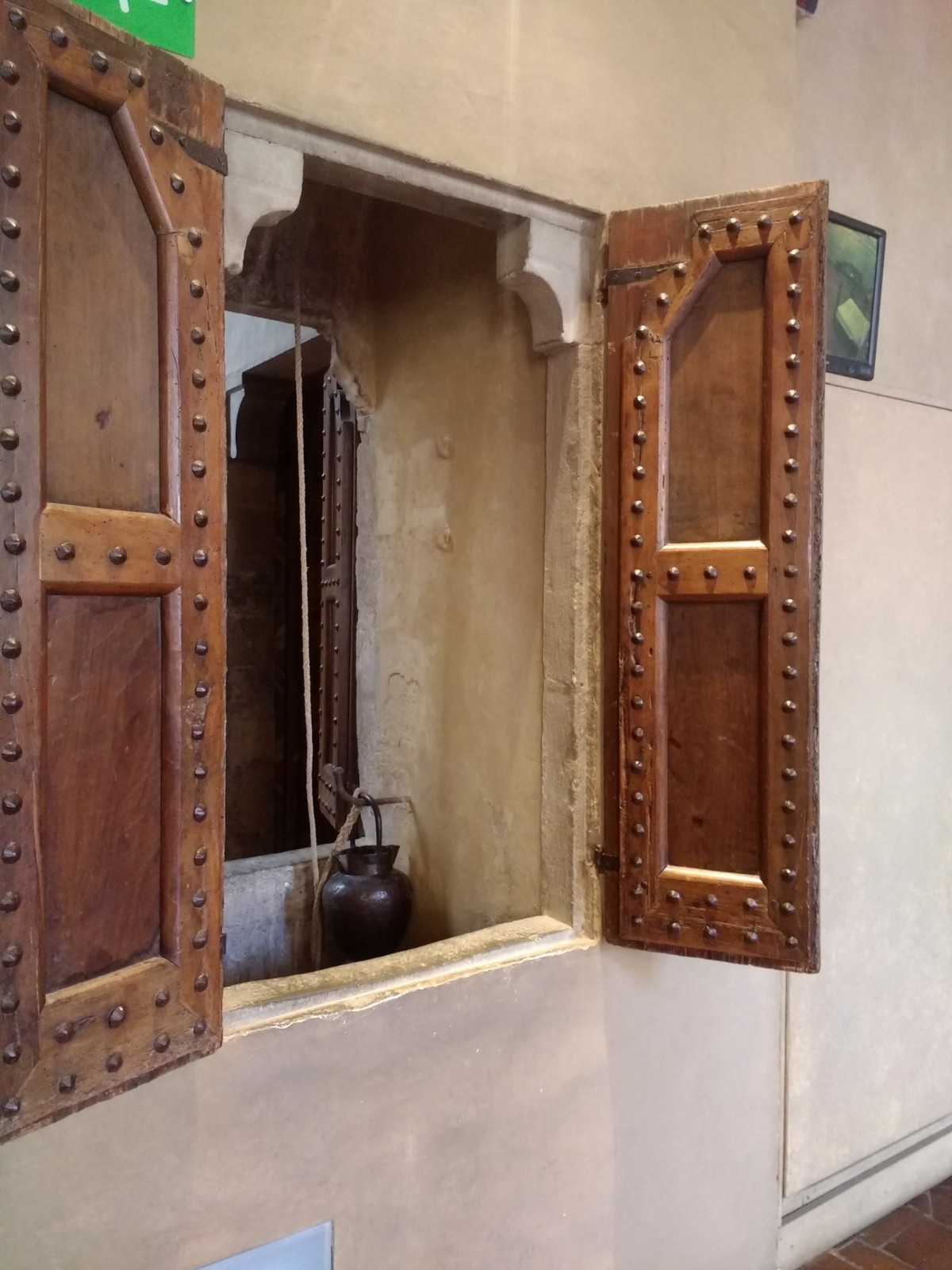
There was a well which could be accessed by each floor.

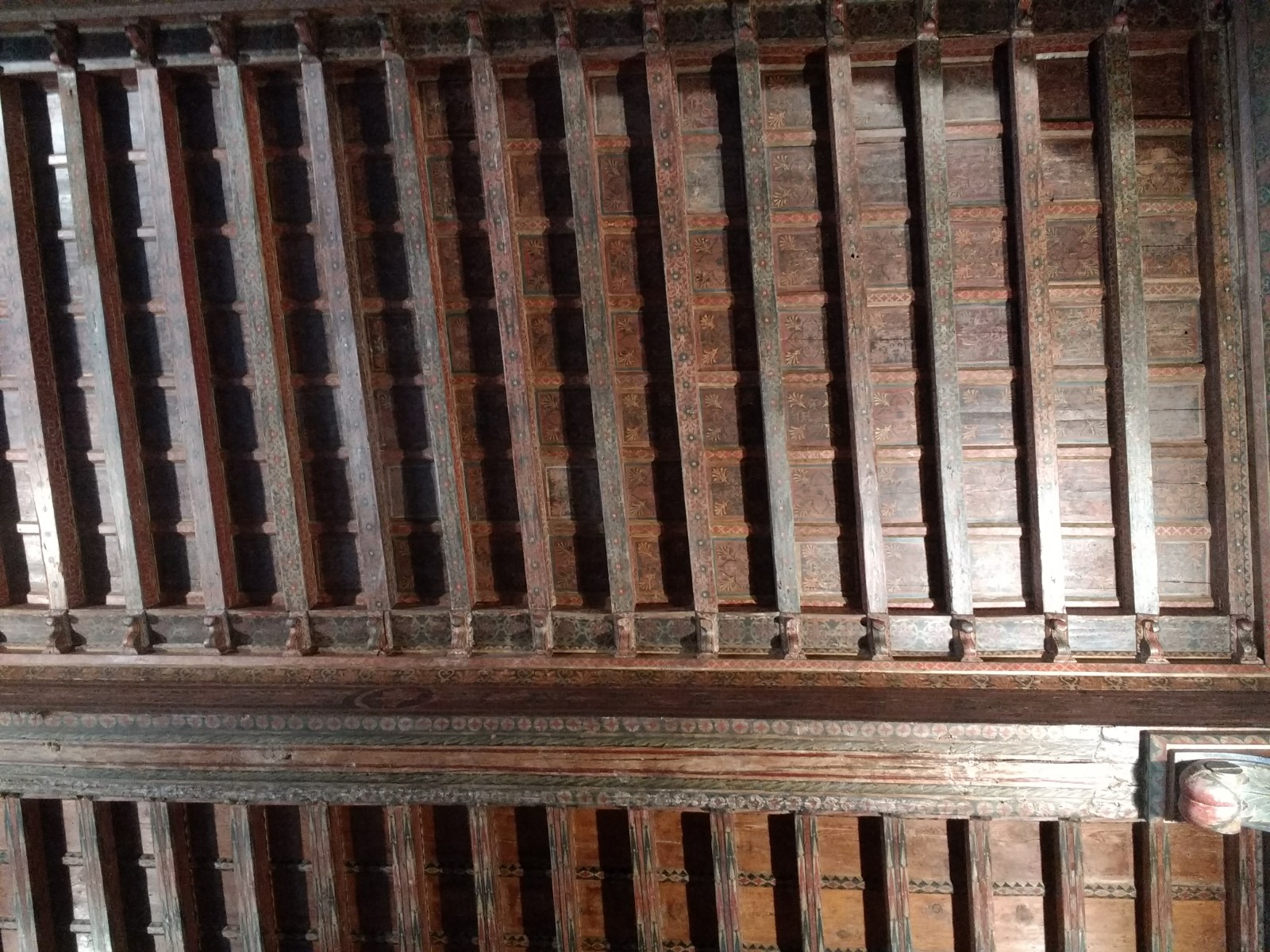
Ceiling
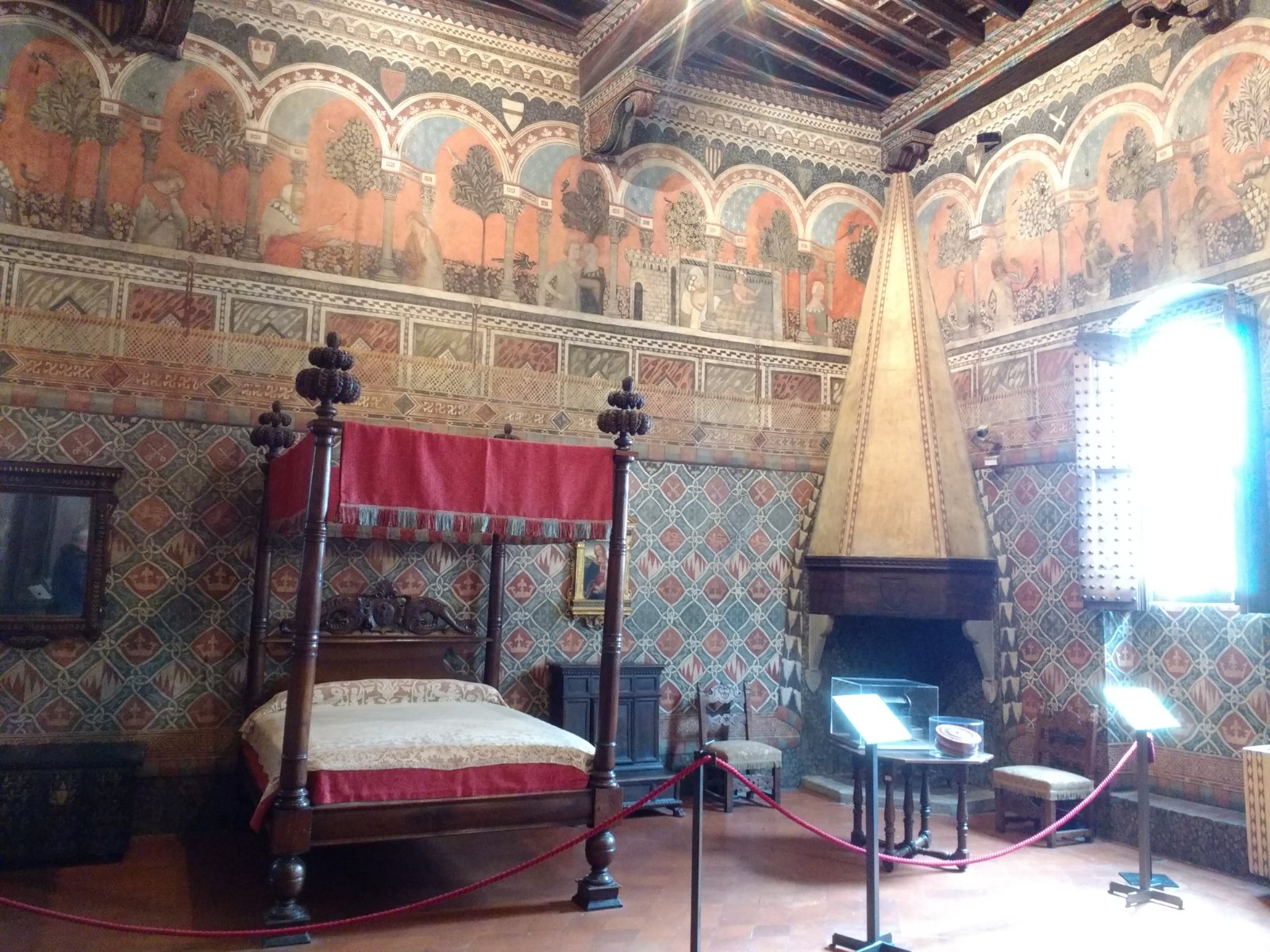
A bedroom
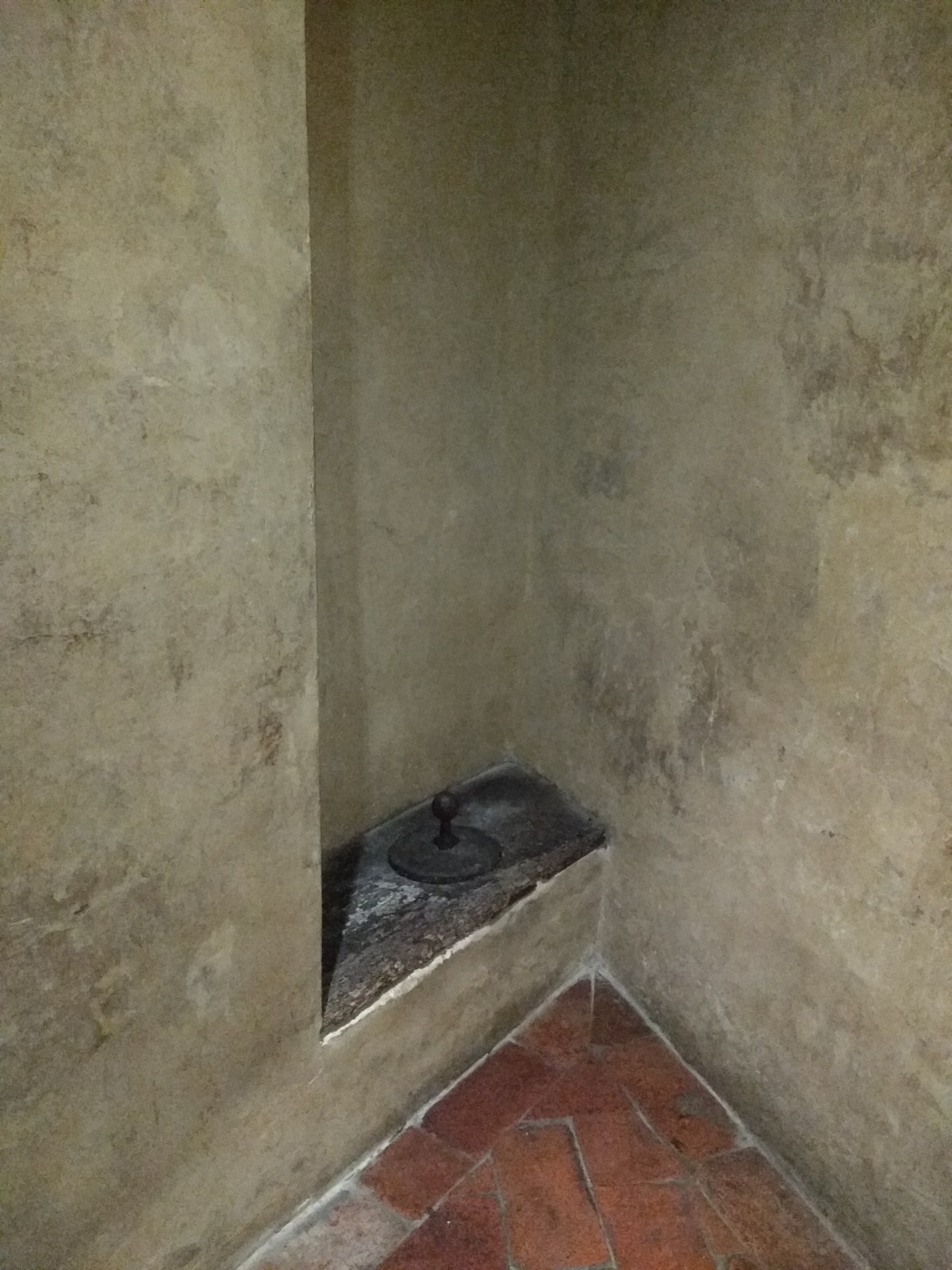
The Palace had two bathrooms, a very rare luxury in those days.
A privy. We saw two like this.

Hand warmers
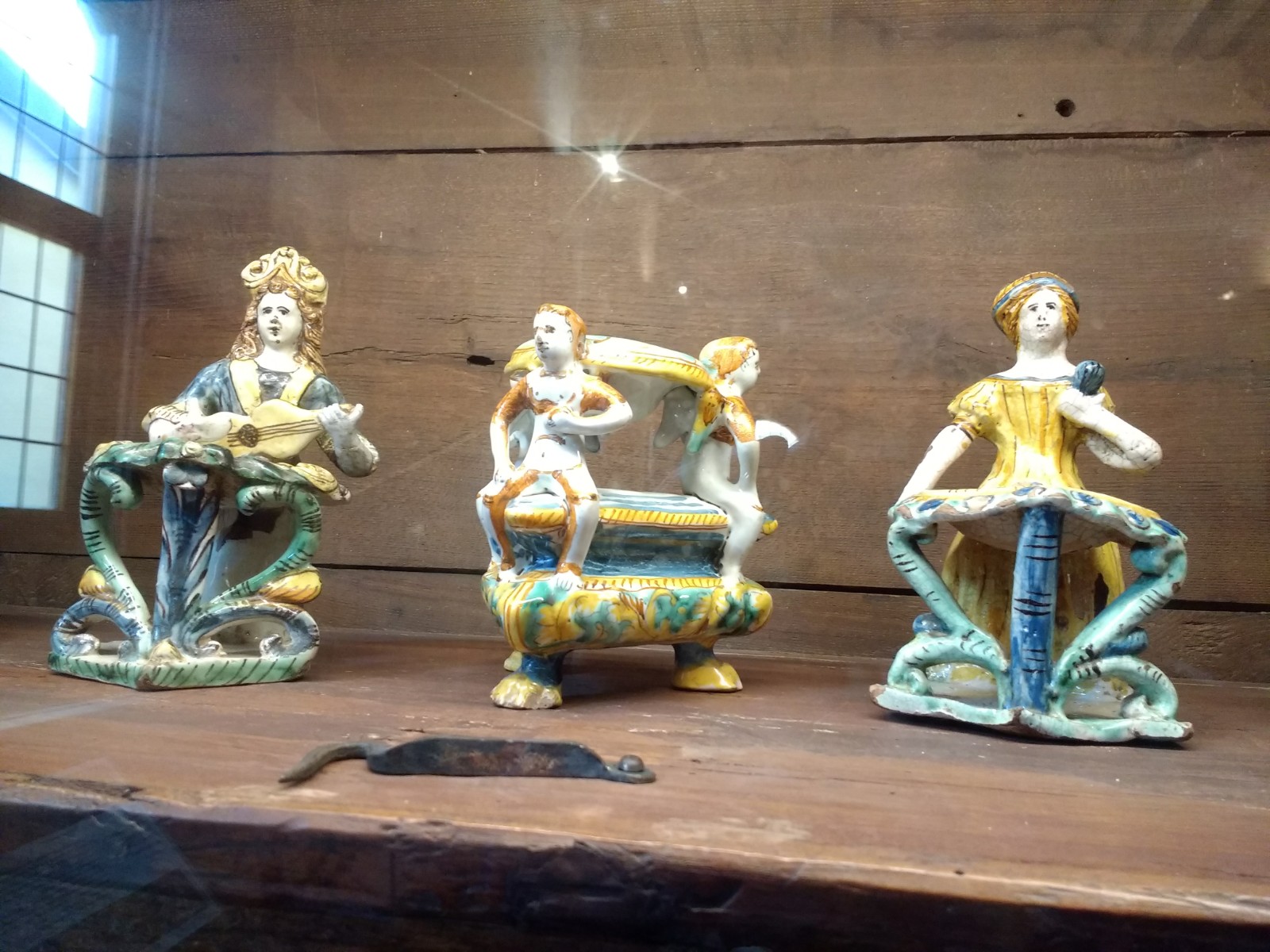
Salt cellars
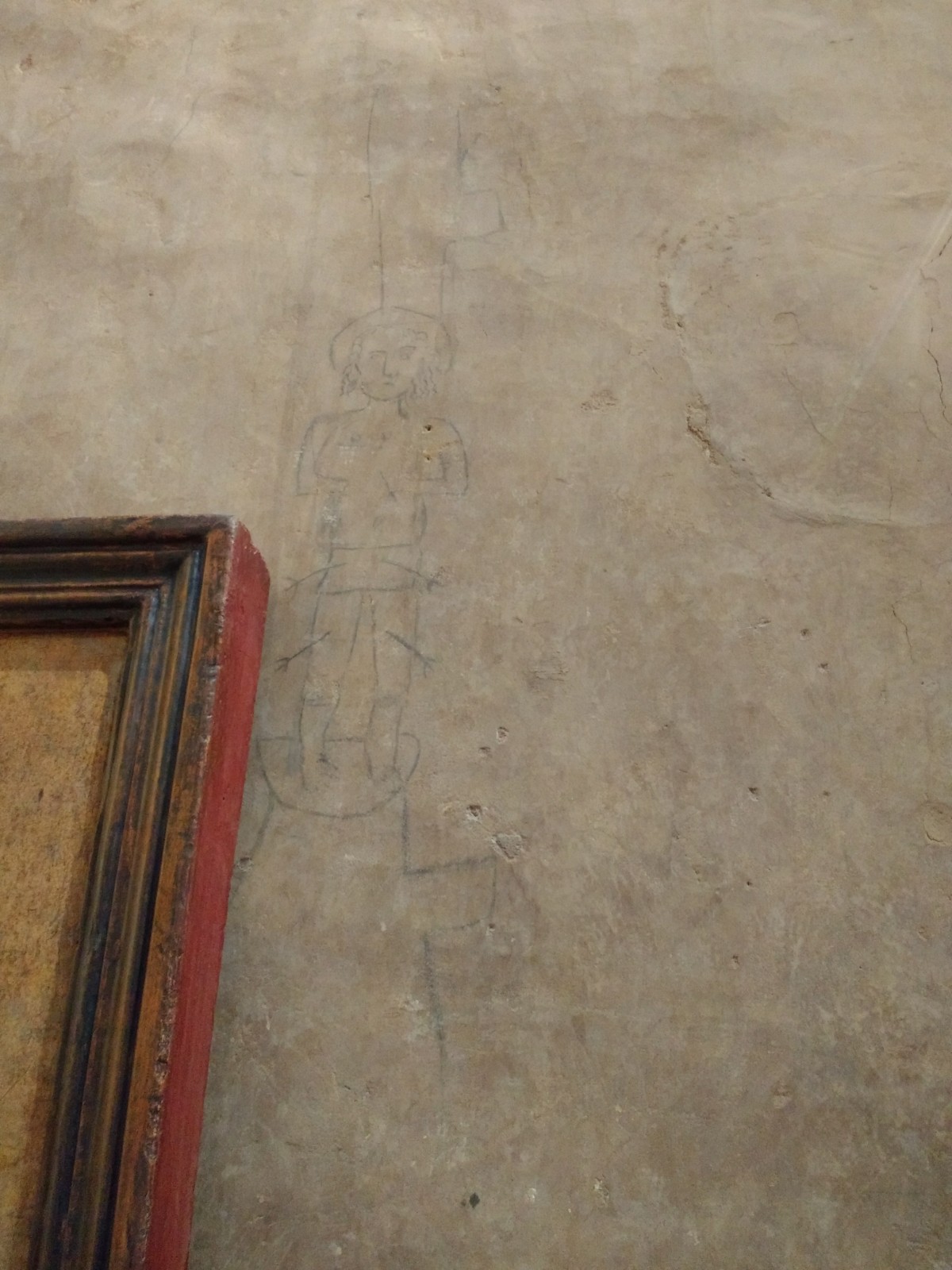
At some point in its history a few of the rooms in the Palace were used as a tax office. The graffiti which has been found is thought to have been done by people waiting to pay their taxes. I wonder if this is meant to be St Sebastian, or their tax inspector?

We didn’t see the top (third floor) which is where the kitchen would have been, common in grand houses so that the heat and cooking smells from the kitchen fires did not pass into the other rooms. There was also less risk to the rest of the building from out-of-control kitchen fires.

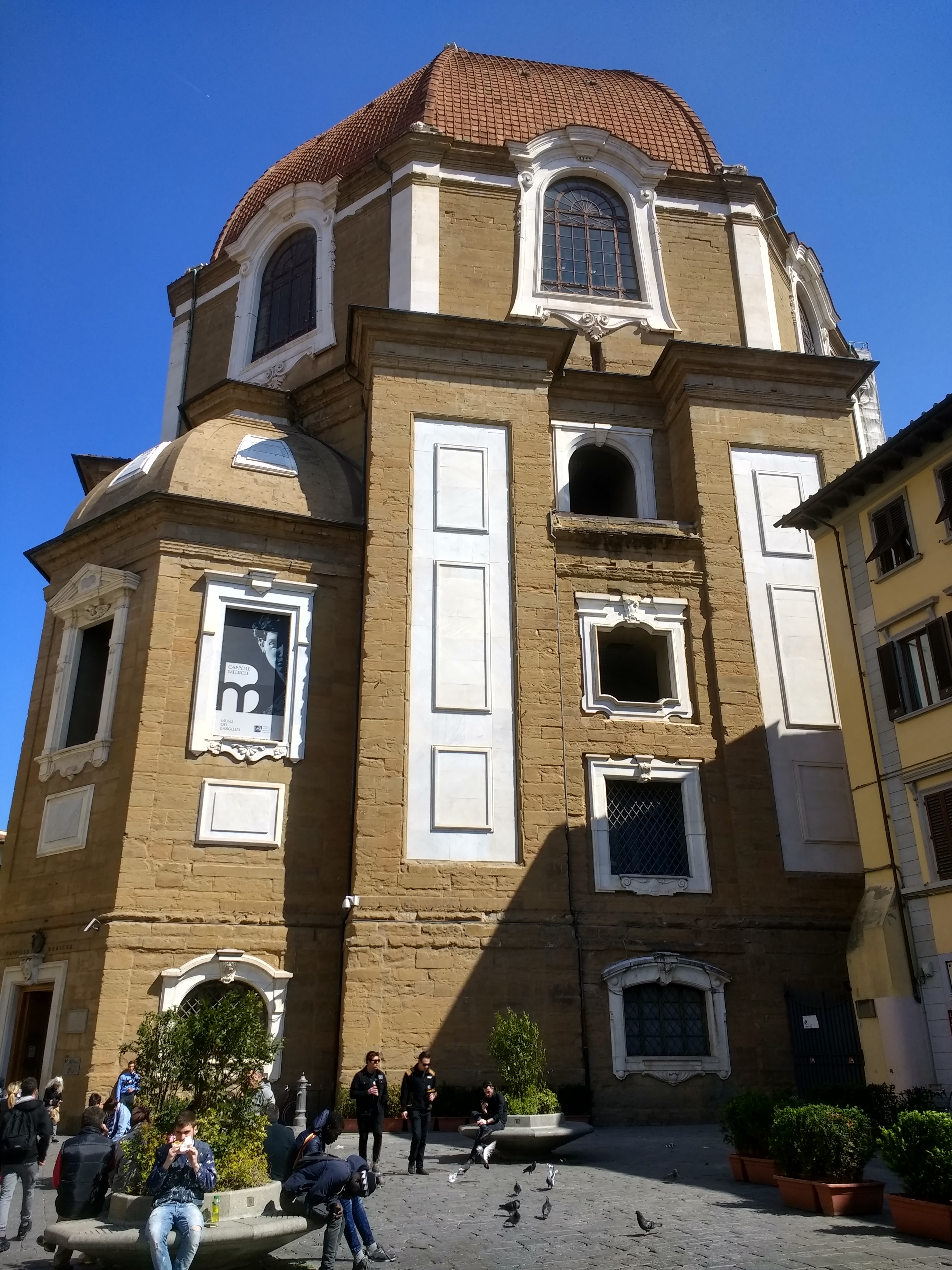
Our next free stop was Cappelle Medicee, burial place of the Medici family.

Cappelle Medicee

The New Sacristy was built by Michelangelo in 1519 over the space of ten years.

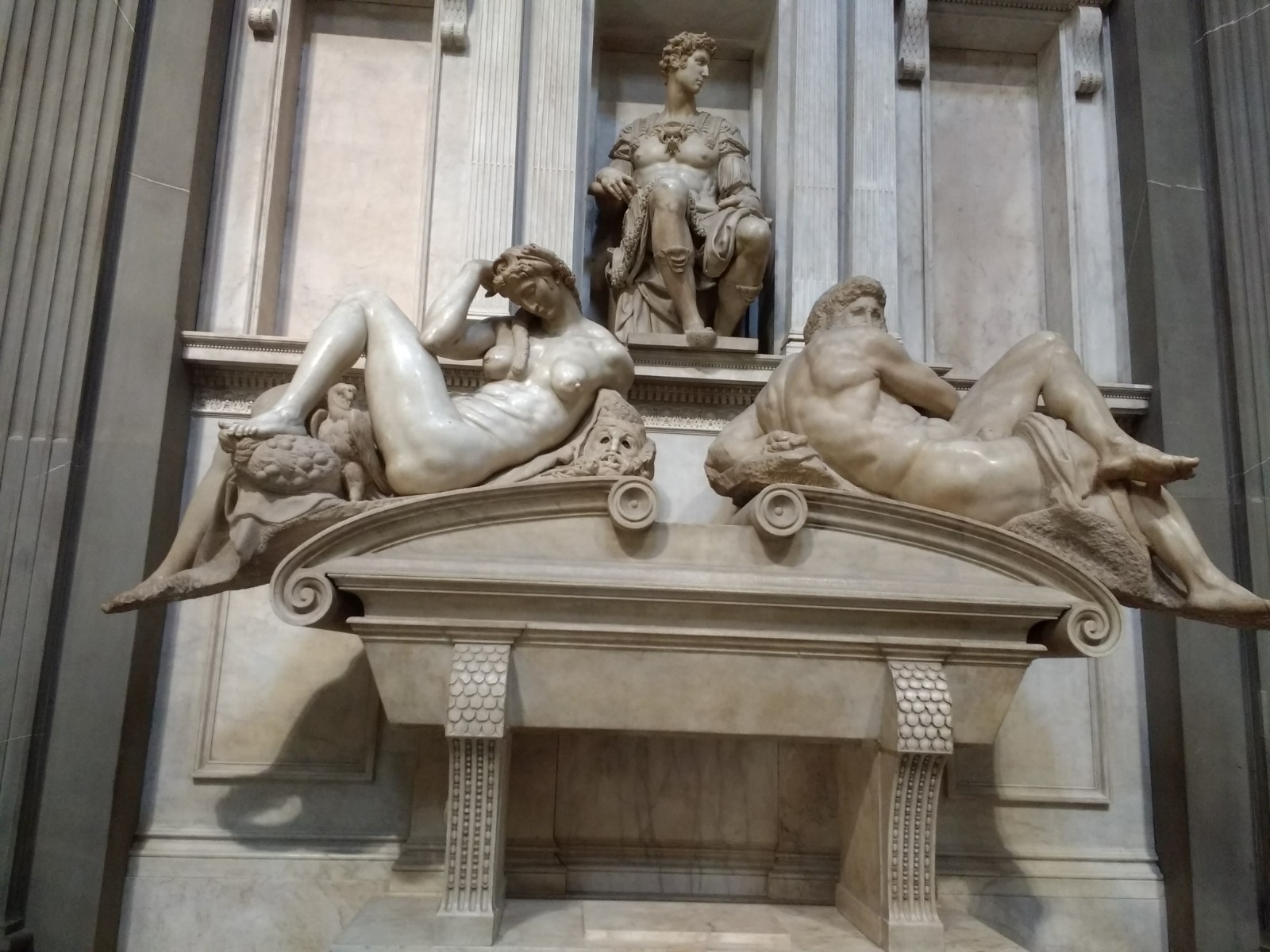
Tomb of Giuliano, Duke of Nemours by Michelangelo
‘Night’ is shown by the sleeping woman on the left, and ‘Day’ by the man on the right.
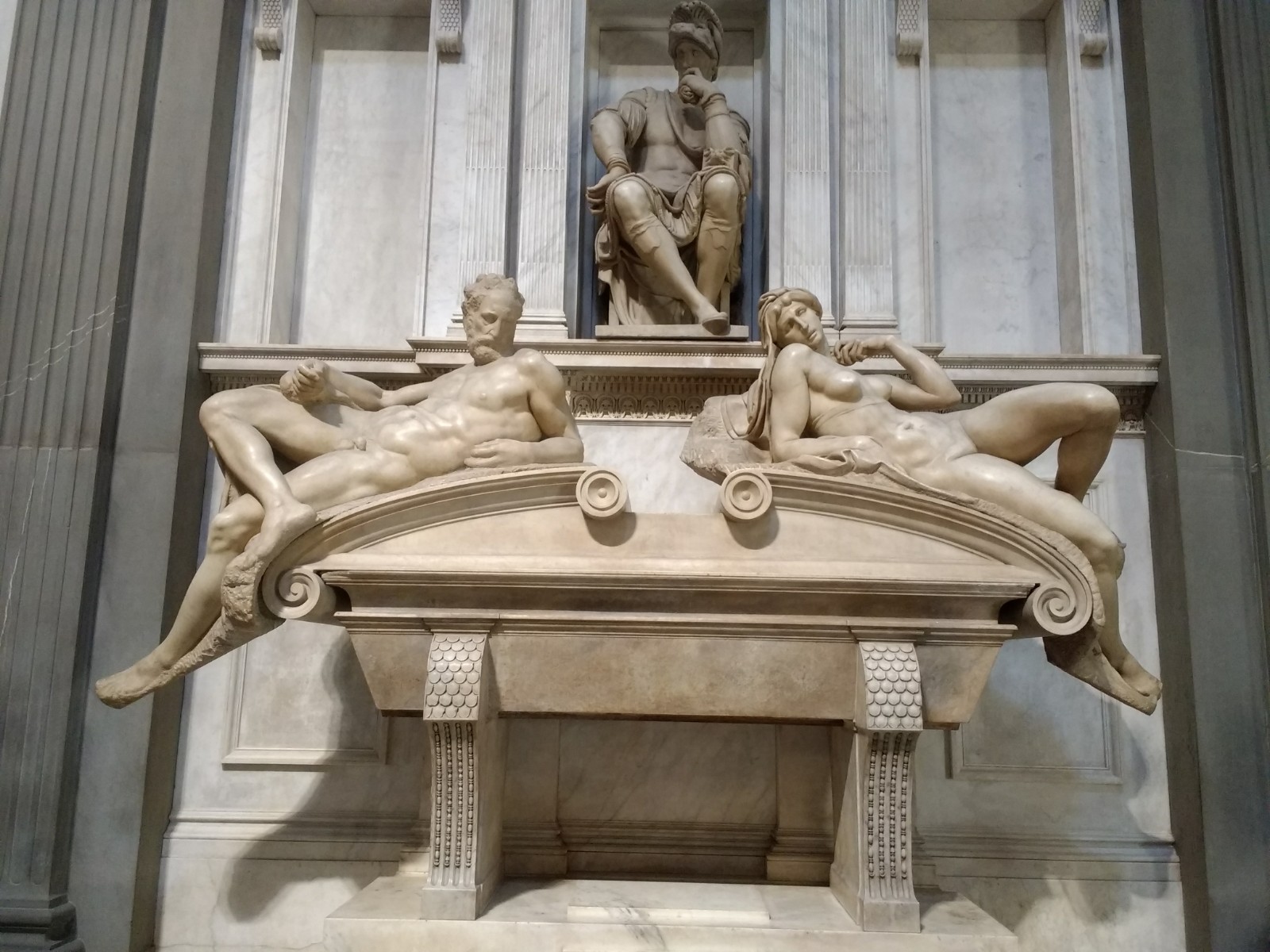
Tomb of Lorenzo, Duke of Urbino, by Michelangelo
‘Dawn’ is shown by the waking man on the left, and ‘Dusk’ by the sleepy woman on the right.

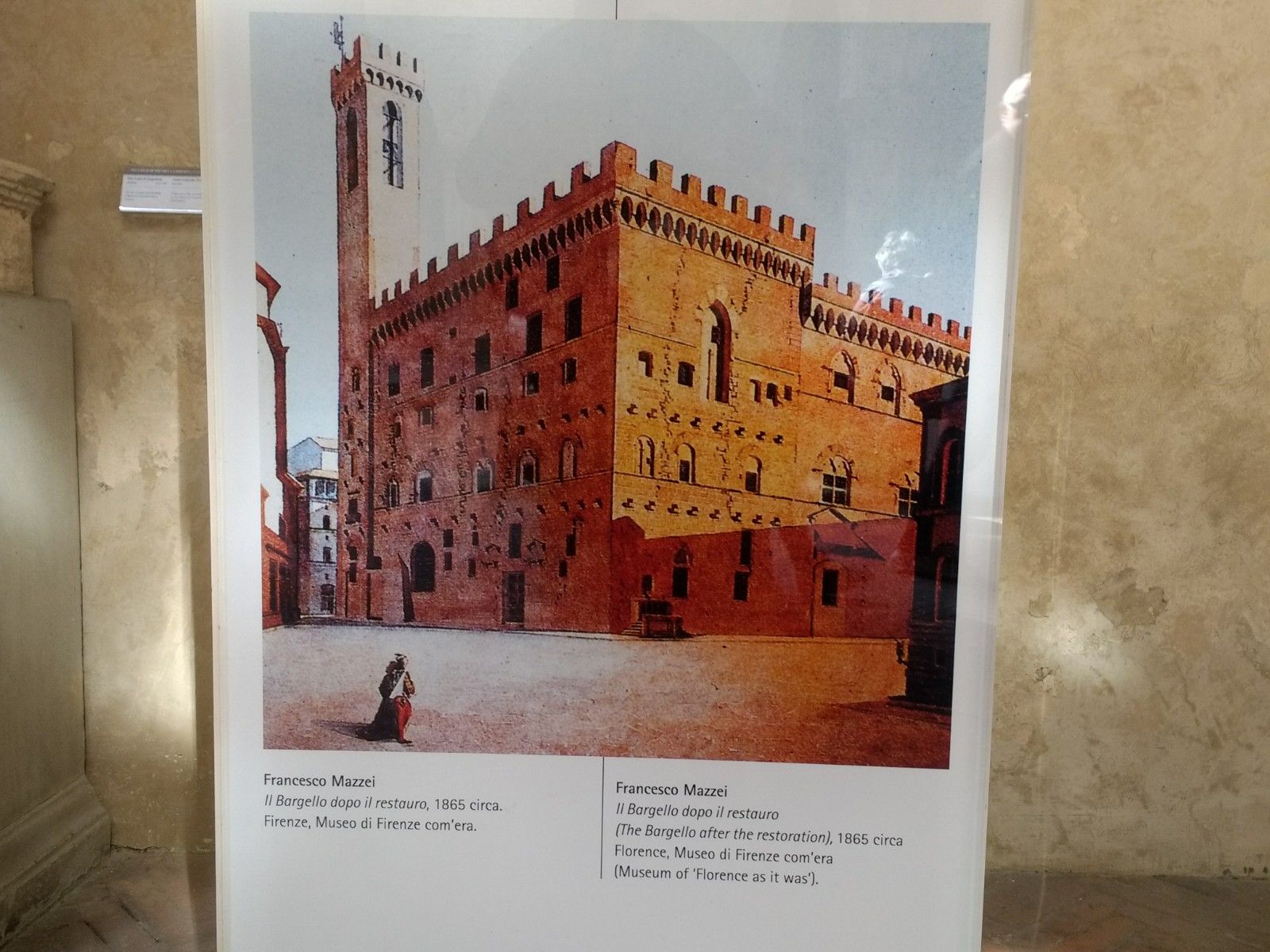
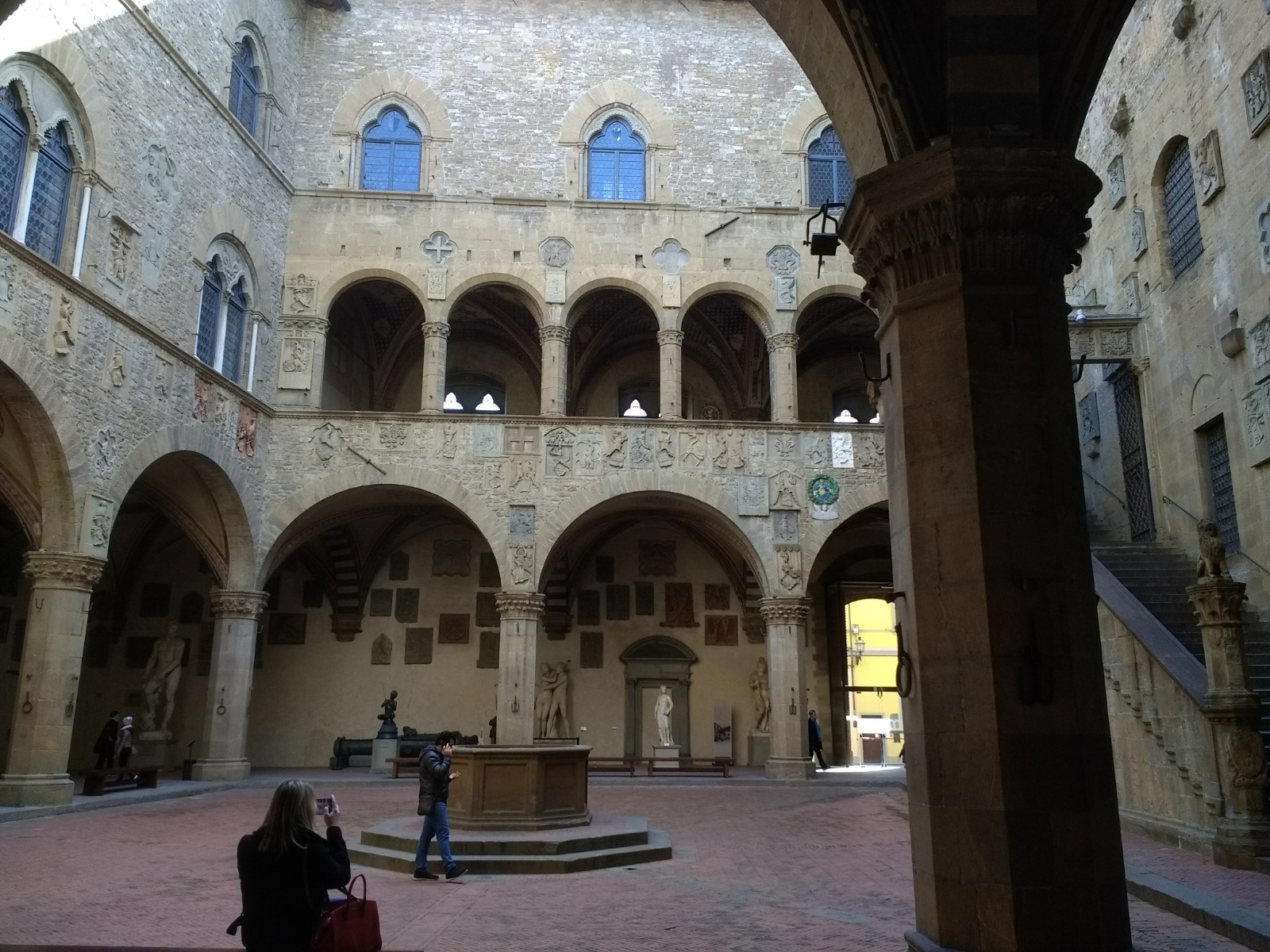
The last of our free museums, Museo Bargello, was built to house the chief of police in the thirteenth century, later used as a jail, and opened as a museum to house gothic and Renaissance sculptures in 1865. We followed Rick Steves’ audio guide and saw a selection of what was on offer.

The courtyard of The Bargello

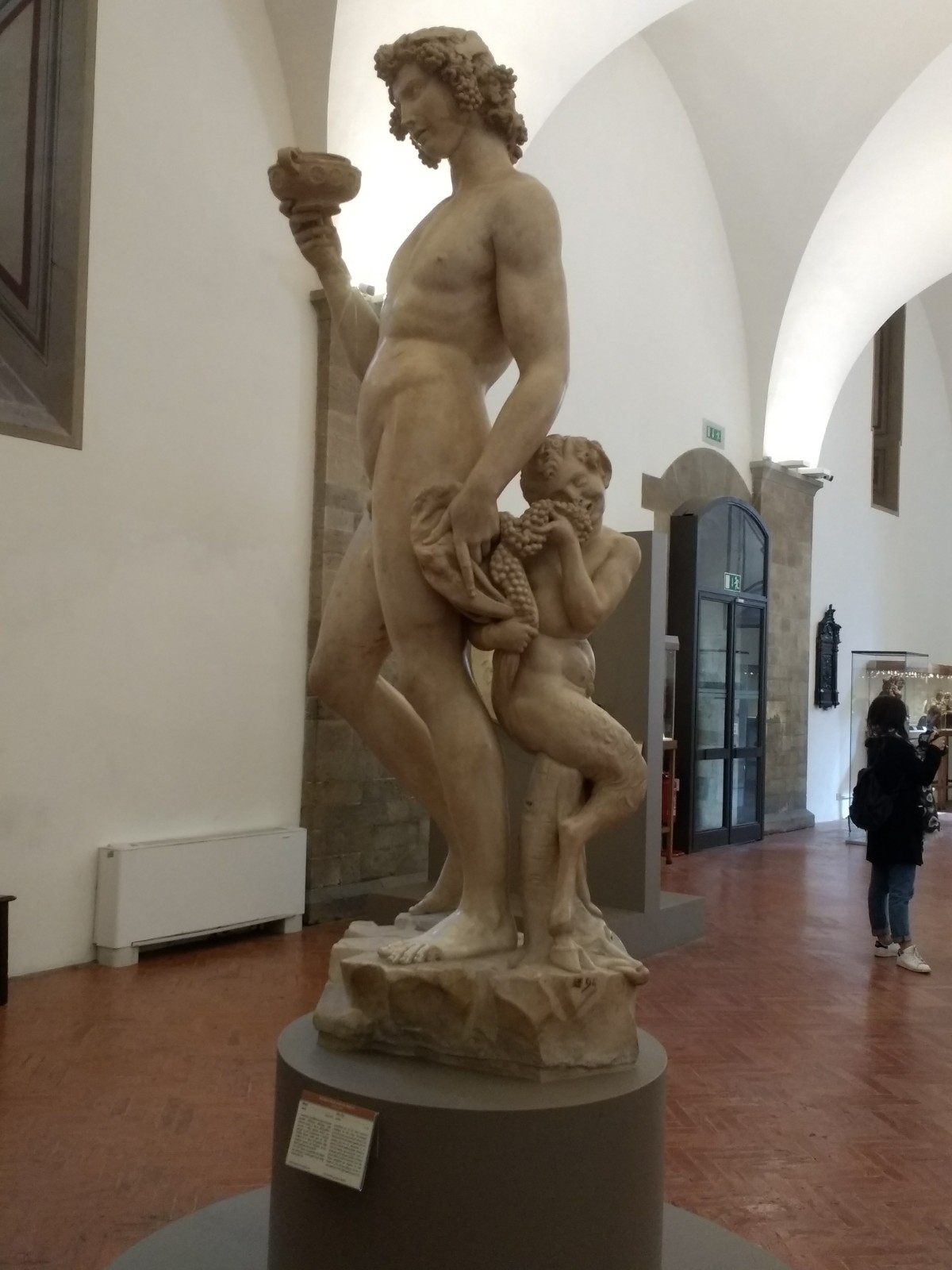
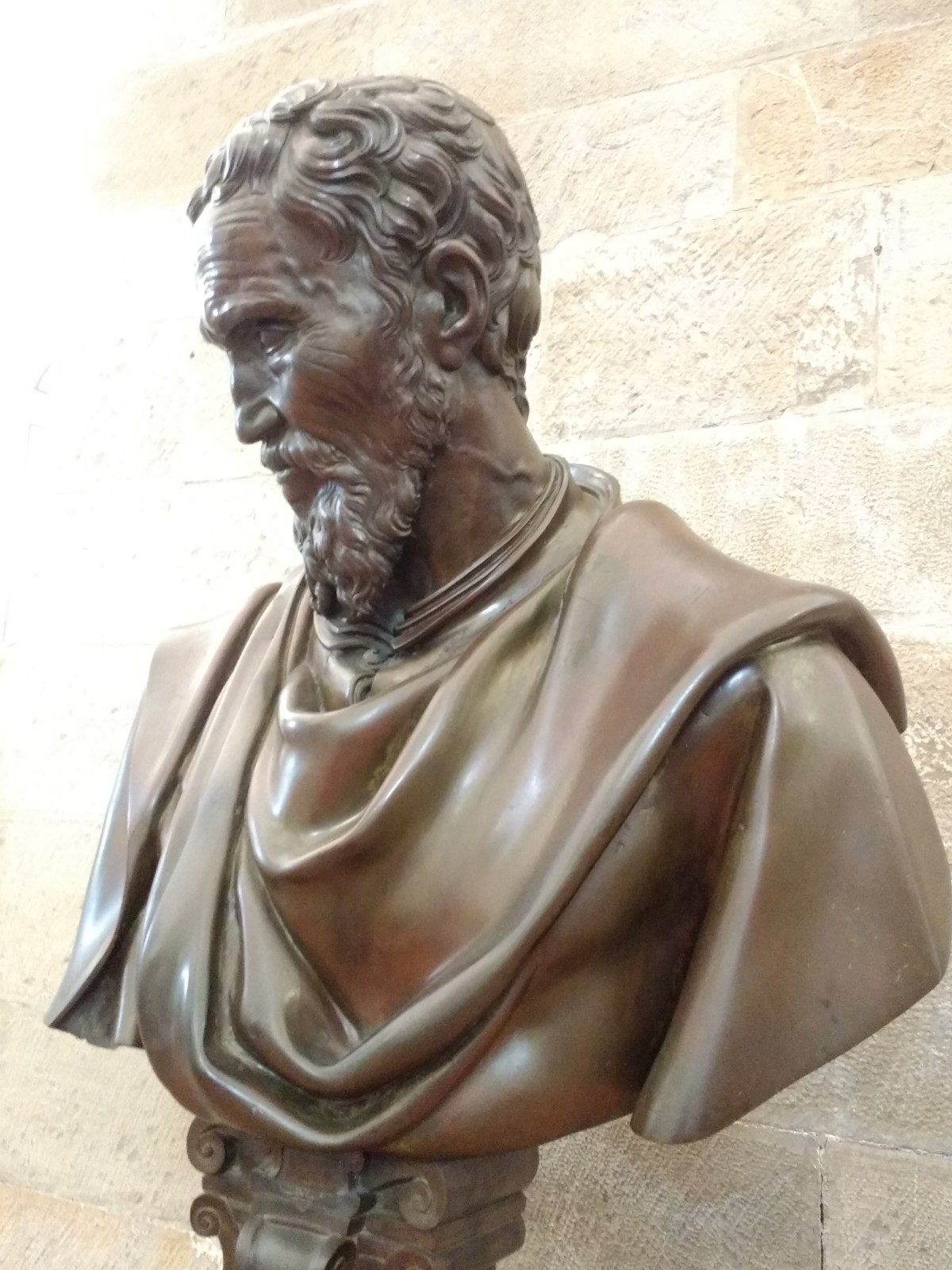
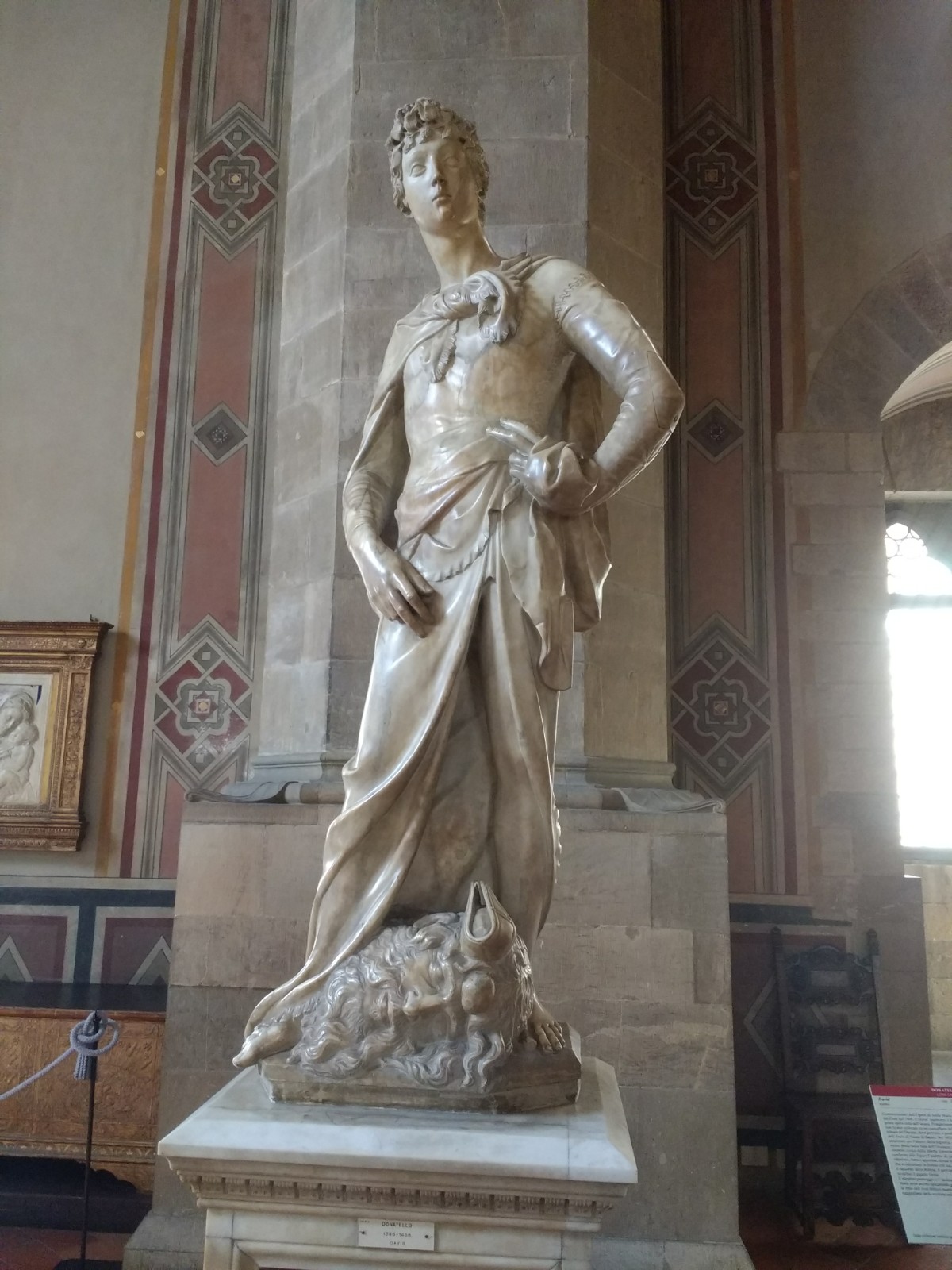
Rick’s descriptions included details of why the pieces were made, how they were received and new techniques and ways of representation used by the sculptors. I won’t reproduce what we learned, just show you some pictures. If you’re interested, all Rick Steves’ tours and talks can be downloaded free.

Bacchus by Michelangelo when just 21.
Michelangelo, from his death mask, by Daniele da Volterra, 1564
David by Donatello
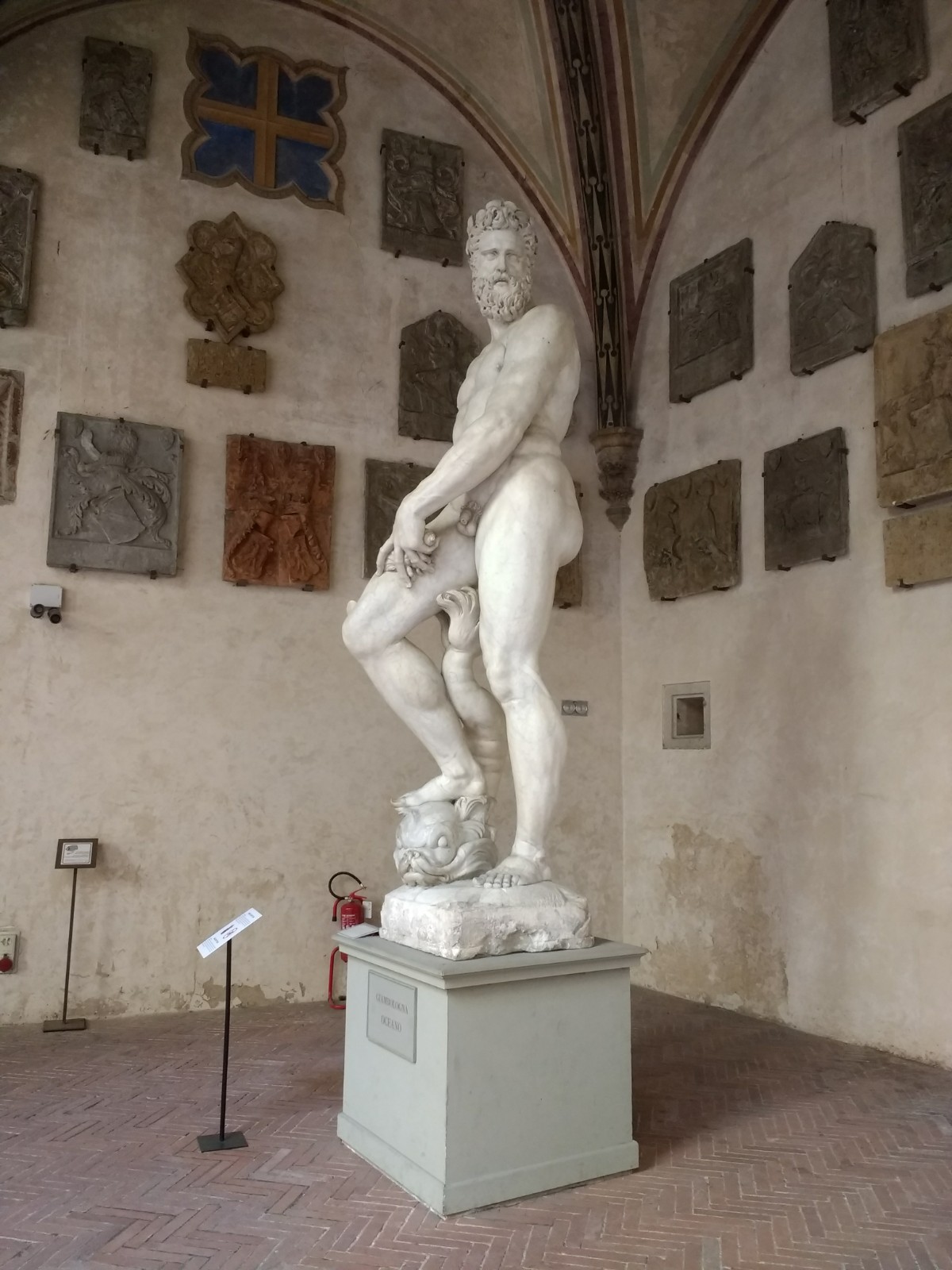
Oceanus by Giambologna

On Foot in Florence

Here on the streets of Florence we can hear English spoken all around, unlike in Naples and Sicily where we came upon very few other English-speaking travellers. The streets are also cleaner, the buildings in better repair and the traffic more organised.

We’ve bought a ‘PassePartout’ family pass to the Uffizi (which also covers the Pitti Palace and the Boboli Gardens, which we are near). This gives us unlimited access to all three sites for a year for €100 between us (plus an unlimited number of children, but unfortunately, only if they’re under 18). It sounds like a lot of money, but just to get into the Uffizi is €20 a time each and this way we will be able to pop in and see a few paintings whenever we feel like it.

We went into a tourist office earlier to ask about the card, but it turned out we knew more about it than the tourist officer did. I told her that we would be here for three weeks and was there anything else we should know about? Almost as an afterthought she told us about three museums that are free tomorrow. I asked if they wouldn’t be terribly overcrowded, being free, but she said that no, they wouldn’t as not many people knew about it. (Possibly because no one has told them).

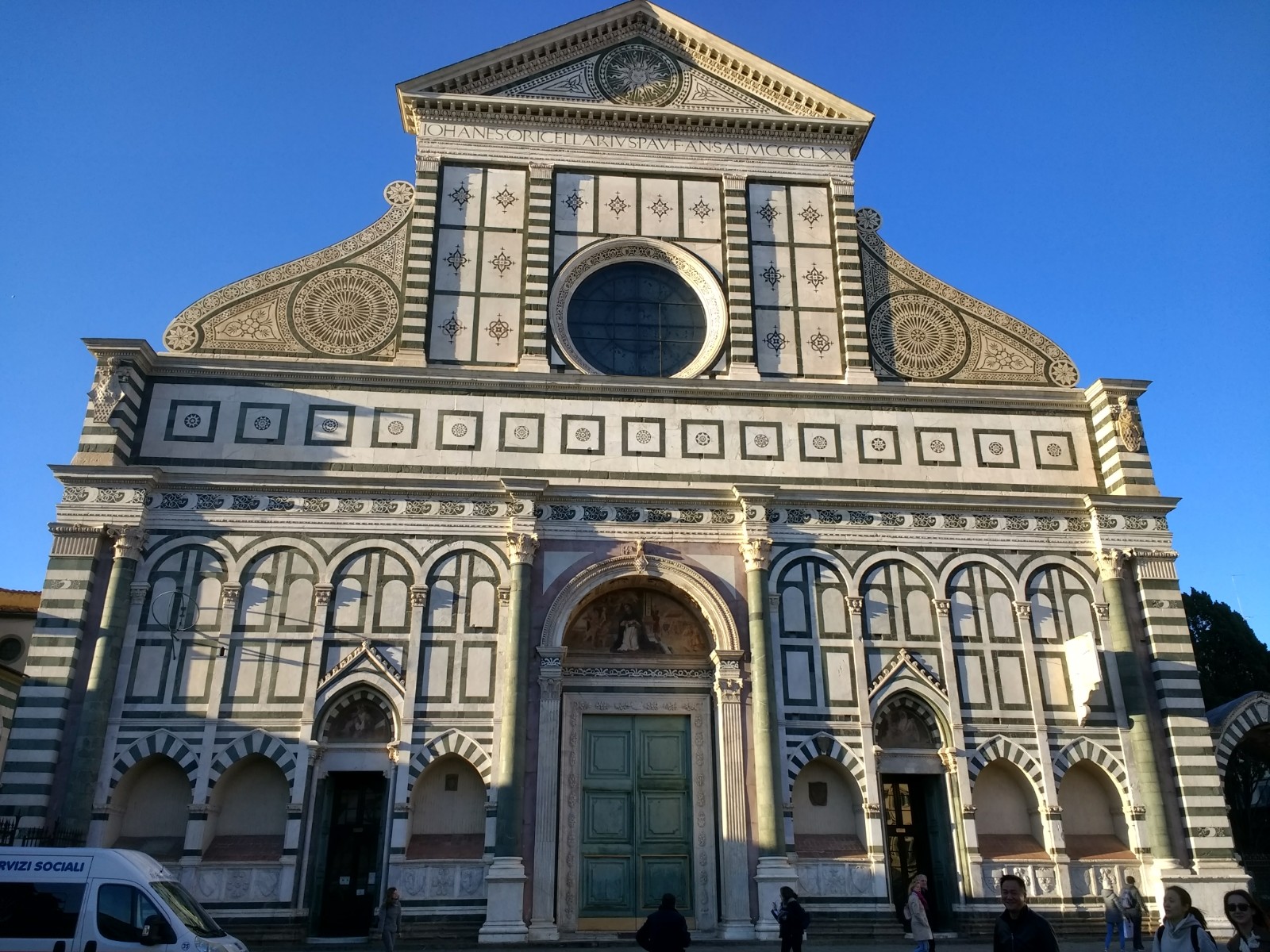
Santa Maria Novella, fifteenth century. Green and white marble facade.

Visited Santa Maria Novella this afternoon. Some fabulous frescoes there, but we are going to try and space the churches out so we don’t get too church-weary.

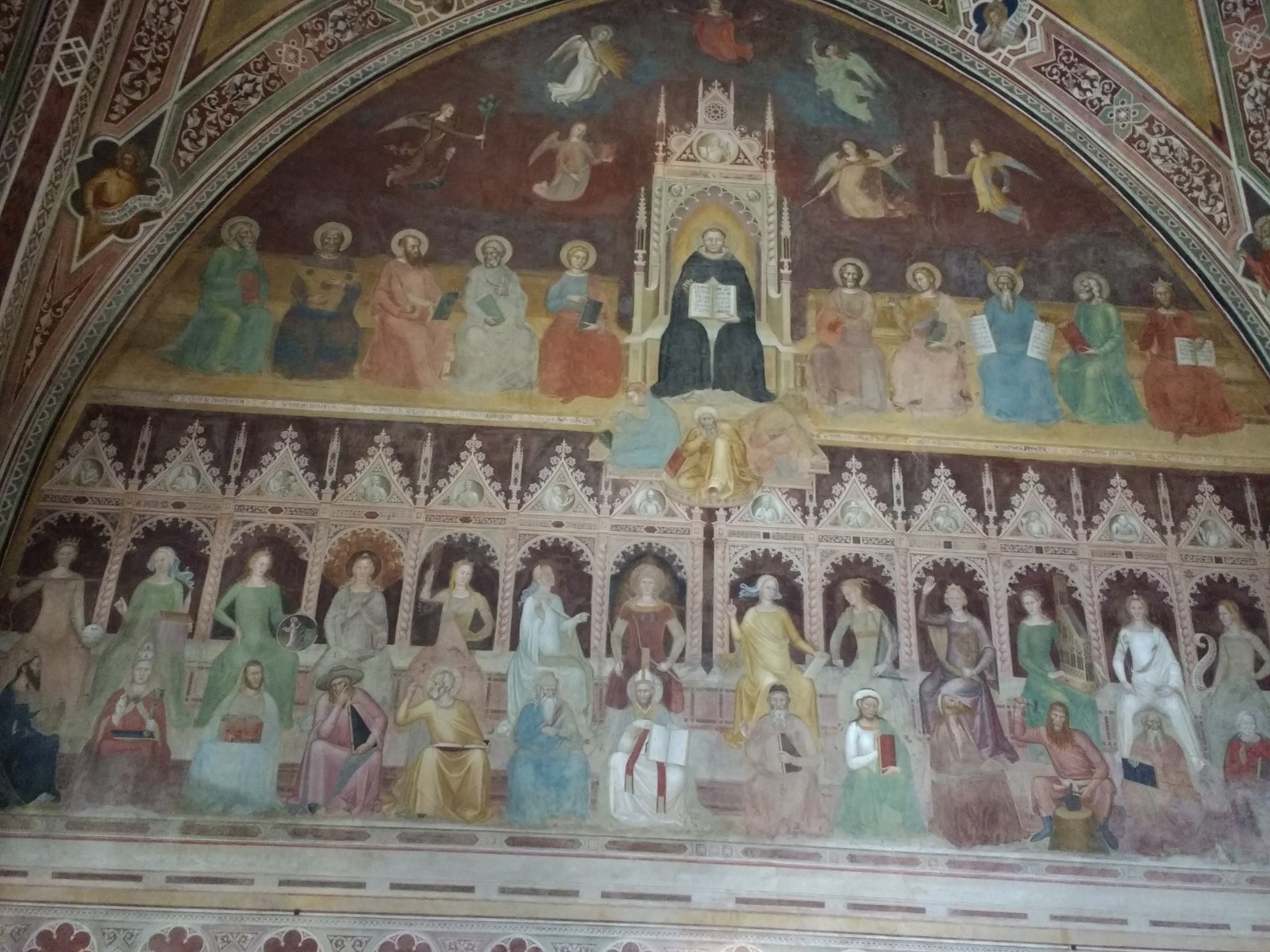
Fresco in Spanish chapel. Moses, seated, in blue, third from right in the top row, is wearing horns (they look more like asses’ ears). When Moses had received the Ten Commandments he was described as returning to the Jewish people ‘with horns’ but, apparently, this is a mis-translation of what was originally written.

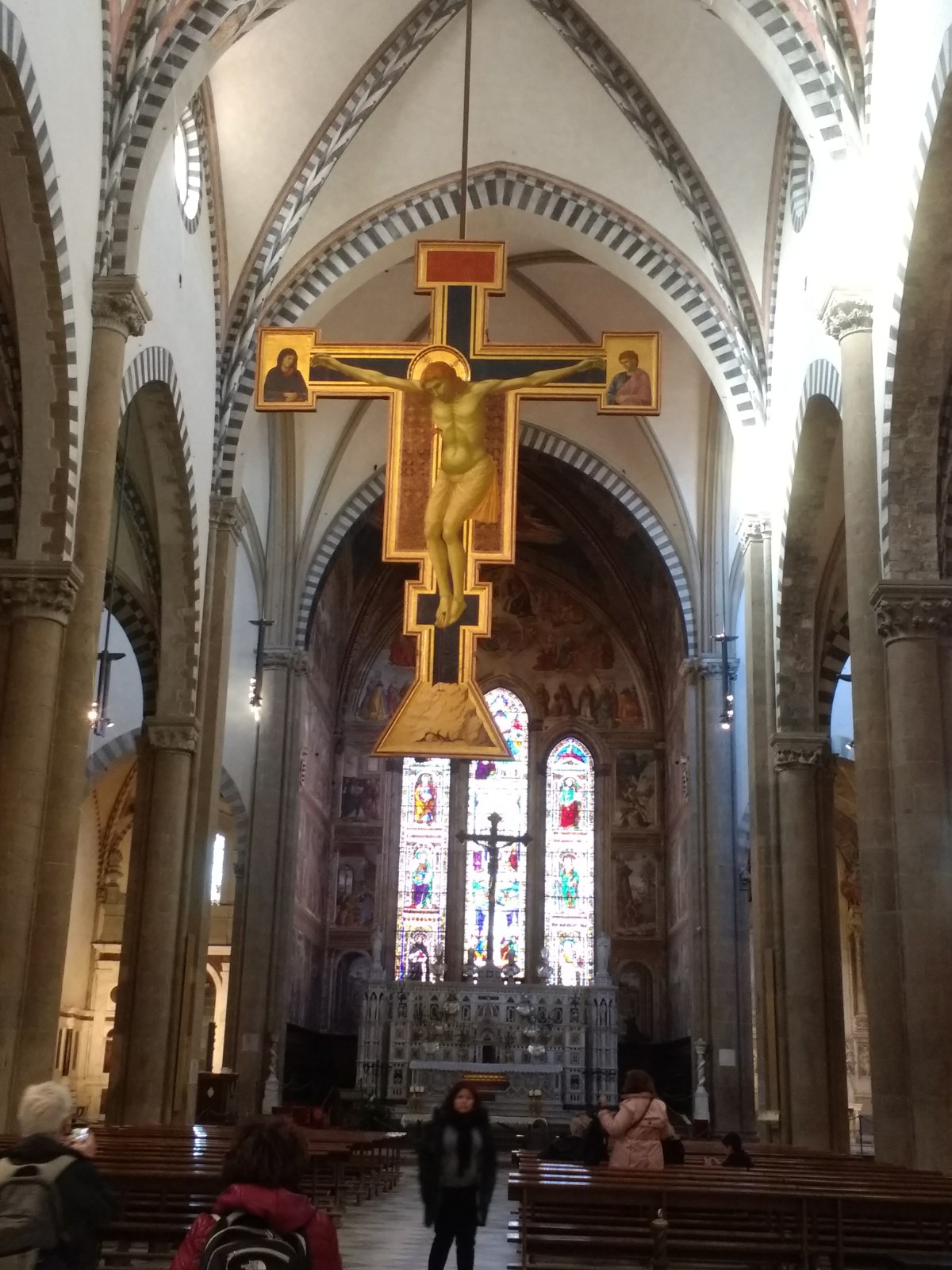
Crucifix by Giotto, 1289

I have two more items to add to my list of essentials to take away when travelling – string and pegs. It turned very windy overnight and Mark was woken up in the small hours by the sitting-room shutters blowing open. They don’t stay in place when closed, and don’t stay in place when open, but all solved with a length of string (the trouble is the ball we’ve bought has 199 more metres on it that we may not need).

The pegs are to secure washing suffiently well in all wind conditions to be confident of it staying on the line rather than ending up in a ground floor garden (not much washing hanging in the street here). I don’t know if you’ve ever noticed that pegs, like knives, seem to diminish as time goes on. There are 10 pegs in this Airbnb apartment, three knives, but six spoons and forks.

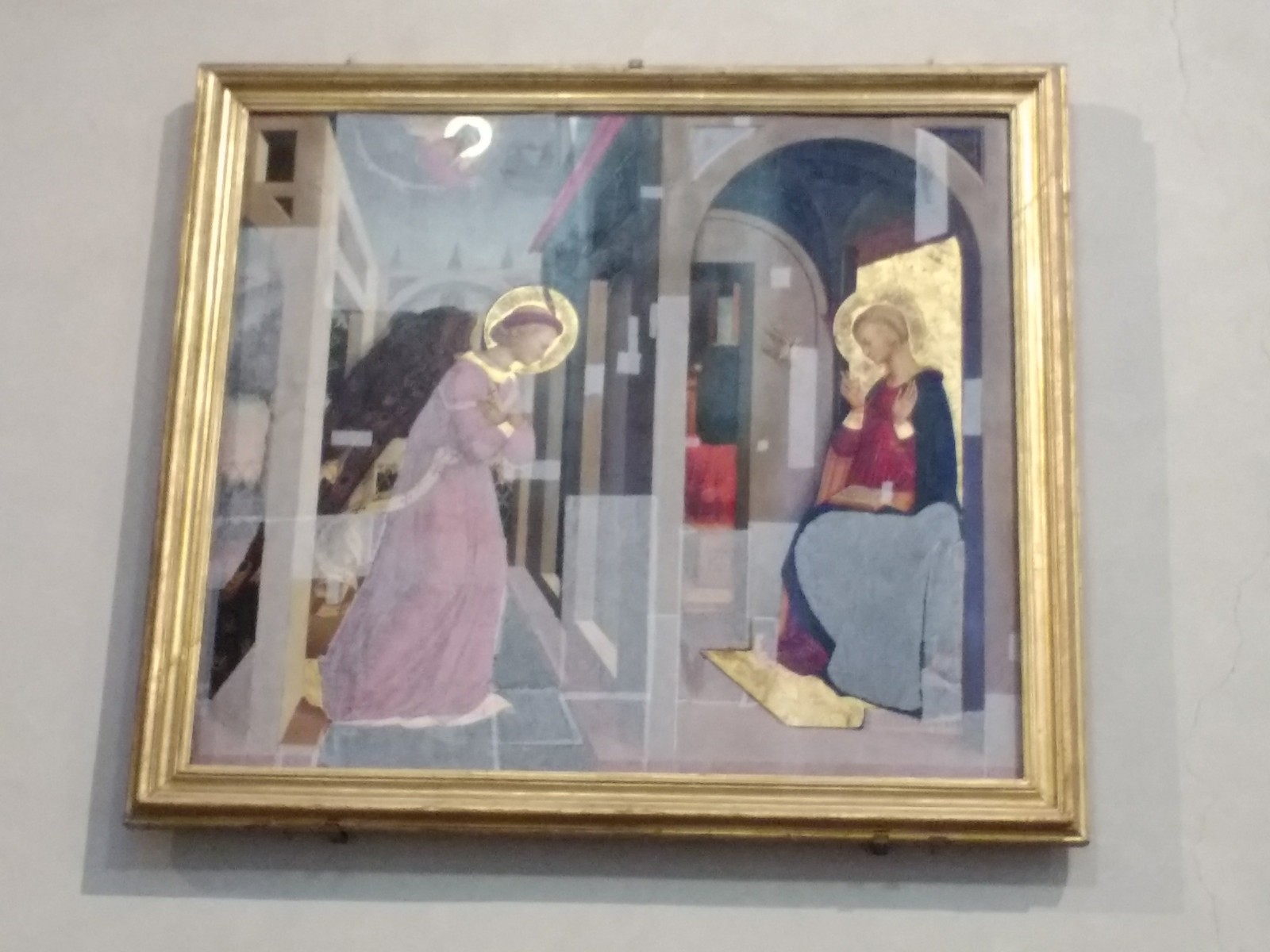
Annunciation by Neri Di Bicci, 1455

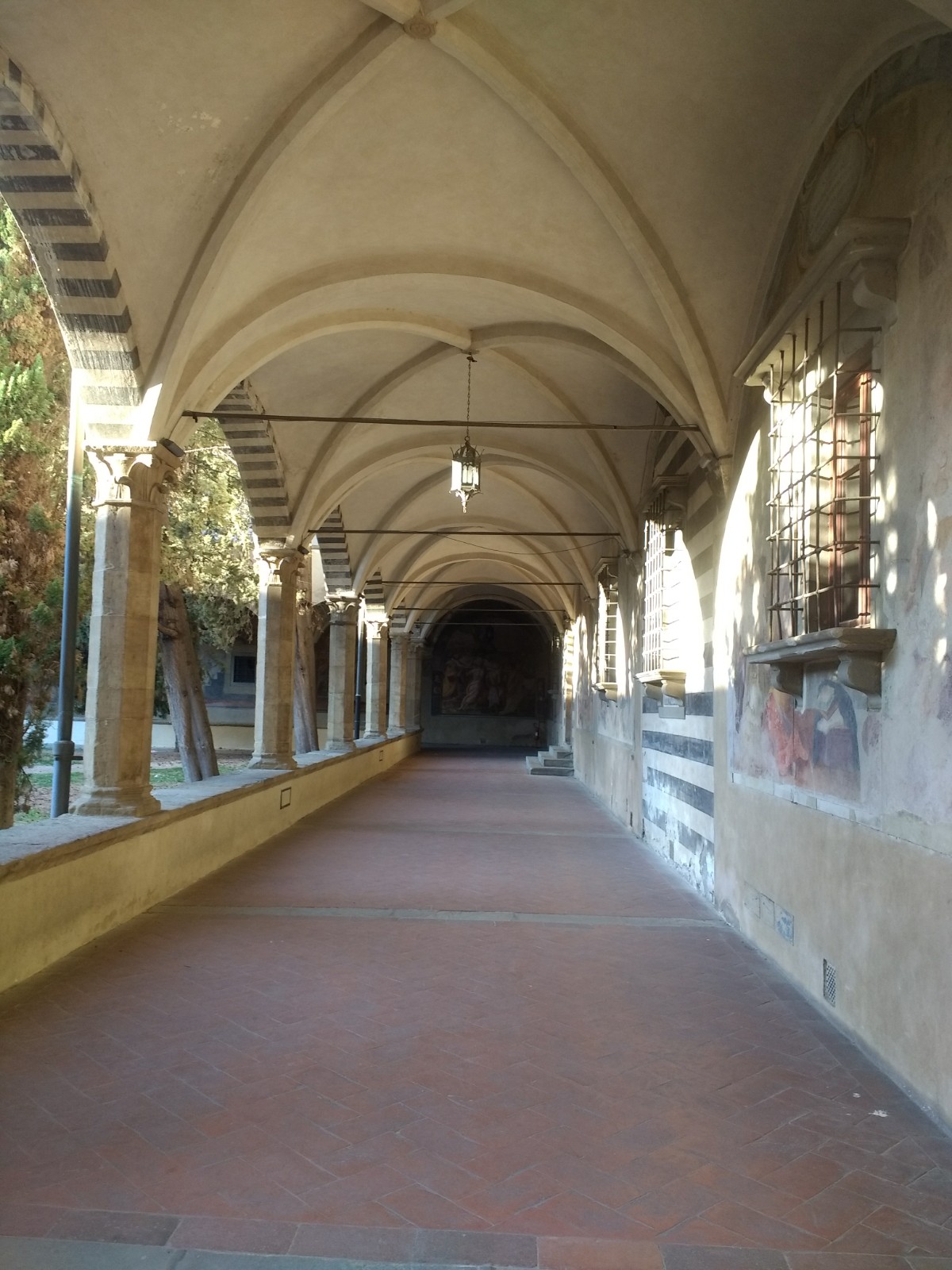
Cloisters
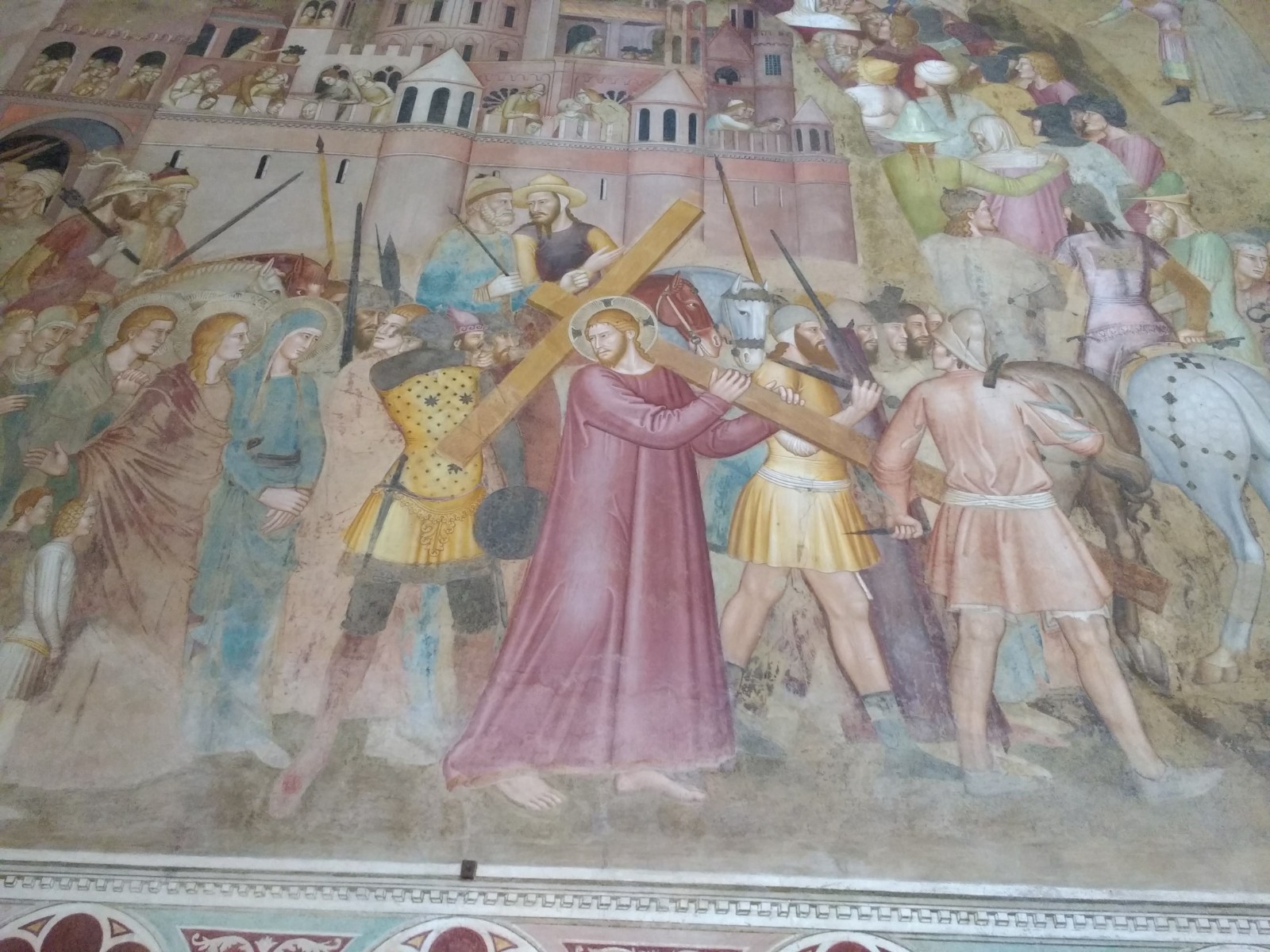
Fresco in Spanish Chapel

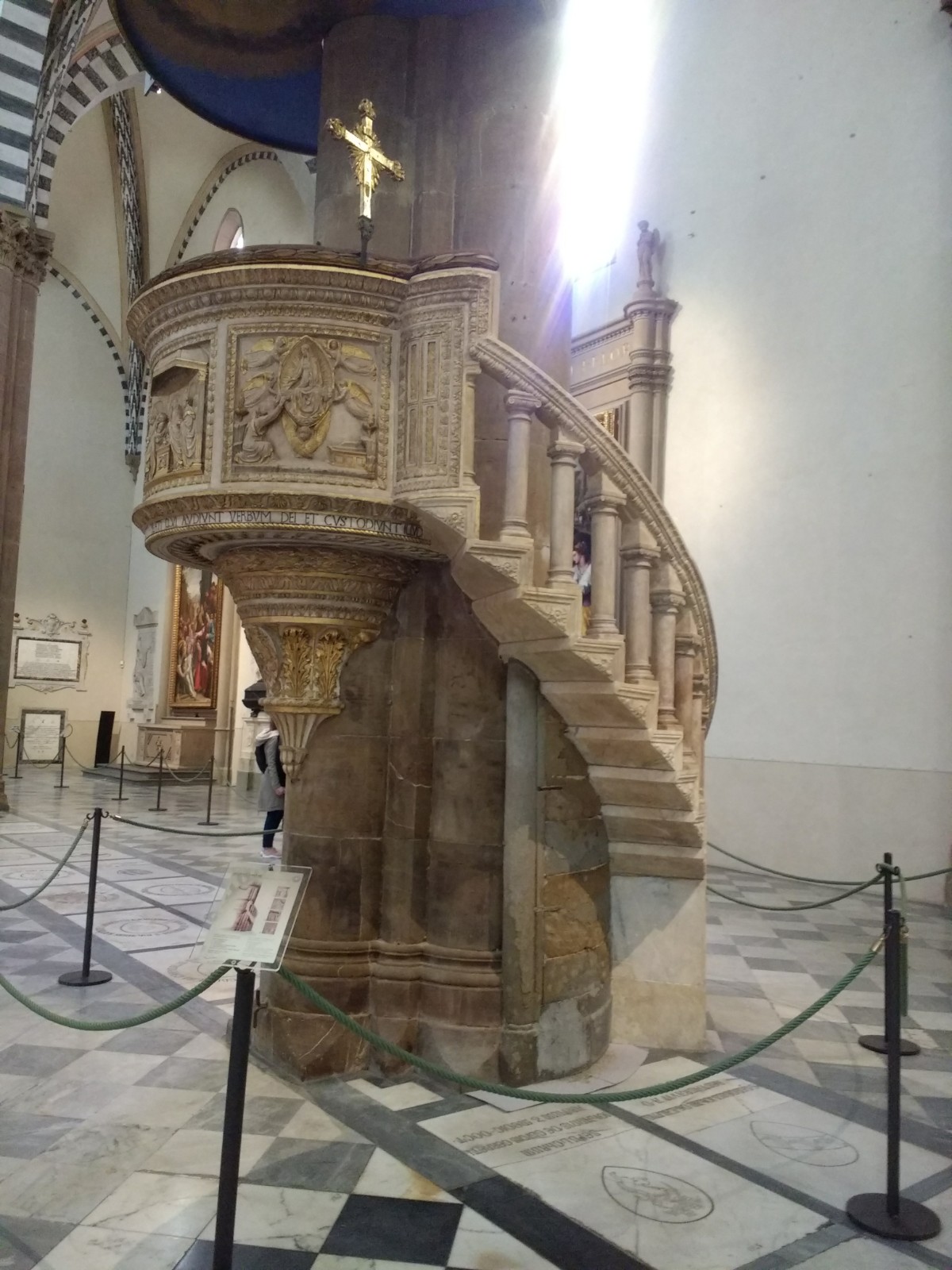
Incidentally, Santa Maria Novella is the venue where, in 2017, Theresa May set out her vision to the EU on the role of the UK post-Brexit. It was also where Galileo was accused of heresy for saying that they Earth went round the sun, rather than the other way round.

Pulpit where Galileo’s accuser spoke. Perhaps this is where Theresa May stood to make her speech too.

Money in Naples and Capri

What do you think, was Naples more expensive or cheaper than Sicily? If you read the blog ‘Money Matters’ you will see that our aim is to keep our spend to about £3000 a month (4 weeks) and we went just over this in Sicily, spending a total of £3140.81. However this wasn’t bad considering a) we were moving around and b) we hired a car for eleven days.

Naples was very inexpensive and our total spend came in at £2228 for the four weeks. How so cheap? First, our accommodation was very inexpensive, second, we bought ‘Campagna Artecards’ which cover us for many museums in Campagna for a whole year. A lot of the places we visited allowed free entry with the card on two separate occasions. In this way we were able to visit Pompeii, the Archeological Museum in Naples and Caserta Palace twice. Most of the other places we visited gave us reduced entry with the card. This splendid card only cost us €43 each.

This is the breakdown for Naples:

Accommodation: £854.03 Entrances (including the cost of two Campagna Arte 365 cards) £197.27 Groceries: £294.50 Meals out (includes coffee, drinks and ice-cream) £375.55 Travel (including taxi and boat to Capri) £292.90 Anne haircut: £45 Mark haircut: £9 UK expenses: £160

How did we do in Capri? I don’t think we did too badly bearing in mind that Capri is a expensive destination with lots of high class shops etc. Our total spend for nine nights came in at £1076.

We were lucky enough to get our accommodation with a 20% discount as we are the first people in. We found groceries very expensive but meals out (we only had two) still cheaper than UK prices. A cappuccino cost between 4 and 6 euros a throw.

This is the breakdown:

Accommodation: £484 Entrances: £61.82 Groceries: £117.15 Meals out (includes coffee, drinks and ice-cream) £190.45 Travel (includes boat, taxi and train to Florence) £148.91 Other: £24 UK expenses £50

I am hoping that in giving you all the figures others might be inspired to get travelling too. It doesn’t have to cost a whole load of dough.

Next, we’re off to Florence for three weeks which we are expecting to be expensive. We will see how we do.

Rocking On In Capri

The other day we tried to visit Villa Lysis, neo-classical/Art Nouveau home of a colourful character called Fersen. Unfortunately we found it closed, but with three conflicting notices of opening times. According to the webpage it should have opened yesterday, but it was still very much closed today (the website have now changed the information to say it opens in April). Mark keeps saying, ‘Remember where you are.’

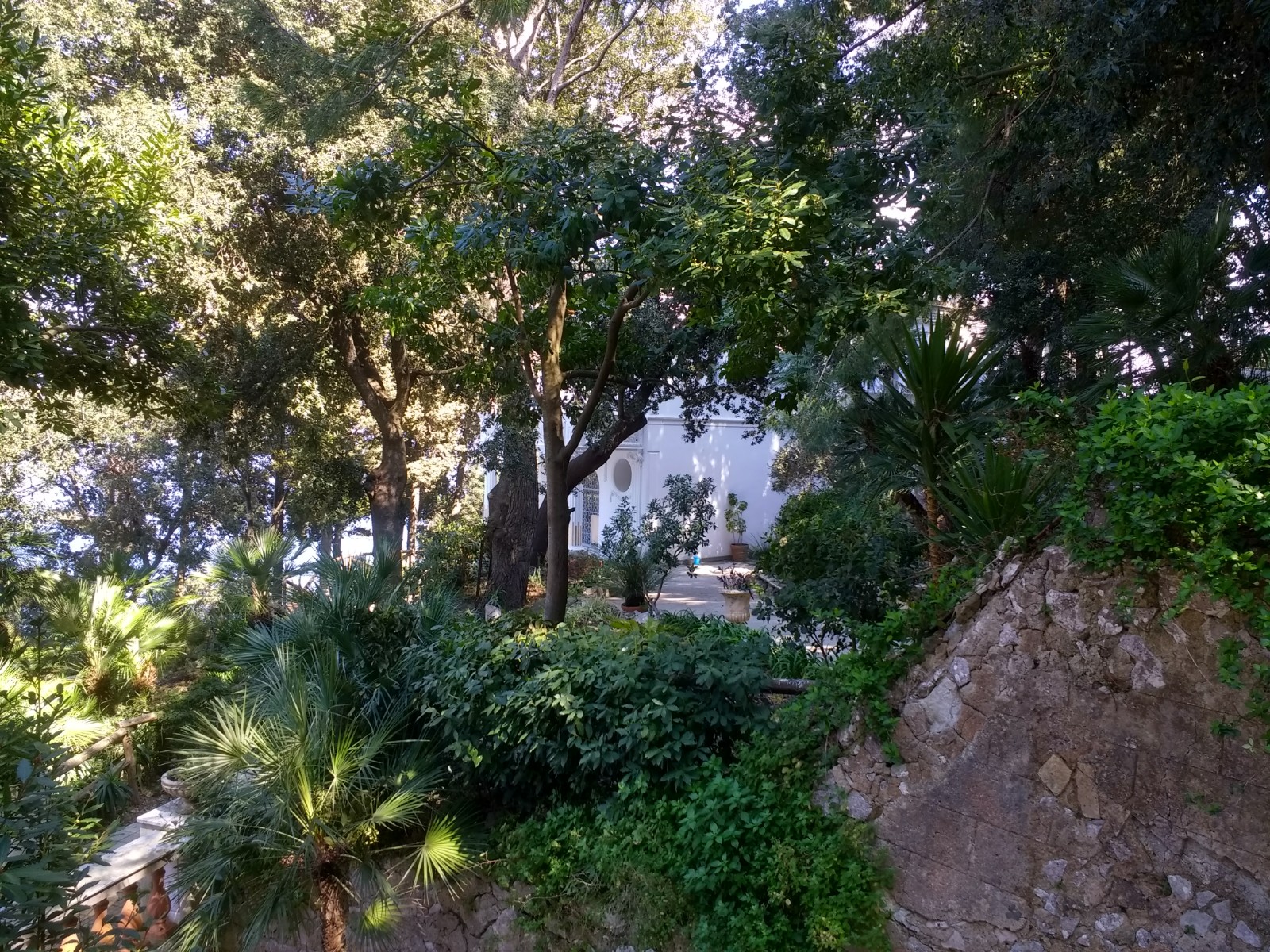
A tantalising view of Villa Lysis. This is as close as we’re going to get.

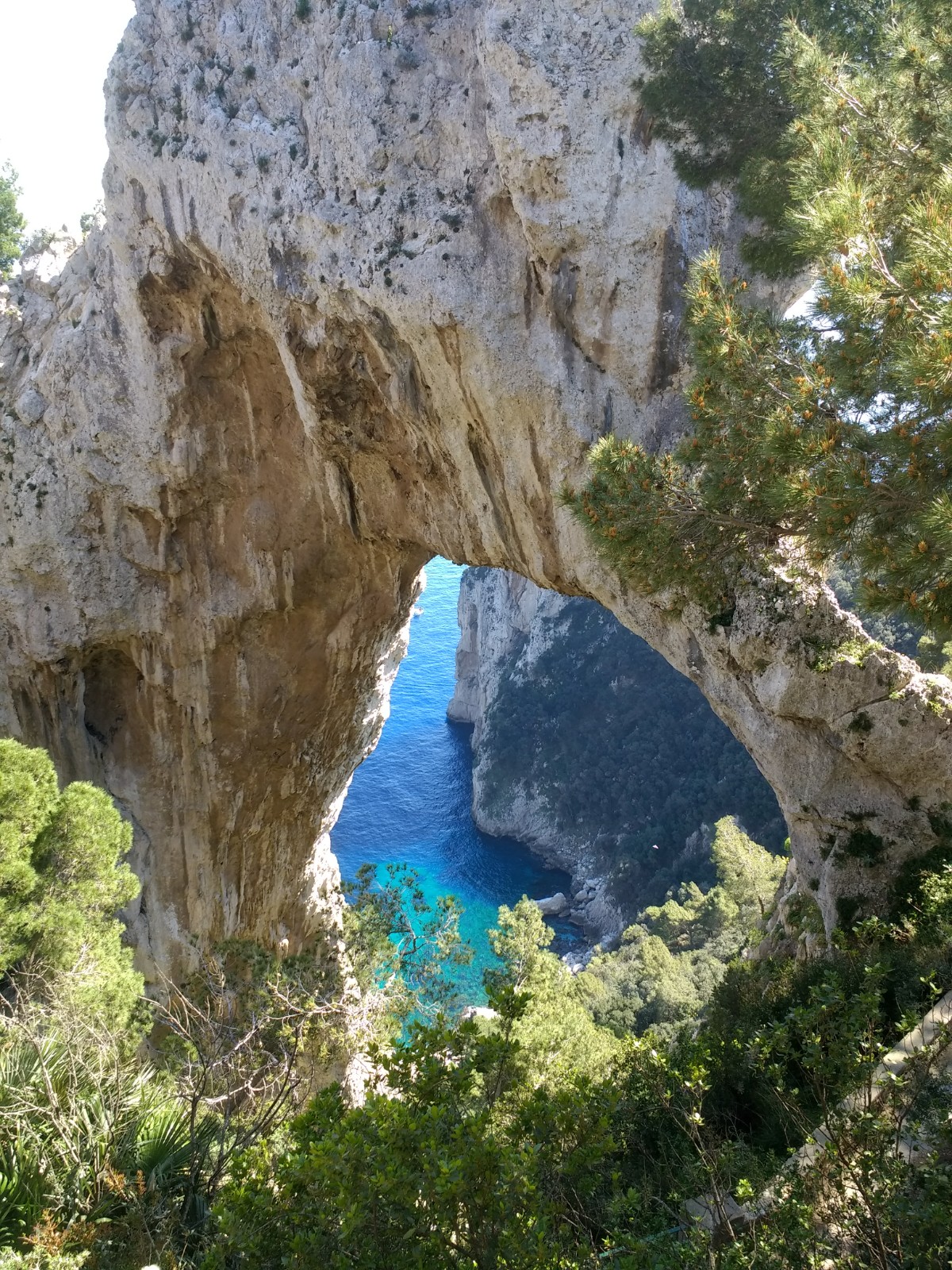
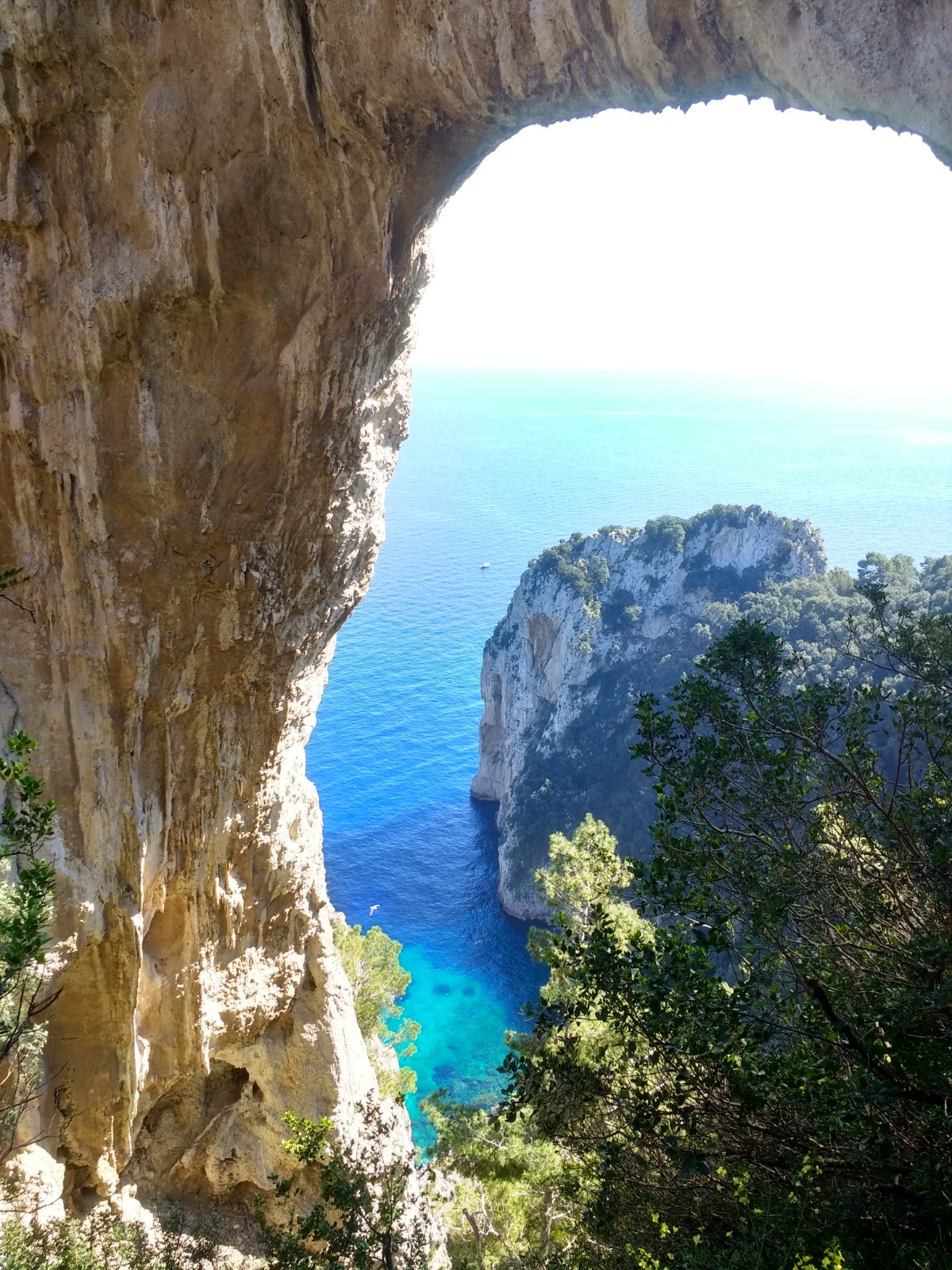
From there, we walked on to the Arco Naturale, a natural arch of limestone standing eighteen metres high next to the cliff face. The views were stunning.

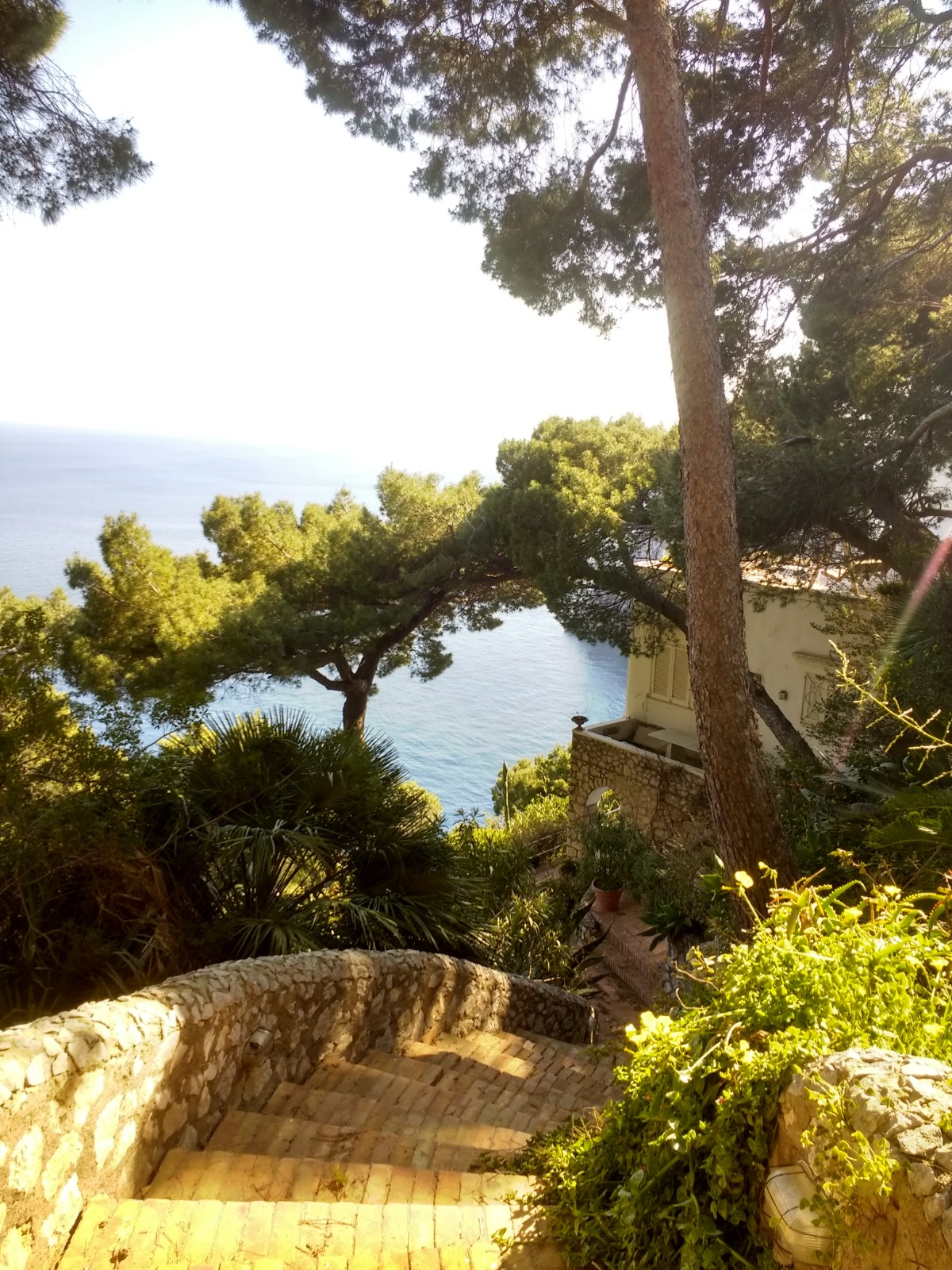
We then took the long coastal path, with many up and down sections, back to Capri Town.

Lots of steps
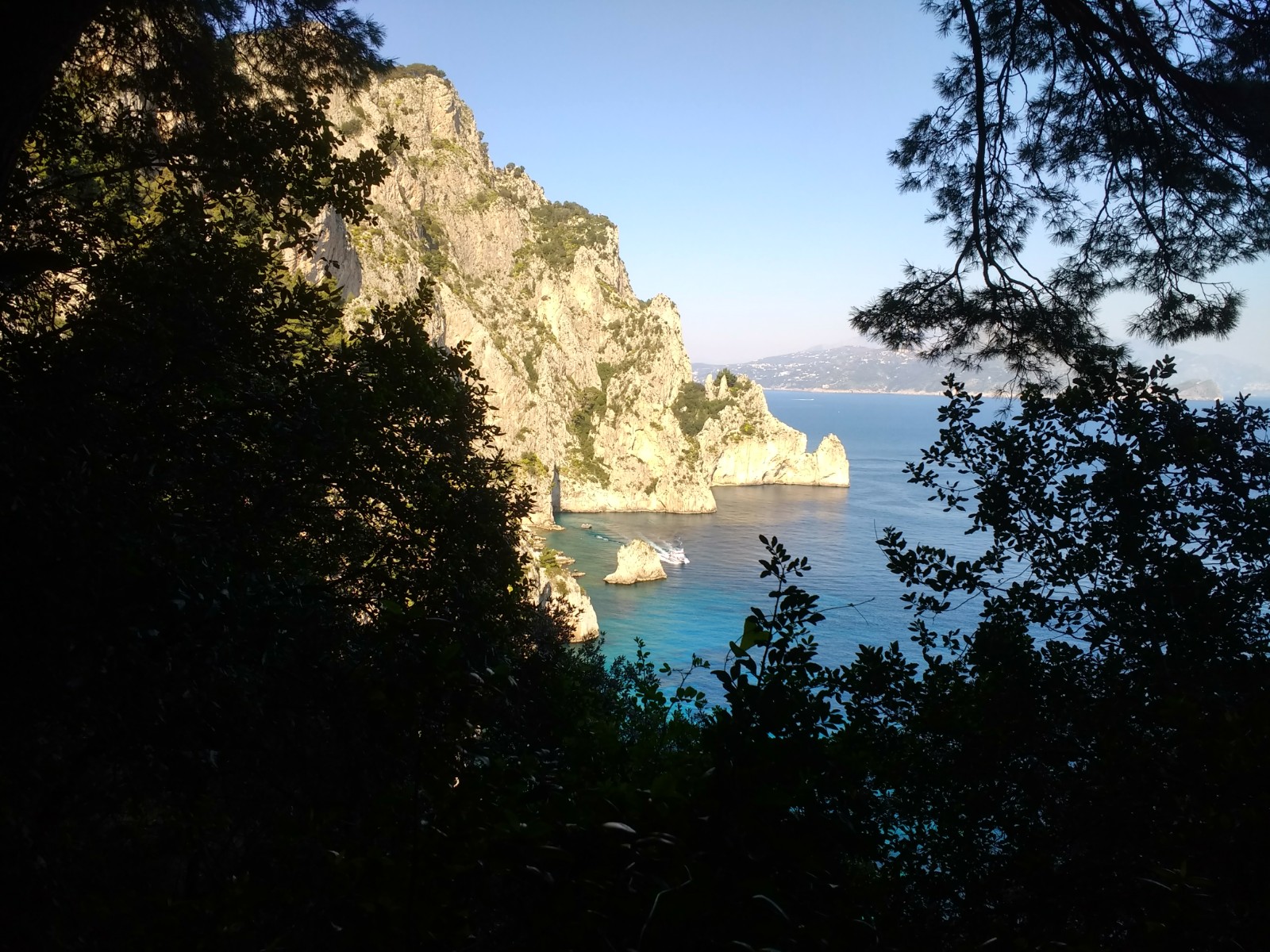
View from path back to Capri Town
Another view from the path back to Capri Town
Villa Malaparte

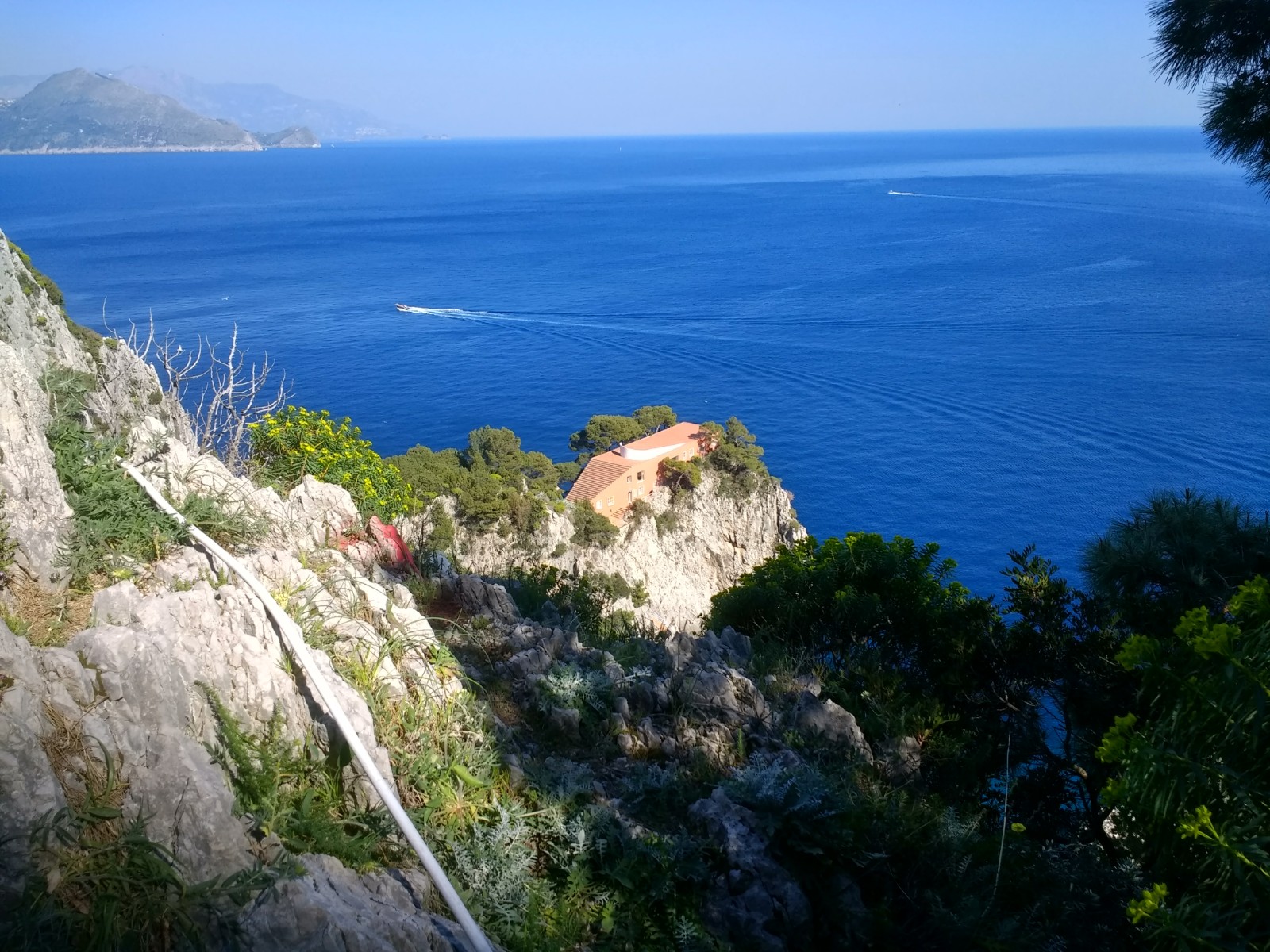
Eventually, we had sight of a very modern-looking house in an isolated position. This was designed by the owner, Curzio Malaparte, in the 1930’s (apparently it is an excellent example of Italian modern and contemporary architecture). A fascist, Malaparte fell out of favour with the Fascist party, and spent time at Villa Malparte under house arrest.

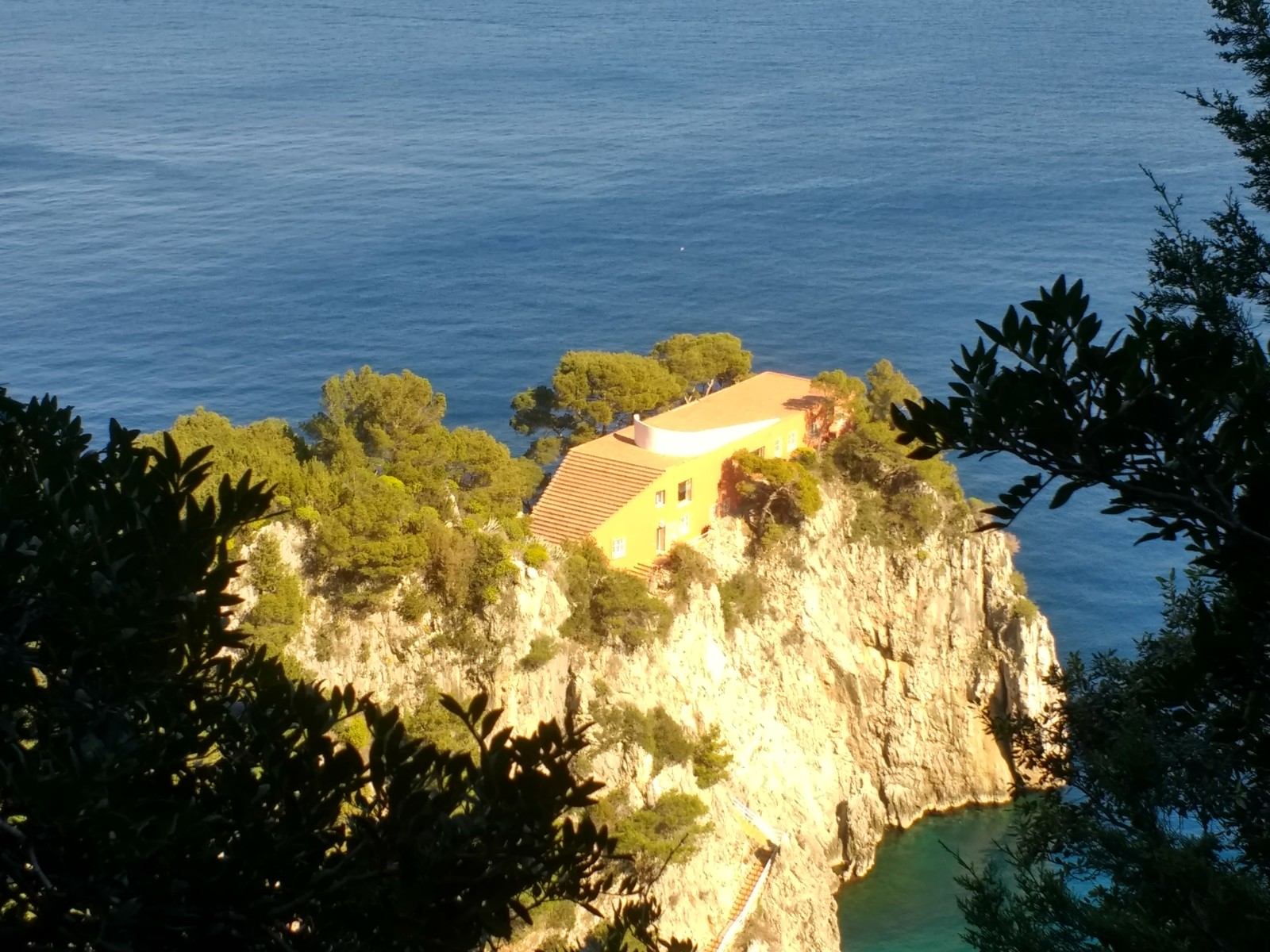
A closer look at the house. You can see the steps, cut into the rock face, rising from the jetty. There are 99 of them.

The house can be reached via a very treacherous looking private path from the path we were walking along, or by boat ‘on calm days only.’ I love the look of the house, but I wouldn’t like to be that isolated.

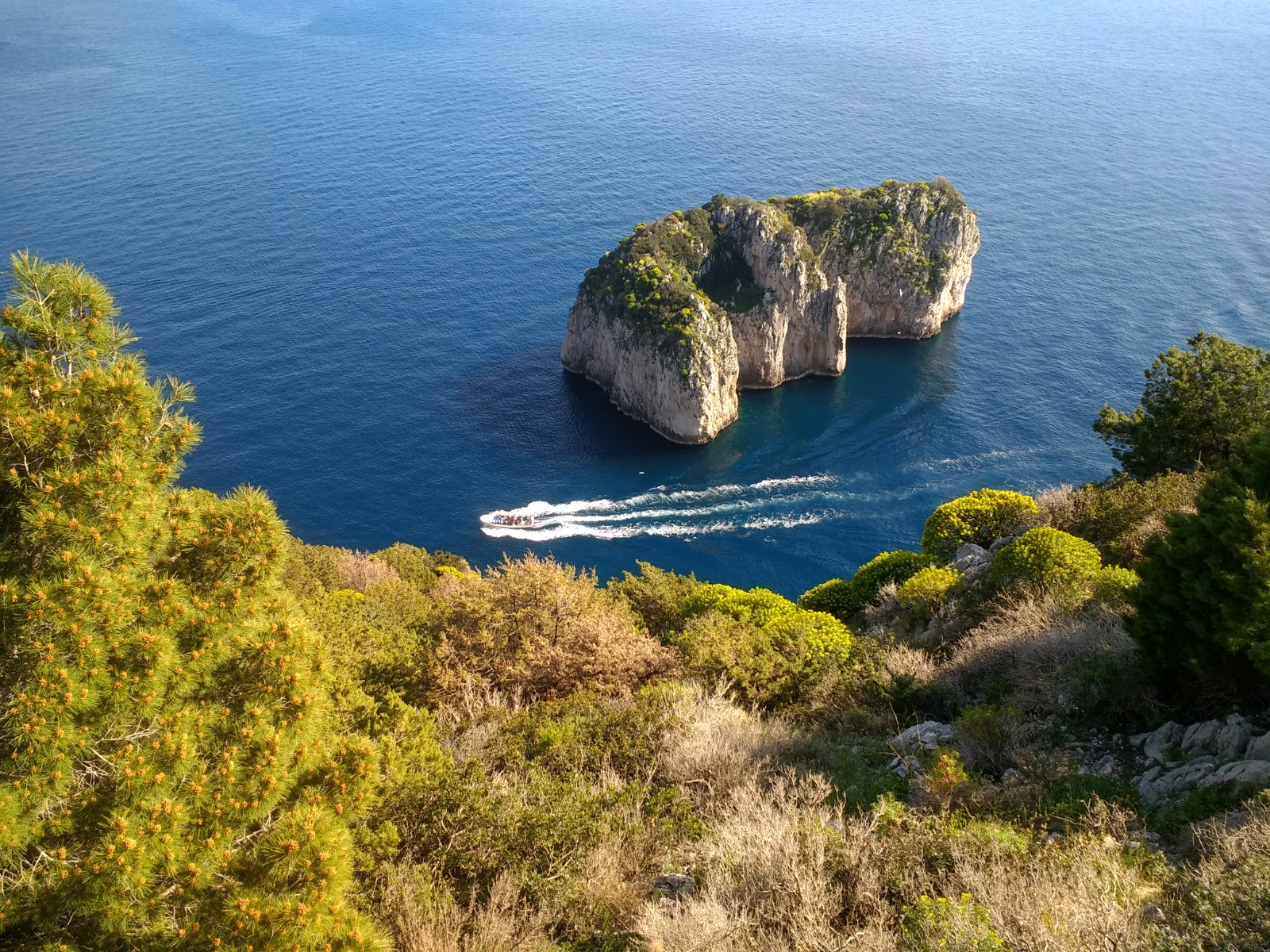
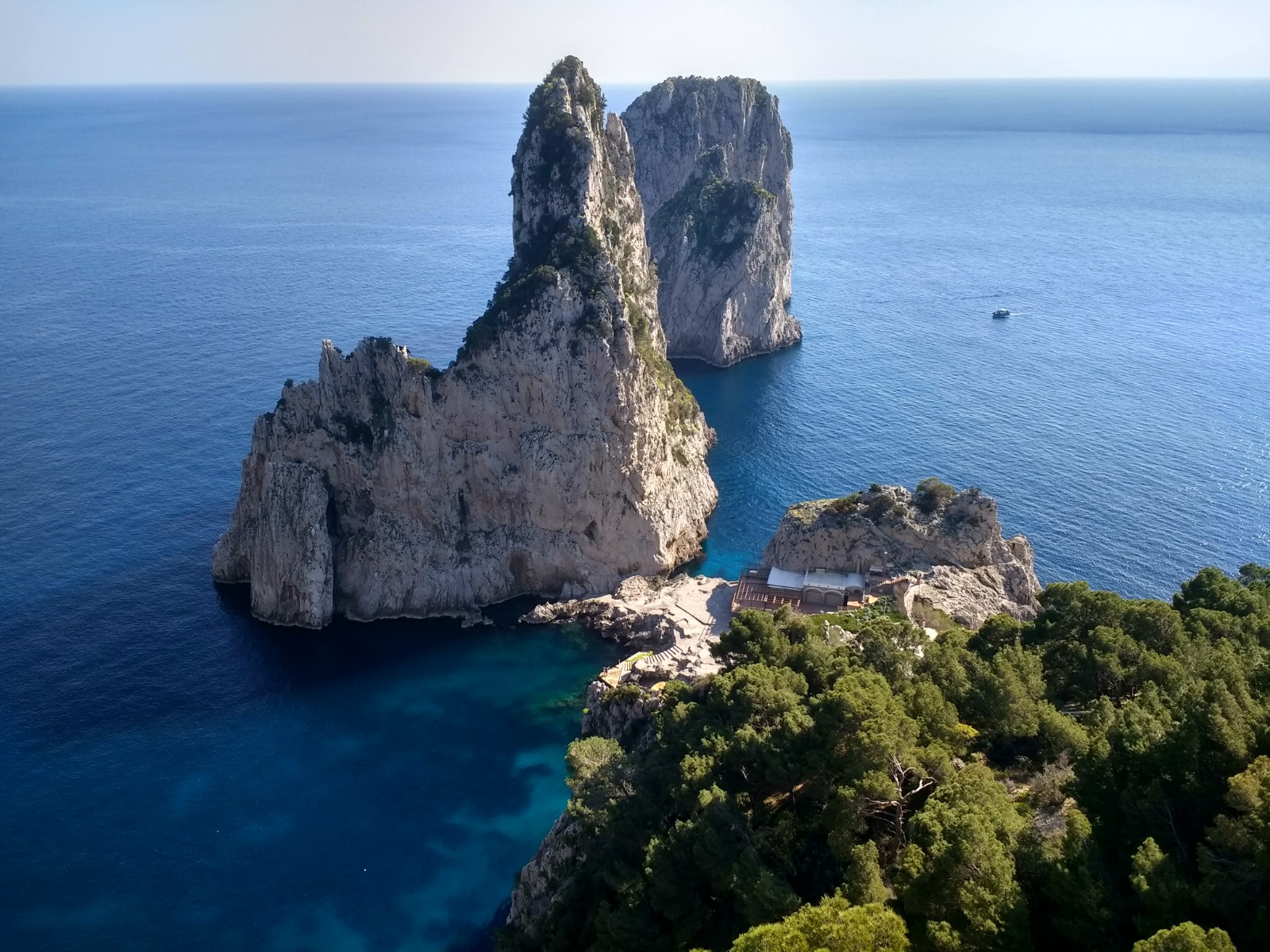
Further on, we had another view of the Faraglioni rocks.

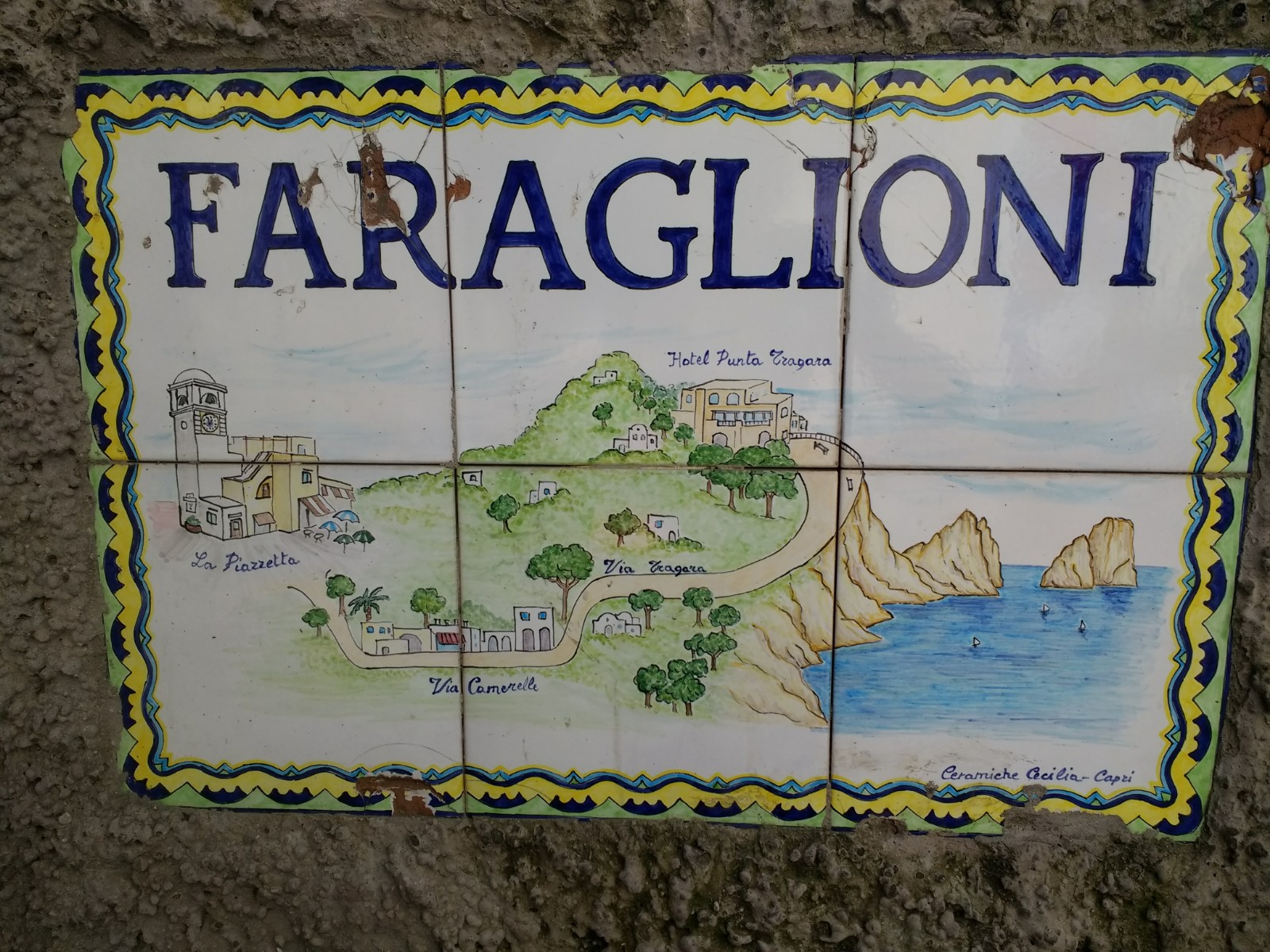
Attractive signs like this, painted on tiles, are all over Capri.
Faraglioni Rocks
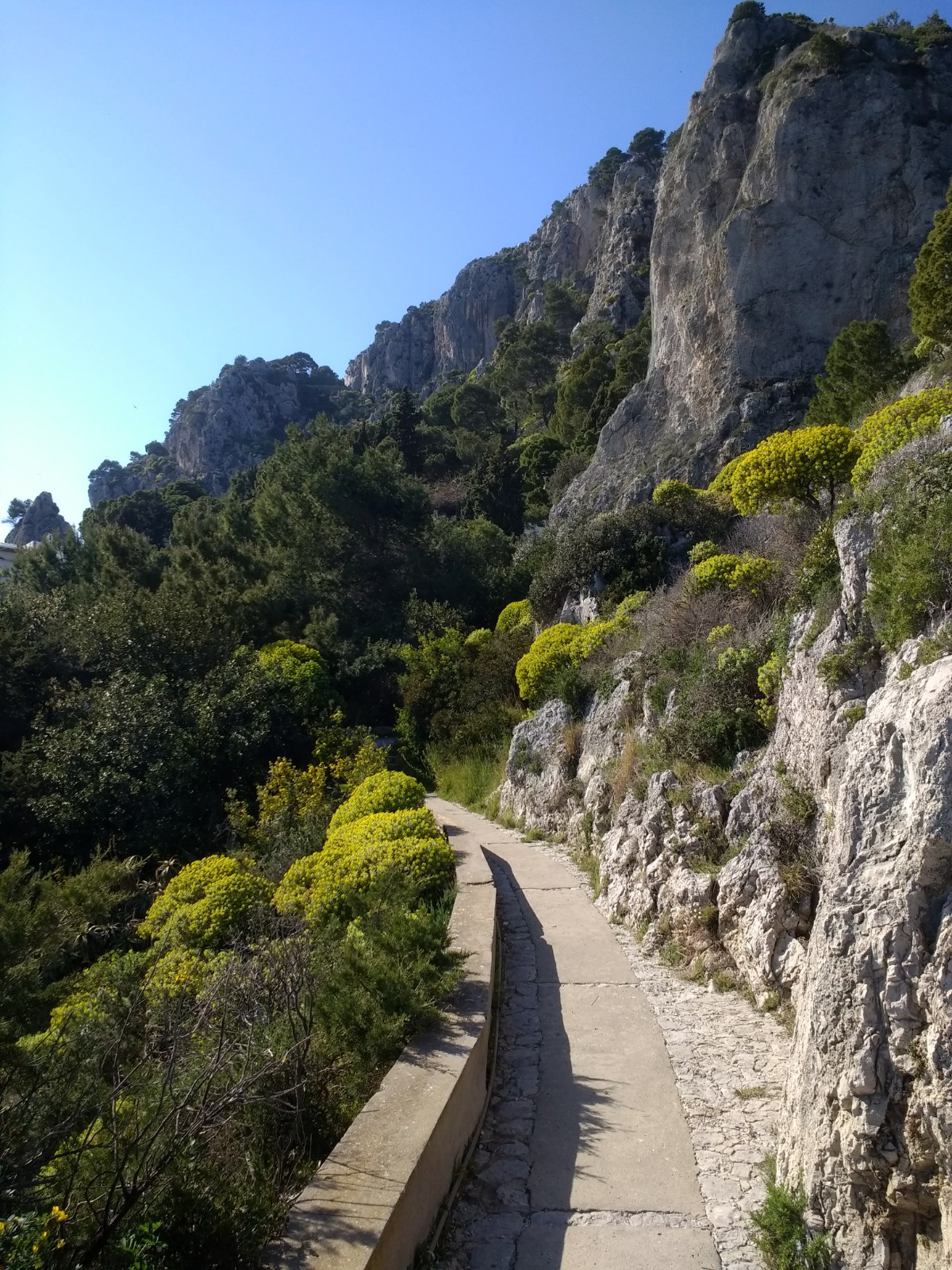
Path back to Capri Town

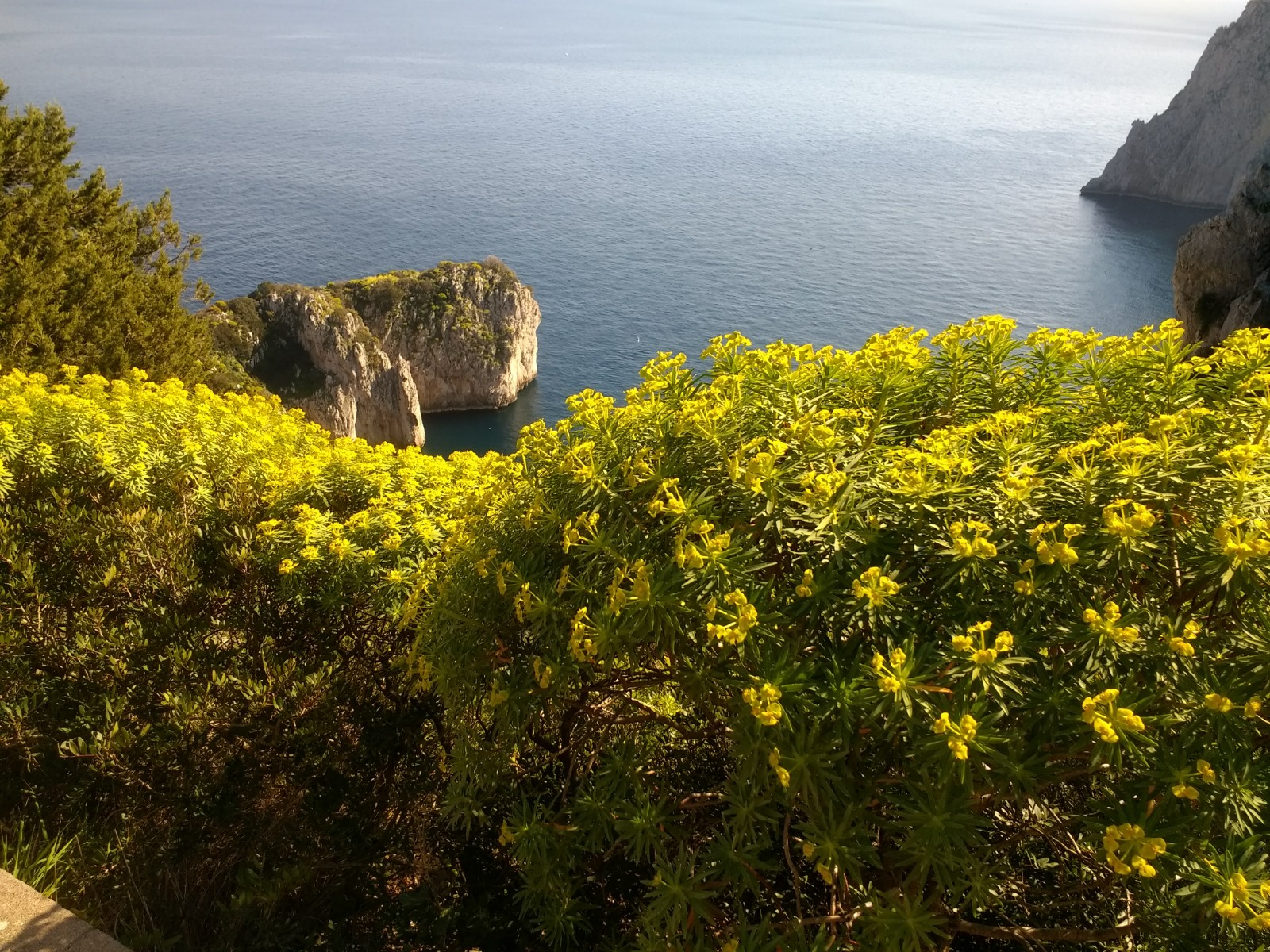
View down
Approaching town

There’s Travelling Light, and There’s Travelling Light …

We climbed Monte Solaro, the highest point on the island, today.

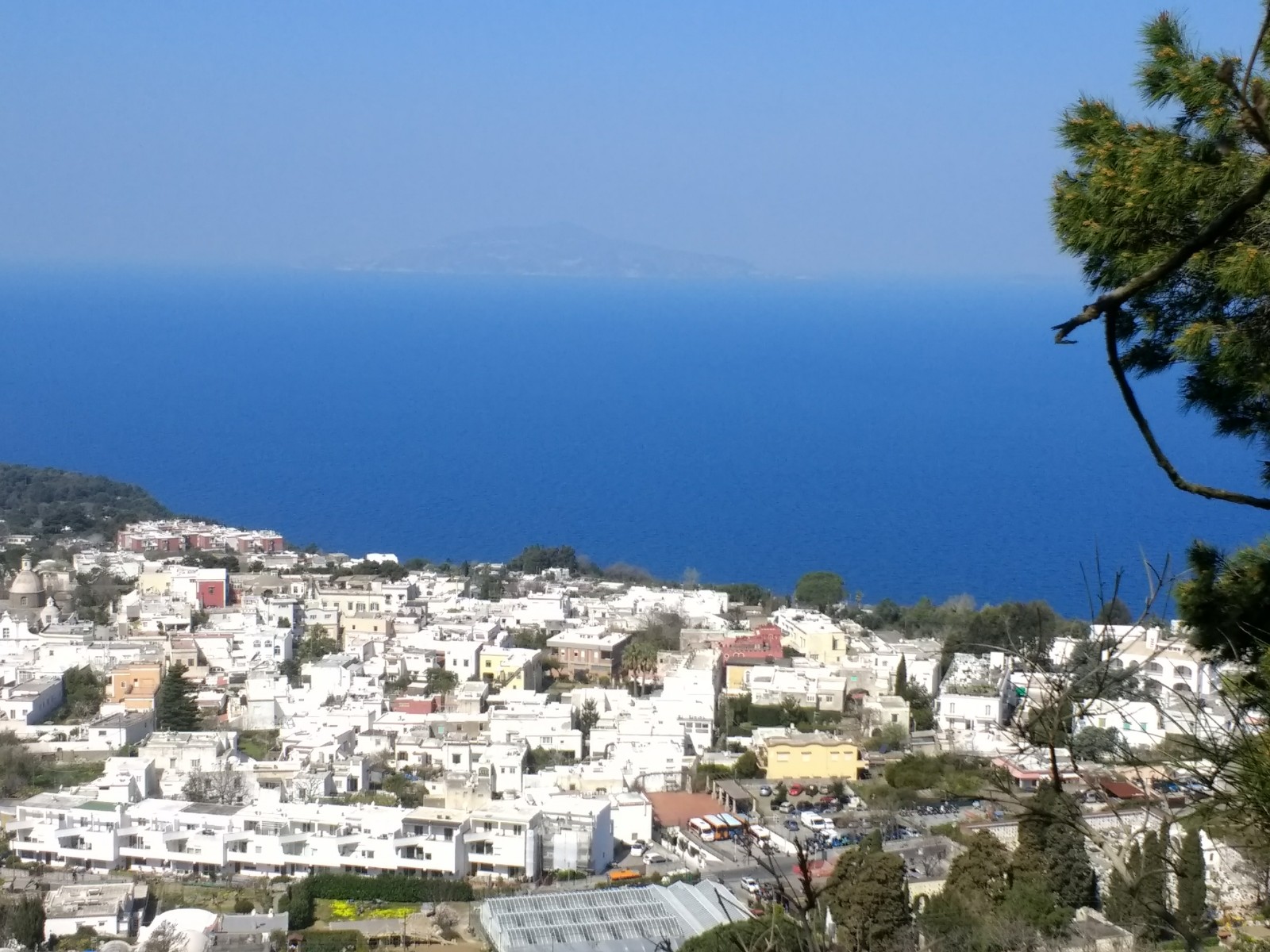
Anacapri from the path up to Monte Solaro
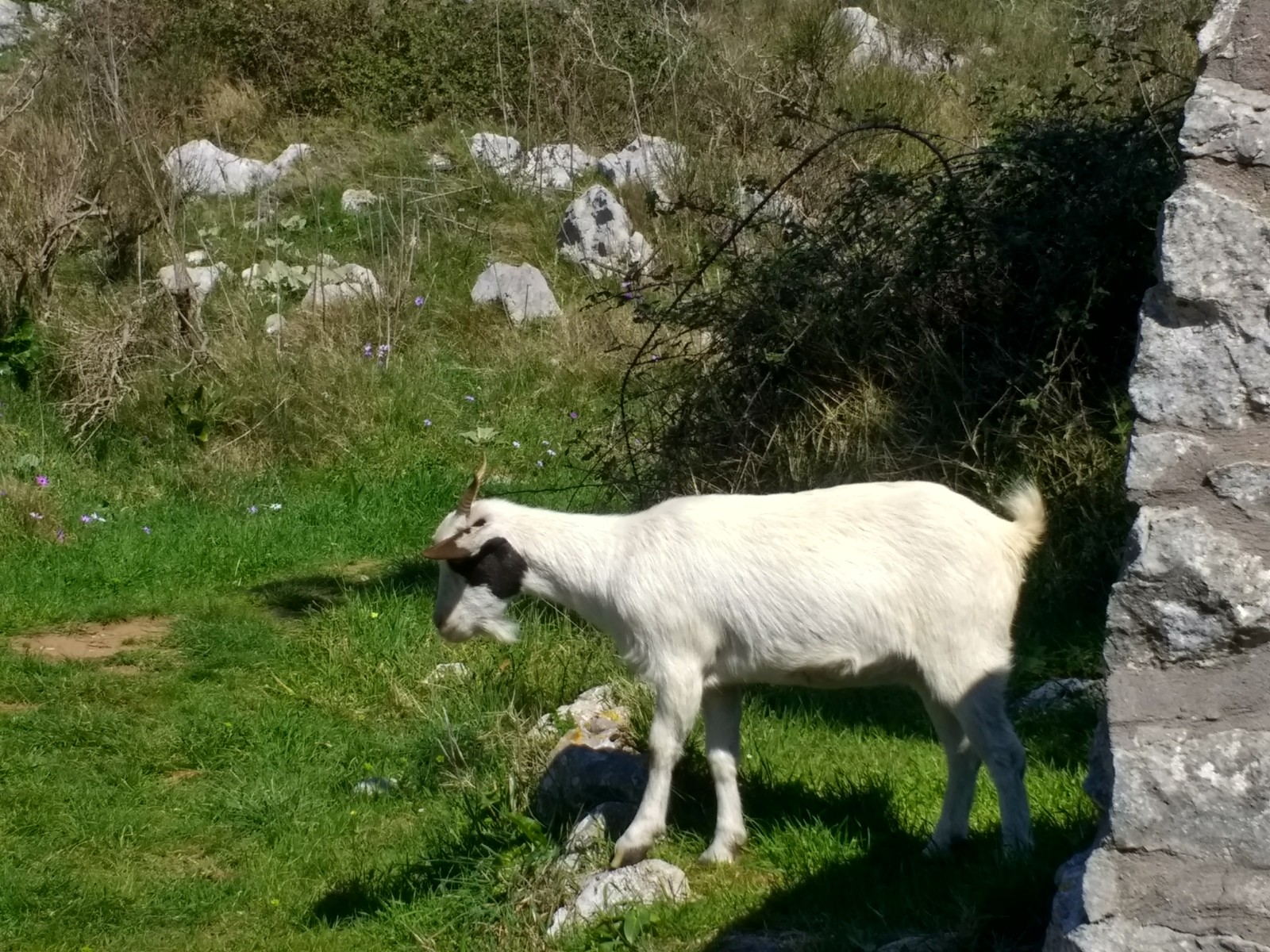
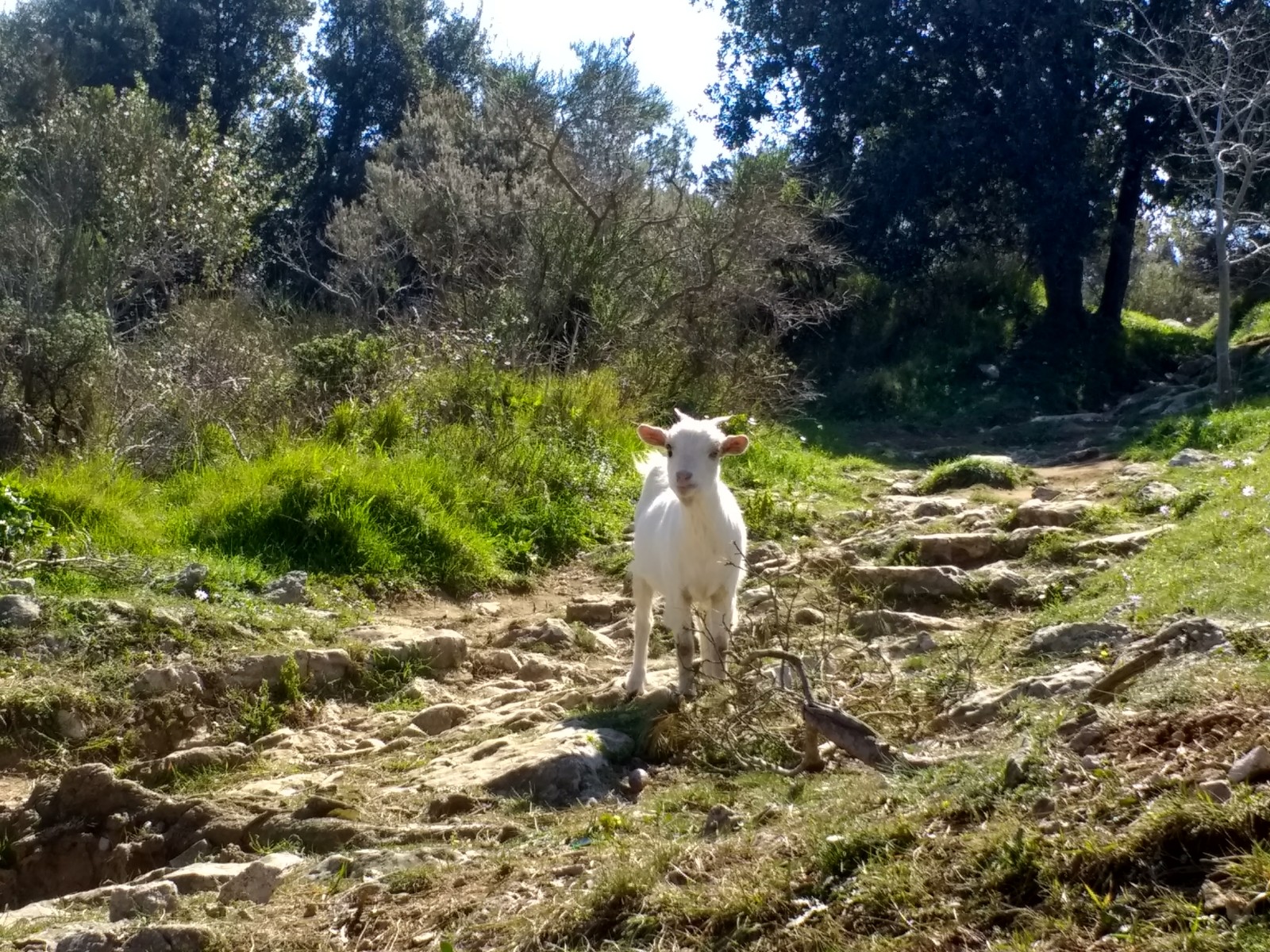
We saw this nanny goat..
with her kid.

At the top we met an Australian couple who are also travelling for a year, but through Europe rather than just Italy. They are also doing Airbnb, but are moving from place to place as the whim takes them, staying for just a few days at a time, whereas we are staying at each place for about a month (to gain advantage from long-term discounts) and have booked ahead as far as August 5.

The other big difference is that they have all their luggage in two large rucksacks while we have two suitcases, a roll-on cabin bag and two medium-sized rucksacks. I don’t know how they can manage with so little, but I am envious of the ease at which they are able to move around.

I have a list of items I consider as essential when staying for long periods abroad.

  • Swiss Army knife (with corkscrew, bottle opener and screw driver)
  • folder of suitable recipes (mainly Italian as I know I can get the ingredients)
  • salt and pepper grinders (the sort that you buy cheaply and are non-refillable)
  • a set of measuring spoons (Airbnb kitchens never seem to have measuring jugs or scales)
  • a good all-purpose knife in its own case
  • apron (for when one of us is cooking)
  • elastic clothes washing line
  • travel kettle (boils enough water for a mug of tea – saves having to heat water in saucepans)
  • cotton-lined rubber gloves (I am allergic to normal rubber gloves)
  • hot-water bottle for winter travel (every place we have stayed in has been freezing for the first couple of days as they have stood empty over the winter)
  • plug in mosquito repellent (the sort you buy tablets for)
  • game for when we have no internet etc. We usually take Scrabble away with us, but even our Travel Scrabble takes up quite a lot of room, so for this trip we have Bananagrams.
  • Chromecast (enables us to watch British TV via the internet on a TV set, provided you are also using vpn)

I wonder what you have on your list of essentials? It would be great if you could leave a comment and let me know.

Anyway, back to Monte Solaro. It was a fairly steep climb up, and I fancied taking the chair lift down, just because chairlifts are fun. We had seen the chairlift stopping and starting most of the way while we were walking up, and we had assumed it was to give them time to load and unload the big containers of water which were being carried on some of the seats.

However, when we got to the top, we discovered that the chair lift is not open until next week and for now they are carrying out tests with the water containers standing in as people.

Oh well. Shanks pony down.

It was just as well as we saw some more goats. The nanny goat was white, and the two kids were black and white, the front half of their bodies were black, and the back half were white. They looked as if someone had held them by their back legs and dipped them in chocolate to halfway up their bodies. Sadly, I didn’t manage to get a good photograph of them.

The shops and restaurants that were closed when we arrived on Capri are now opening up for the end of March. Over the last few days we have noticed that the activity is getting more frenetic. Having let the places get dusty, dirty etc over the winter it seems as if people have just realised the tourist season is just round the corner and are now busy with the paintbrush and broom.

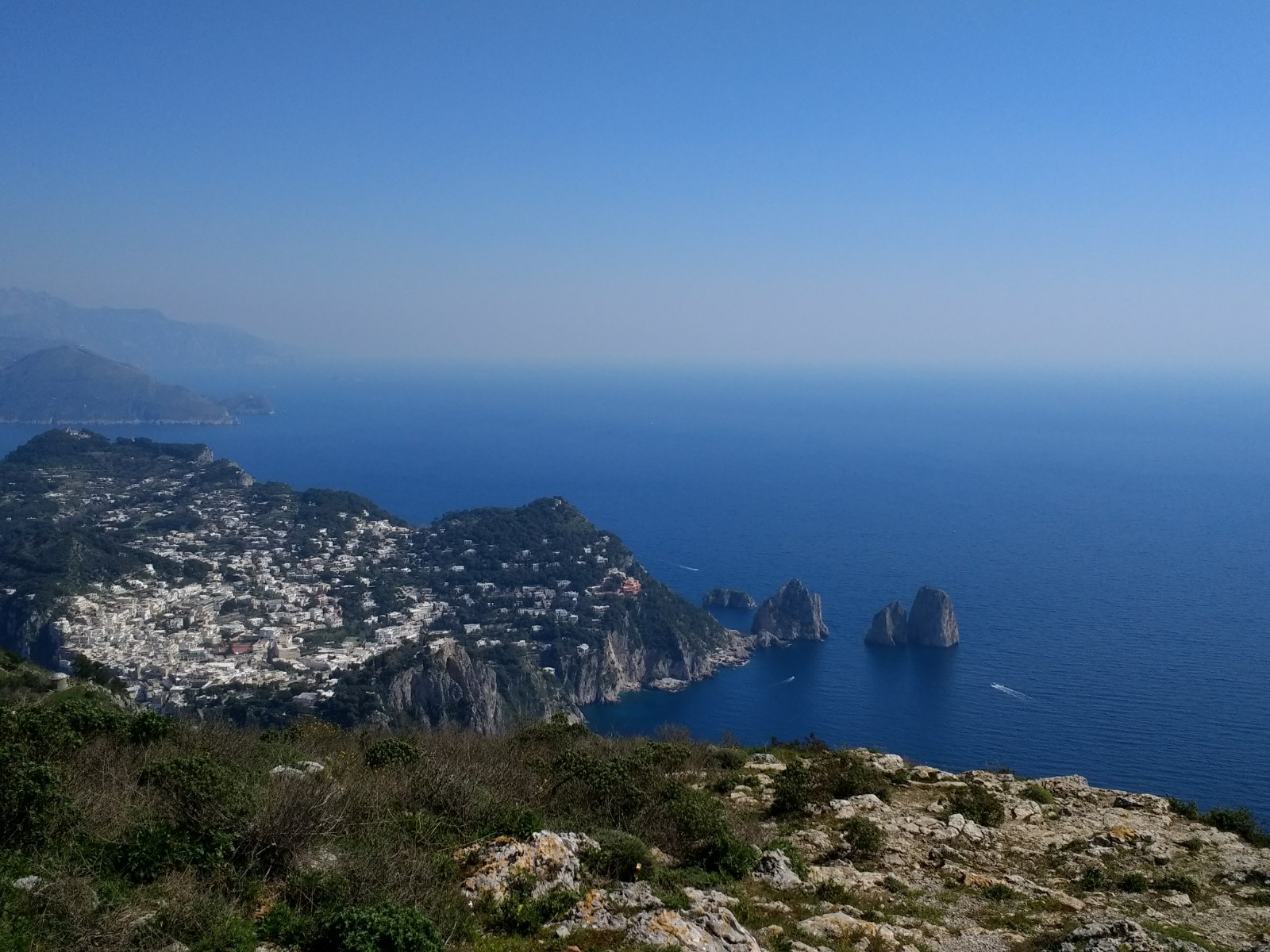
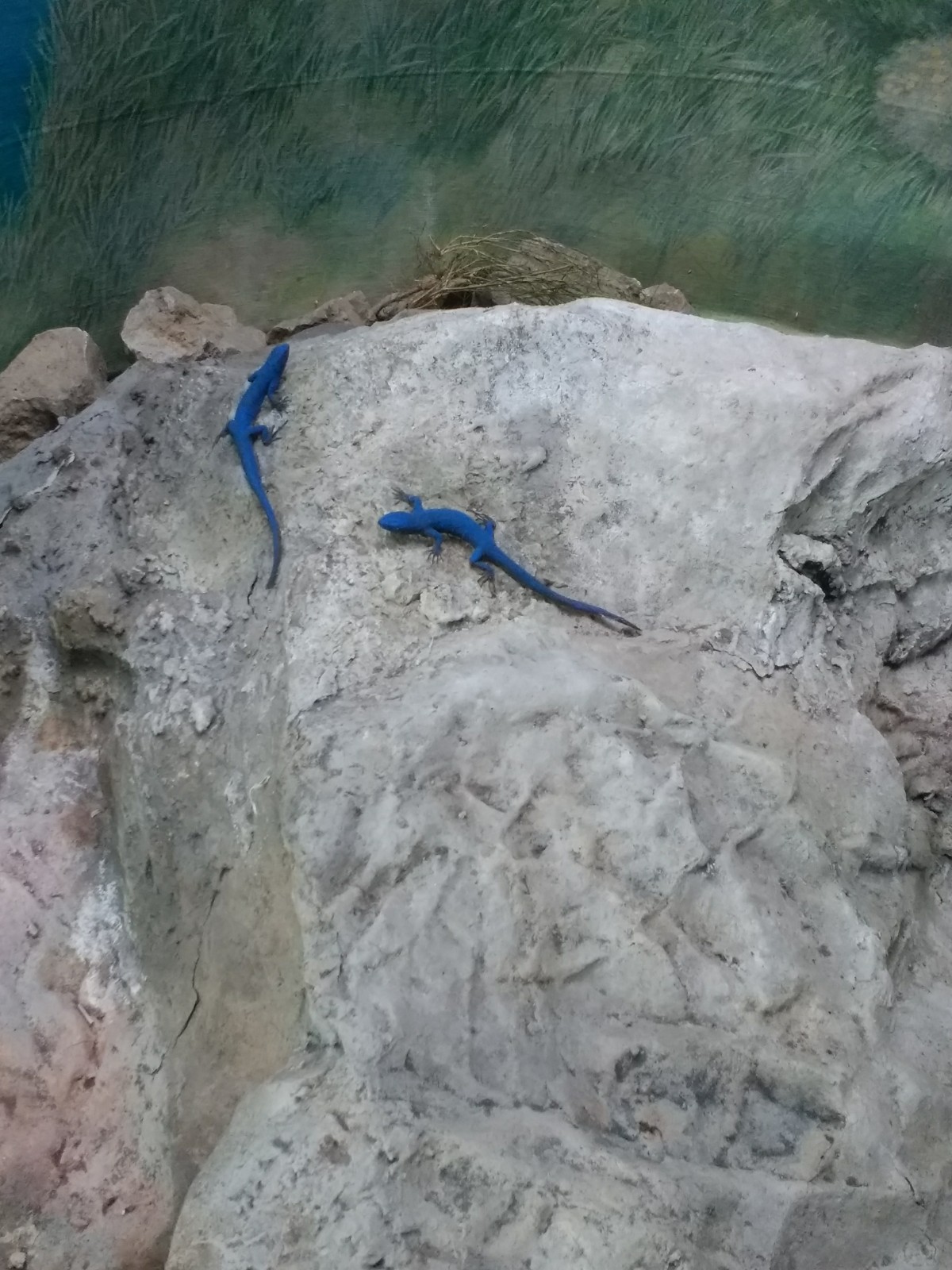
Lizards and butterflies are also coming out of their hidey-holes. The lizards here are green or green and brown, but on the farthest of the Faraglioni rocks, the same lizards are blue, to match the azure blue if the sea.

Faraglioni Rocks from Monte Solaro


Models of the blue lizards