The Benefits of Buffalo

When two entrepreneurial couples moved to Laos for a year out of their busy lives, little did they expect they would start up together in a completely new venture.
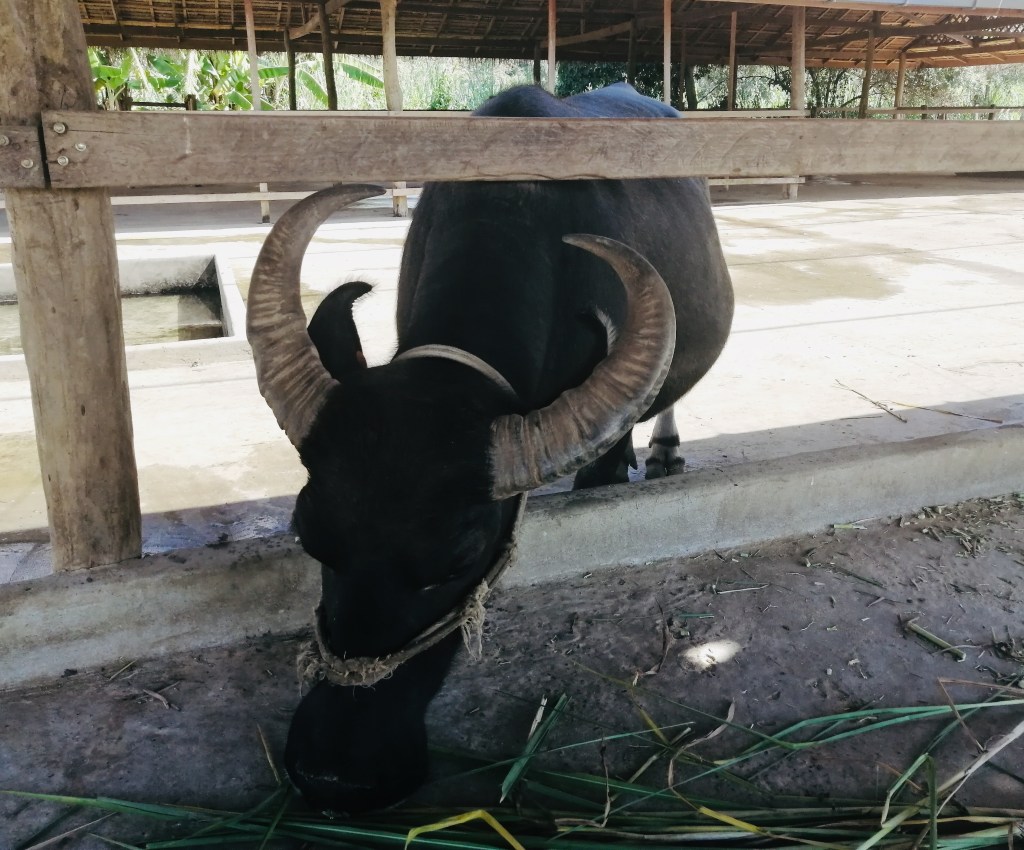
A pregnant buffalo

Cheese-loving Rachel O’Shea and Susie Martin asked for buffalo curd one day (a favourite from time spent in Sri Lanka) but were met with blank looks, there being no concept of milk-based products in Laos (It is too hot for dairy cows). Buffalo were kept to work, to fertilise the land and for meat, but had never been milked. In fact, when Rachel and Susie spoke of yogurt, people thought it came from fruit (a sensible misconception when you think where coconut milk comes from).
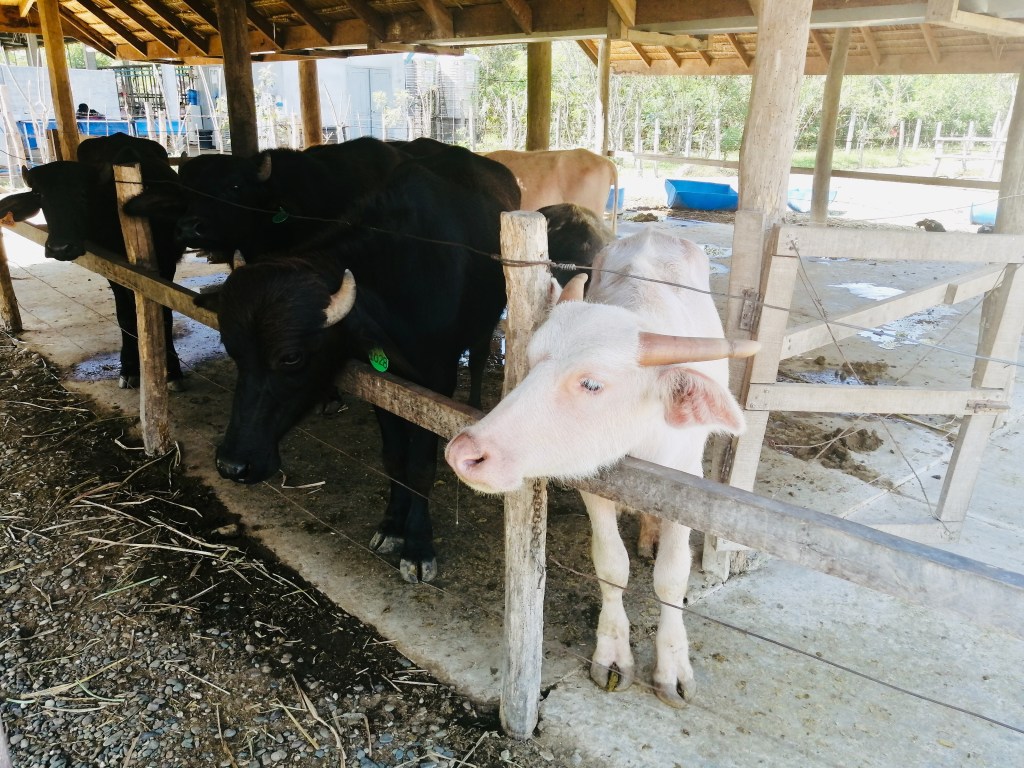
Buffalo calves

Realising that here was a business opportunity, the two women, together with their partners, Matt and Steve, watched YouTube videos on milking buffalo, borrowed some animals and milked them (watched by a large crowd of incredulous locals). Rachel, a chef, then set about turning the milk into yogurt, mozzarella, ice-cream and cheesecake. On being sent samples of the products, hotels in Luang Prabang asked when they could place their orders.
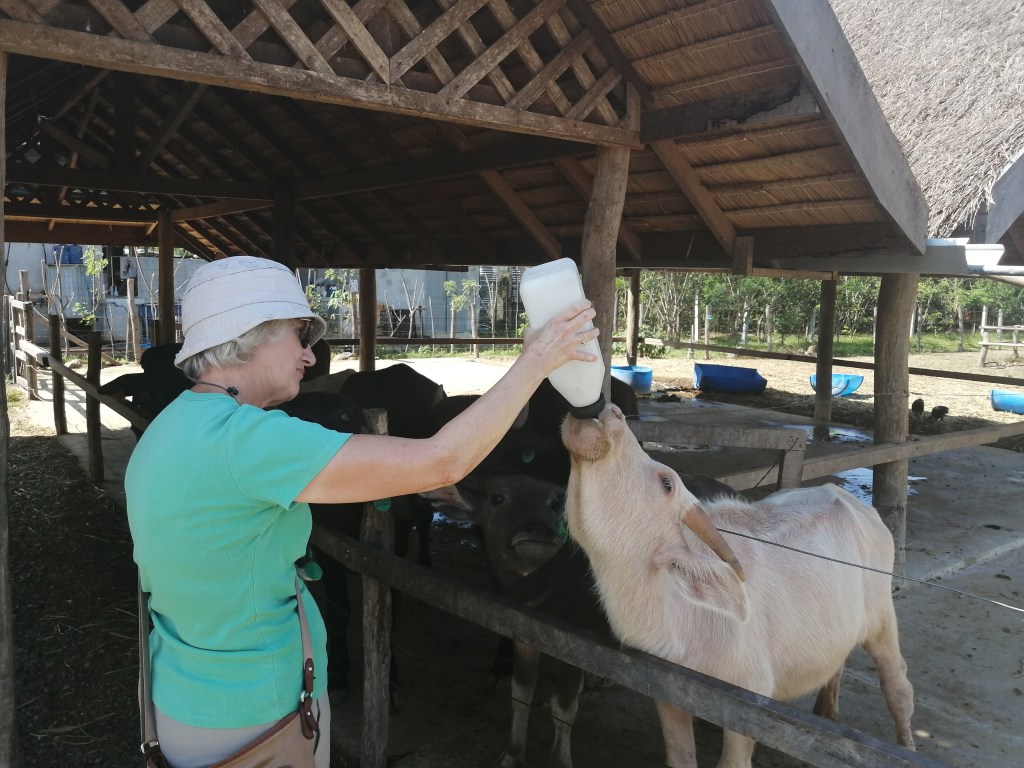
These calves had already been weaned, but our guide was desperate for me to be hands-on (I’d already turned down an opportunity to milk a buffalo).

The business was viable, but the four were keen to not merely provide a living for themselves, but also to help the local community. The local farmers receive rent for the land the dairy uses and a steady income for the use of their buffalo. Pregnant buffalo are looked after by the dairy and milked once a day when the calves are born (to allow the mothers enough milk to feed the calves too). All pregnant buffalo and their calves are vaccinated and returned to the farmers in better condition than previously.
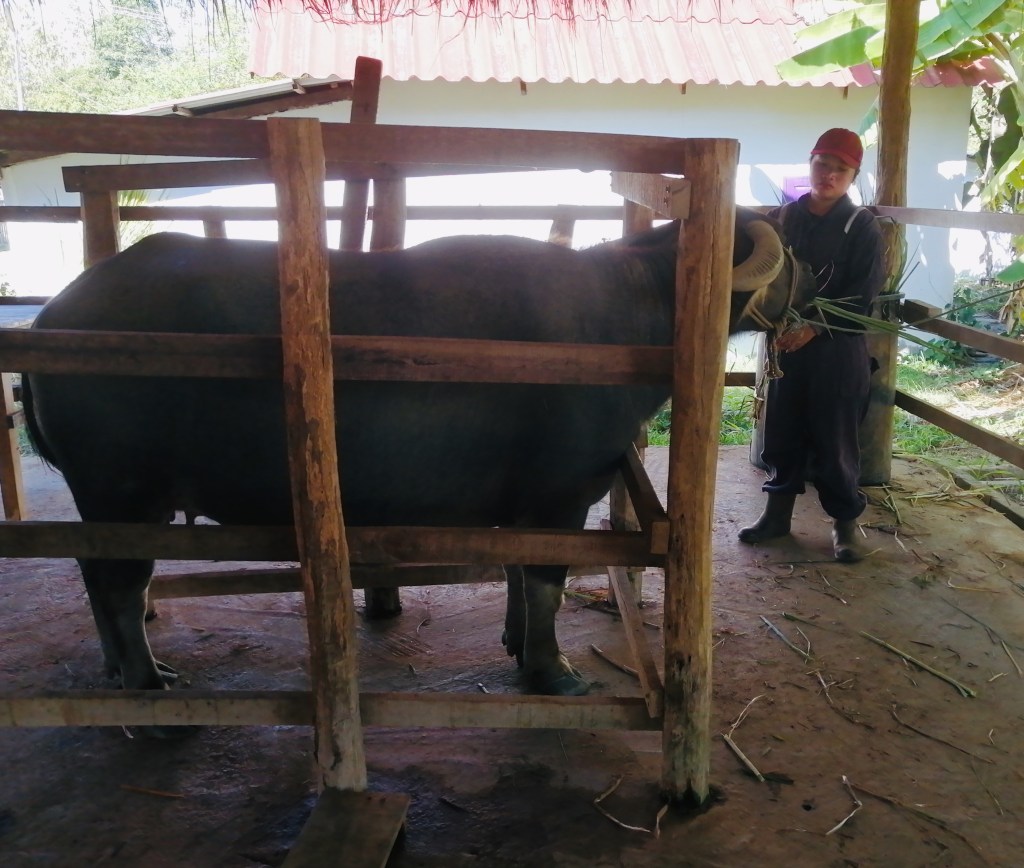
This buffalo had a problem with one of its feet and was put in a crush so the staff could take a closer look.

The staff are taught English (the dairy brings in tourists too) which has led to the local children having English lessons as well.
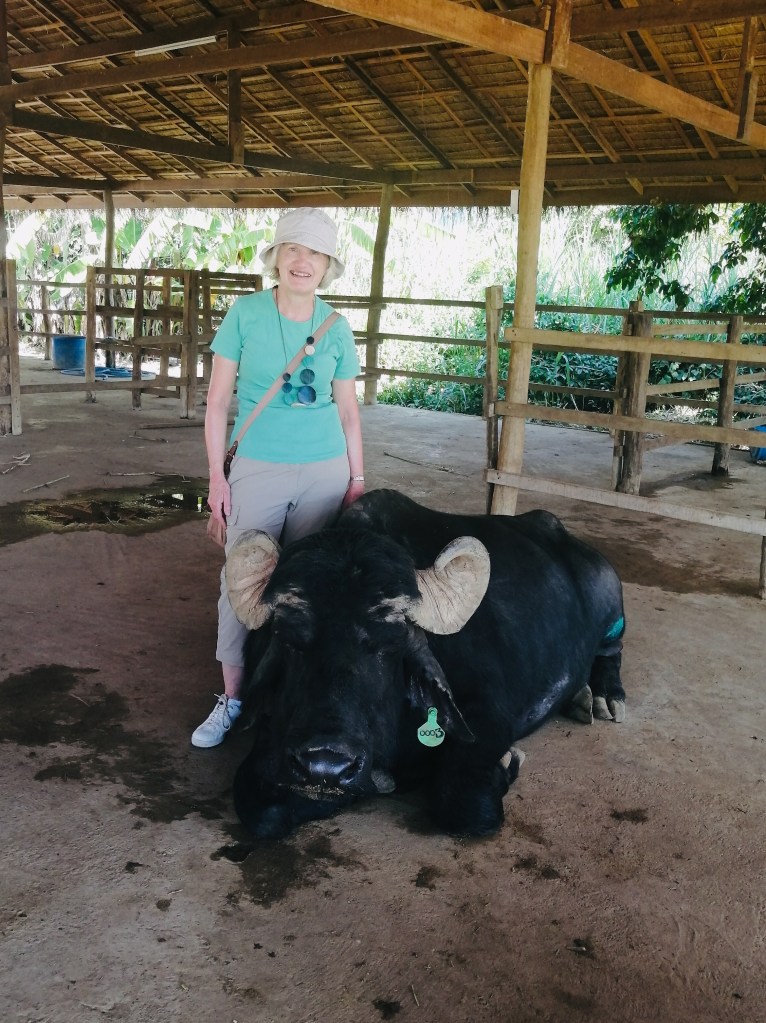
This is Ferdinand, a former stud bull with a sad story. He fell from a female while trying to perform his duties and broke his shoulder. His shoulder has now healed, but he is not as nimble as he once was and now there is a new stud on the farm.

A recent initiative has been to encourage local mothers to add buffalo milk to their children’s rice. Forty per cent of children under the age of two are under-nourished in Laos and buffalo milk is the perfect supplement being higher in protein, lower in lactose and higher in fat than cows’ milk.
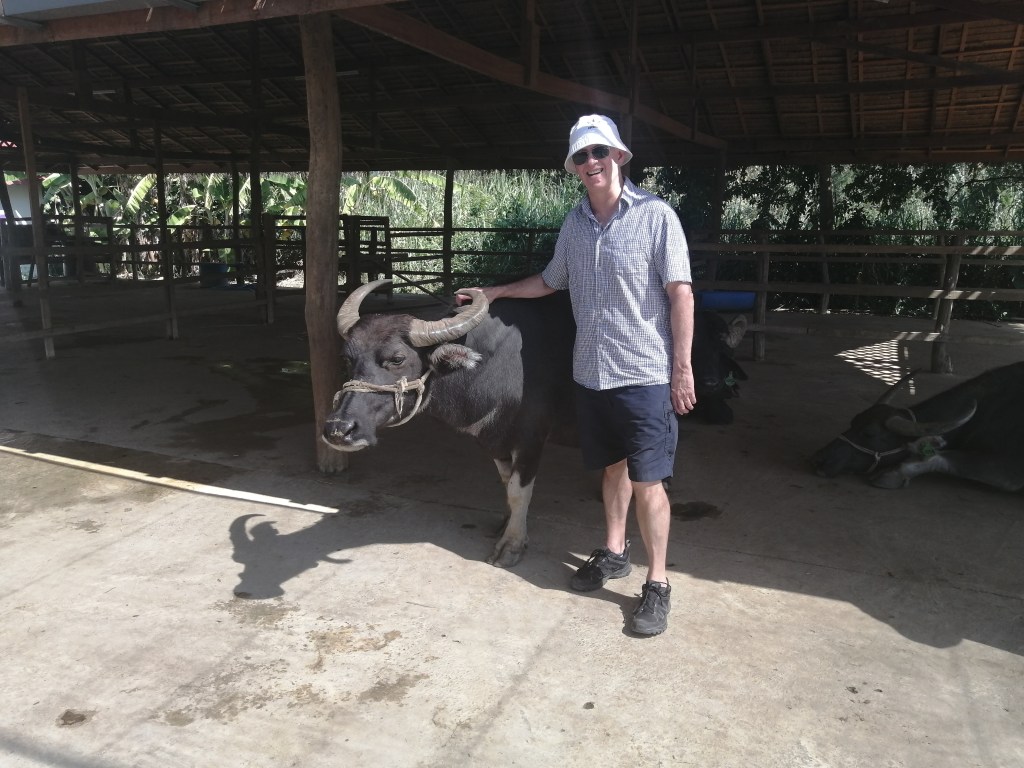
Mark with a new friend

After an extensive tour of the farm we were ready for some lunch in the restaurant and what could be better than tomatoes and mozzarella followed by buffalo ice-cream. The whole meal was delicious, although not quite the same as what we’ve had in Italy.
A Tuk-Tuk Ride From Luang Prabang

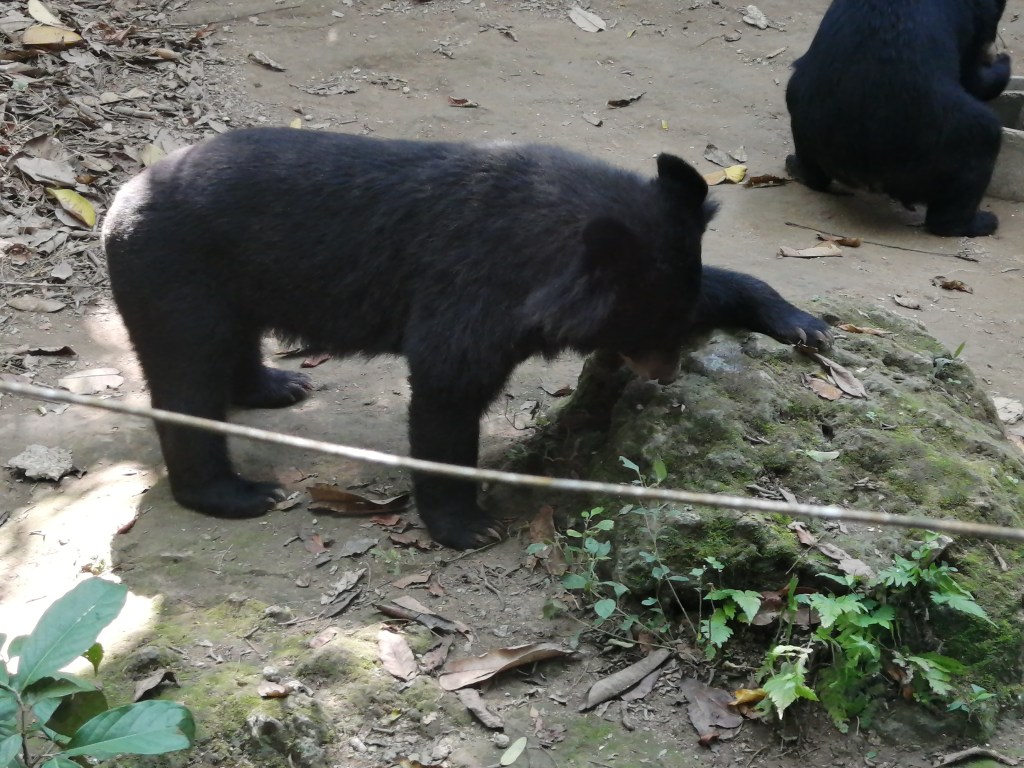
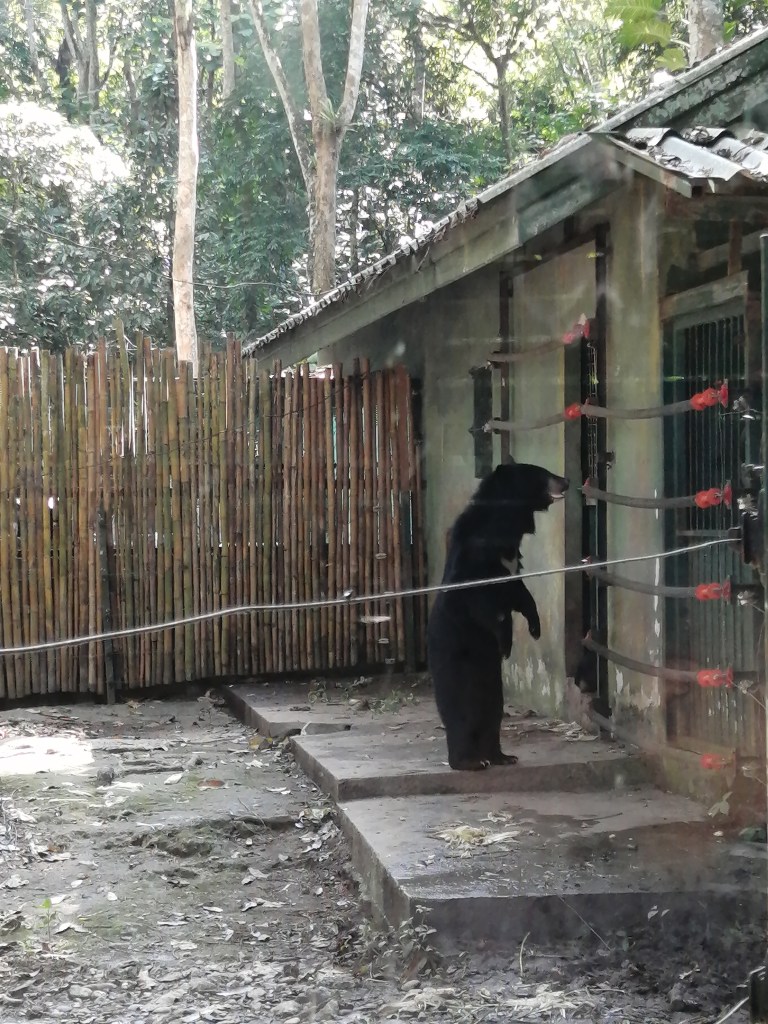
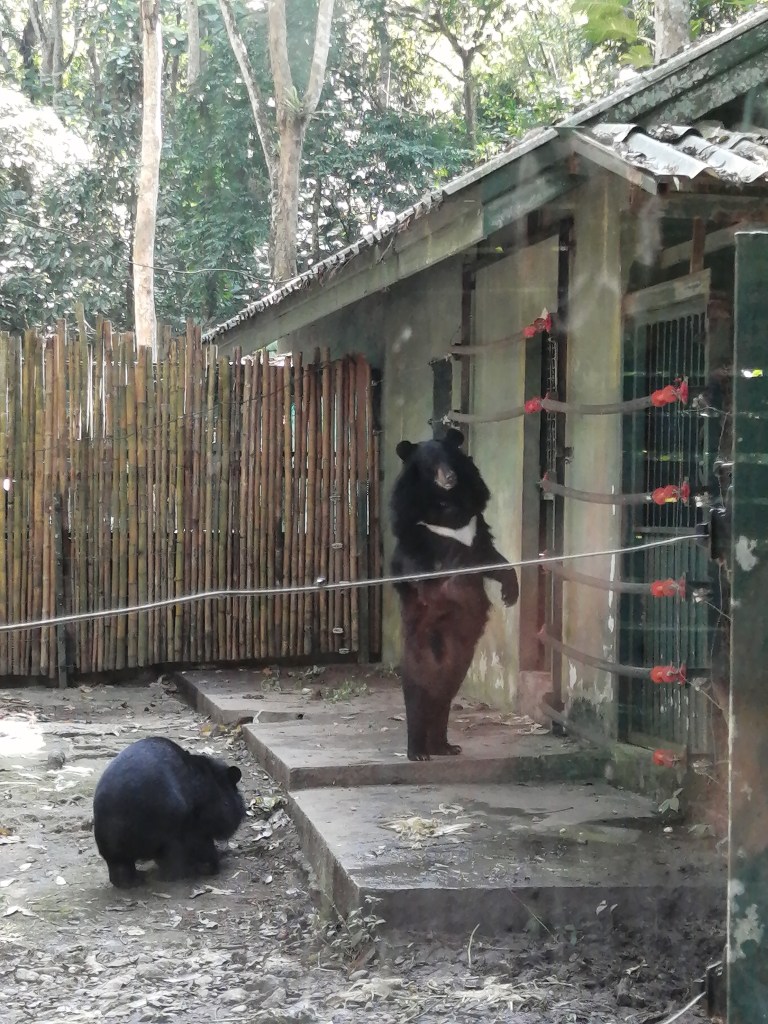
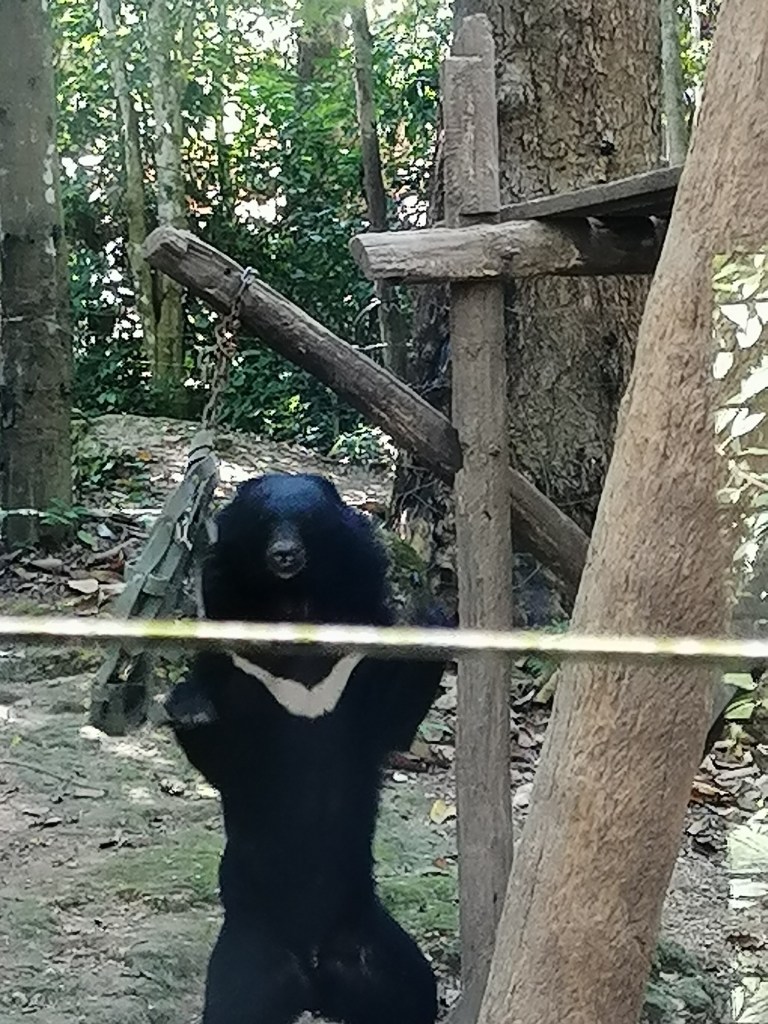
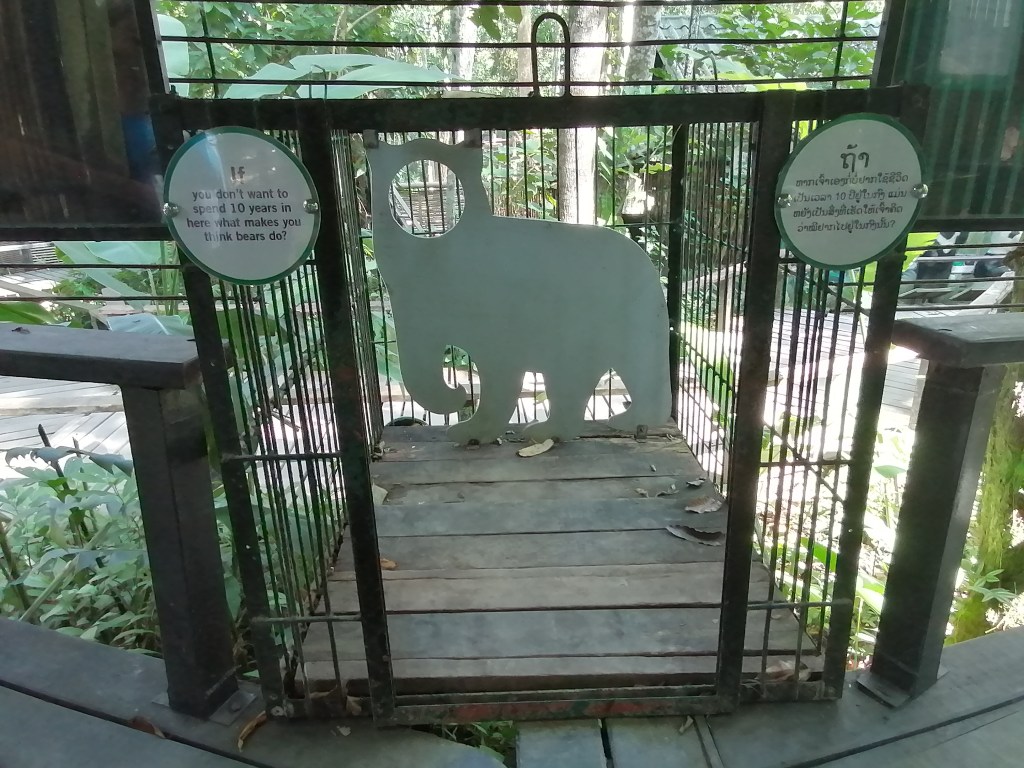
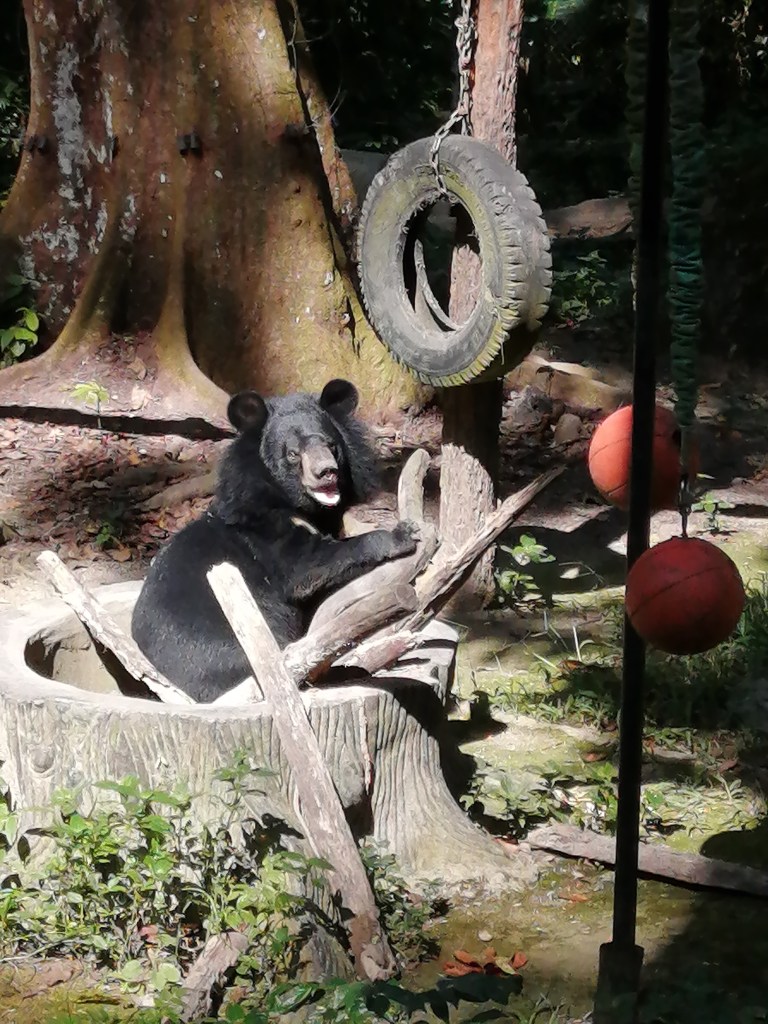
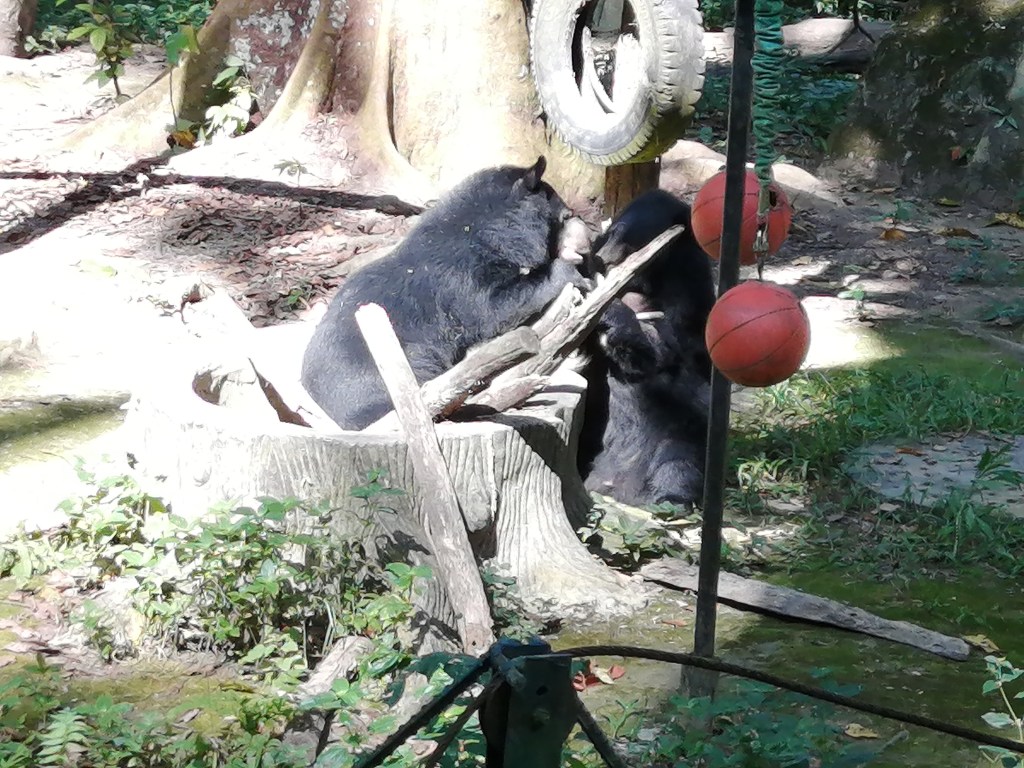
A 45-minute ride from Luang Prabang in a 4-wheeled tuk-tuk took us to Kuang Si Waterfall and Bear Sanctuary. Following a path through the forest, we spent most of our time watching and photographing the bears (Rescued by an Australian charity, Free the Bears, and the government of Laos) in their enclosures.

‘Hello.’
‘Do you want to play with me?’
‘I know there’s some corn here somewhere.’
‘What’s going on in there?’
‘What are you looking at?’
‘Walk like a hu-u-man …’
The sad reality is that there has been a significant decrease in the wild bear population all over Asia as bears are killed for use in traditional medicine. Some bears are kept in small cages so that their bile can be used to treat liver and gallbladder conditions in humans, despite cruelty free alternatives being available.
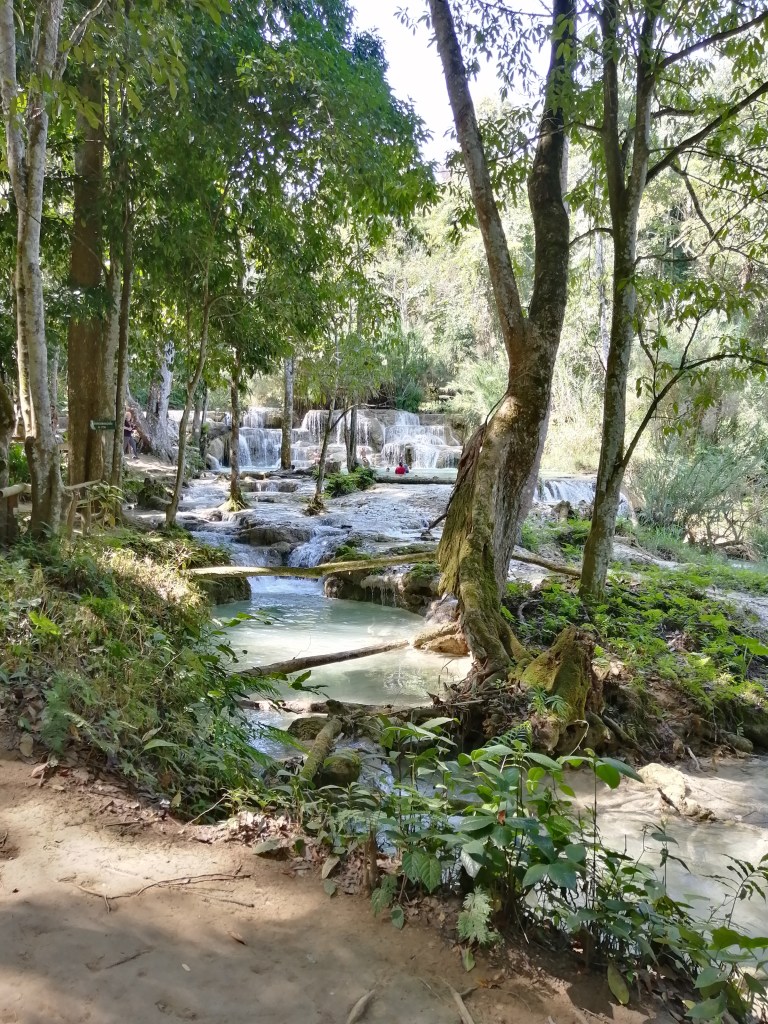
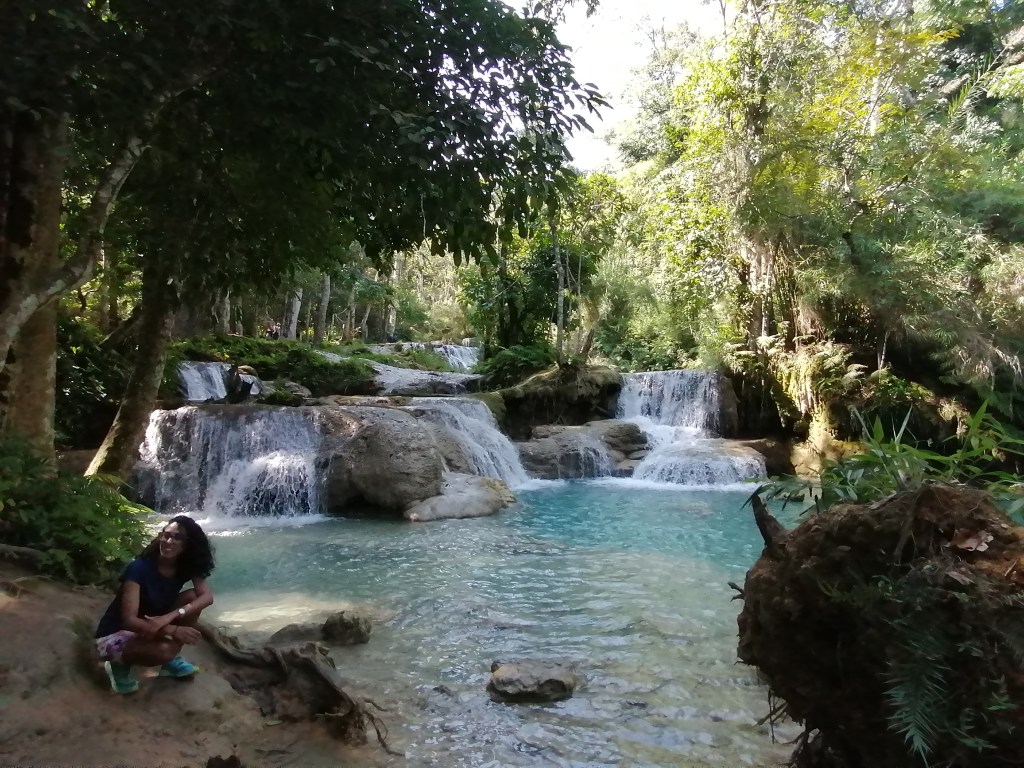
After this, we thought we’d better see the falls. They were pretty and a number of people were bathing in the water.
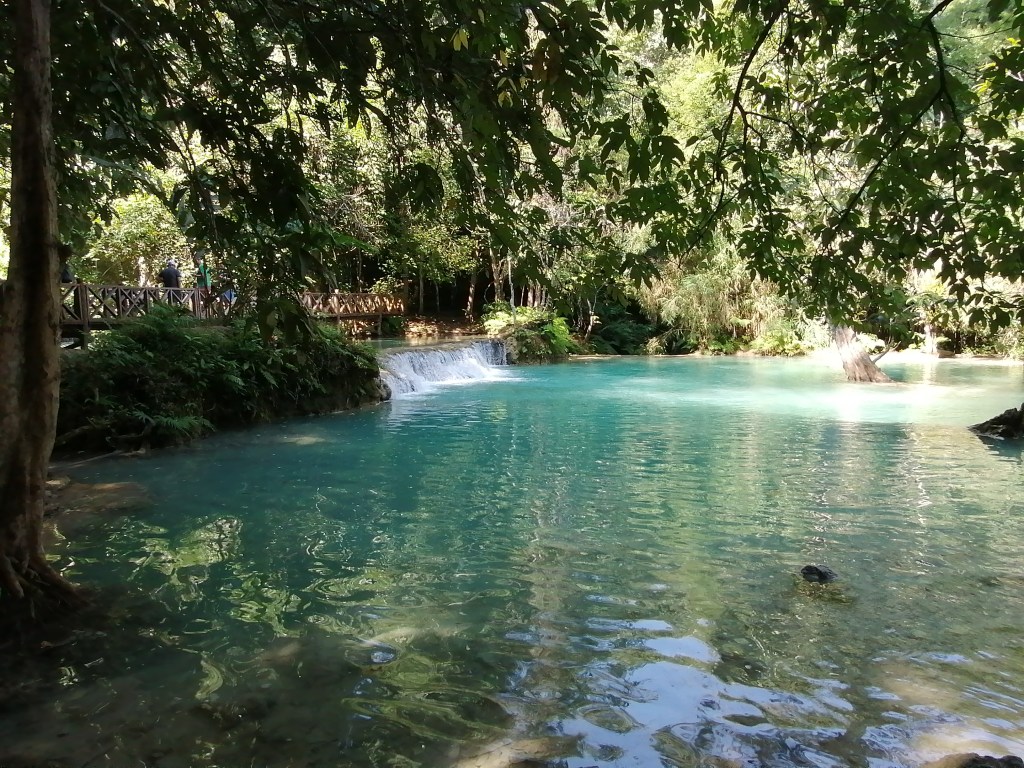
The water was beautifully clear.
Some of the waterfalls have been created, or enhanced, using man-made structures. I can understand the thinking. The falls are a big tourist attraction and a poor country like Laos wants to make the most of them.
Last water picture

On the way back to Luang Prabang, we stopped off at a buffalo farm, but more of that in the next post.

Cruising Down the Mekong Day Two

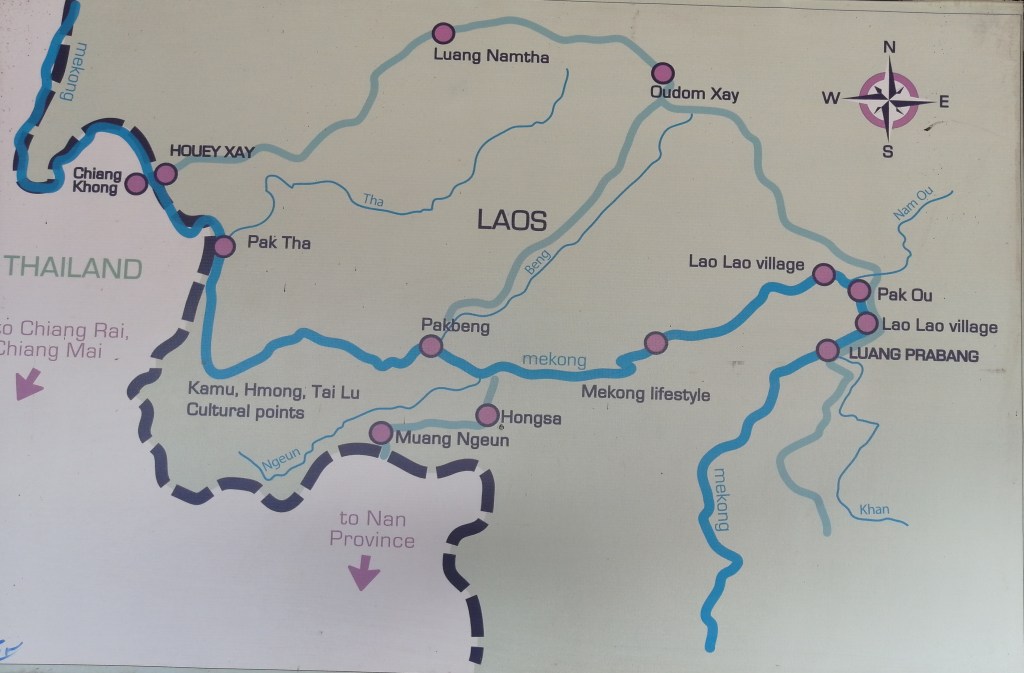
We crossed the border from Chang Khong in Thailand to Houey Xay in Laos on Saturday, then, after boarding the boat, motored to Pakbeng for an overnight stop. From Pakbeng we went to Luang Prabang, our final destination. The trip in this direction is downstream, and slightly shorter than the upstream journey from Luang Prabang to Houey Xay.

We woke up to low level clouds and cool temperatures on Sunday. Boarding the boat early (7.45am) we were glad to make use of the blankets on board.

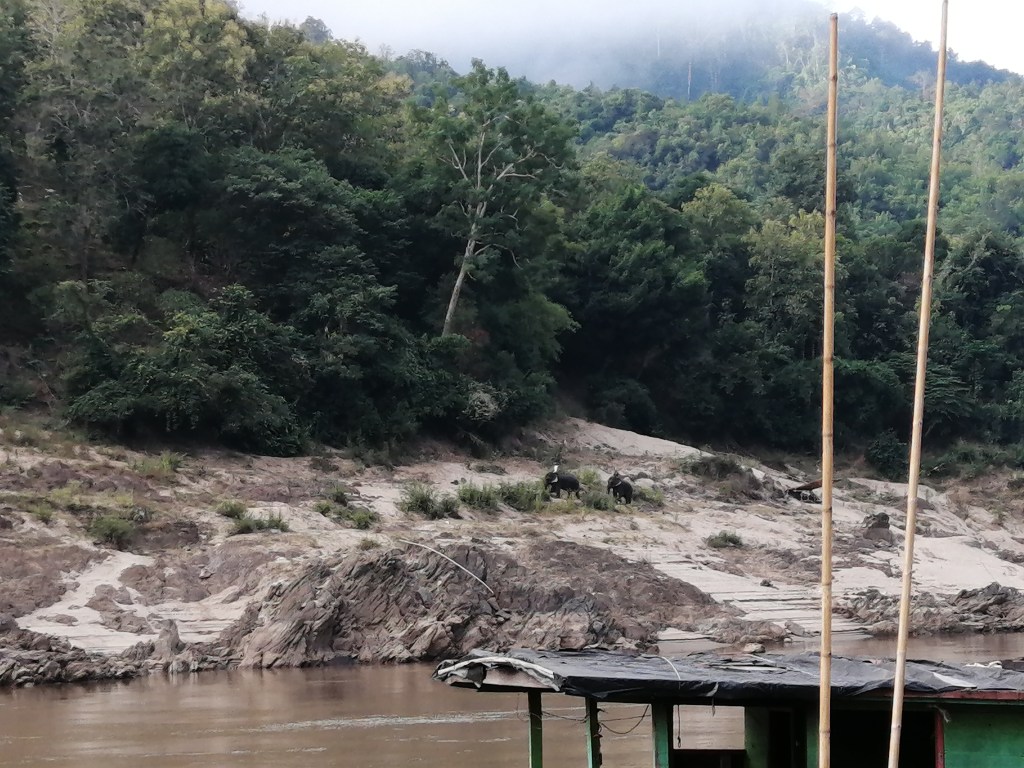
If we’d been happy to get up 45 minutes earlier, we would have seen these elephants from the elephant sanctuary opposite coming down to the river for their daily bathe.
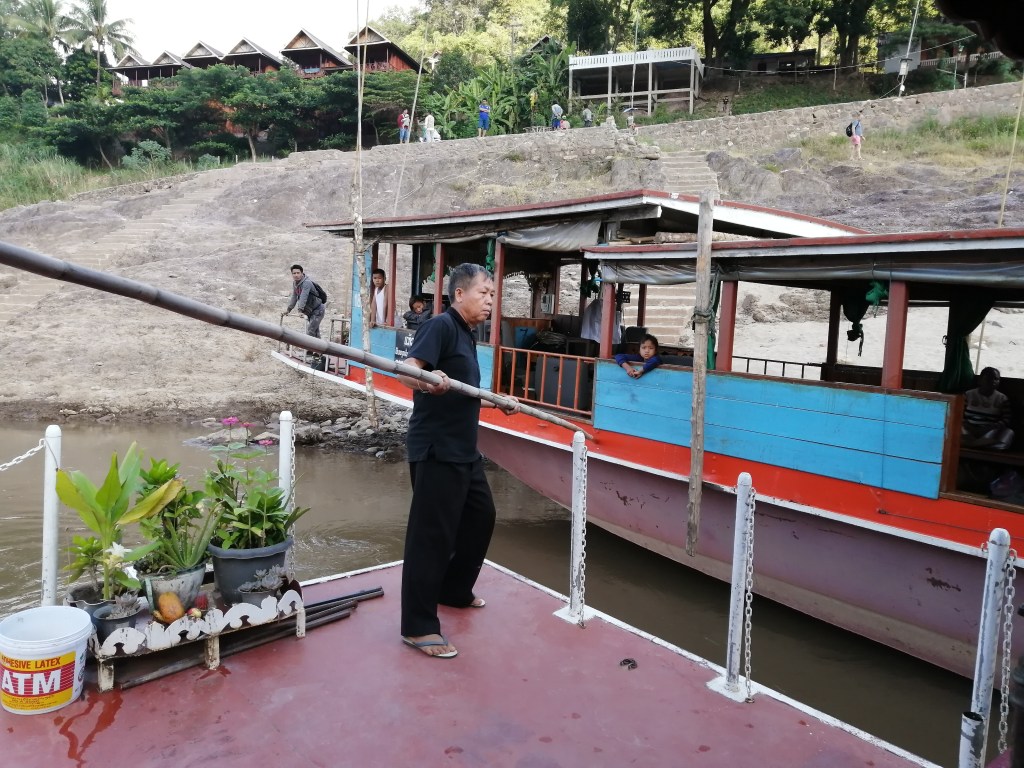
As the boat had spent the night sandwiched between two vessels of a similar length, the crew had a job inching us out in the morning.
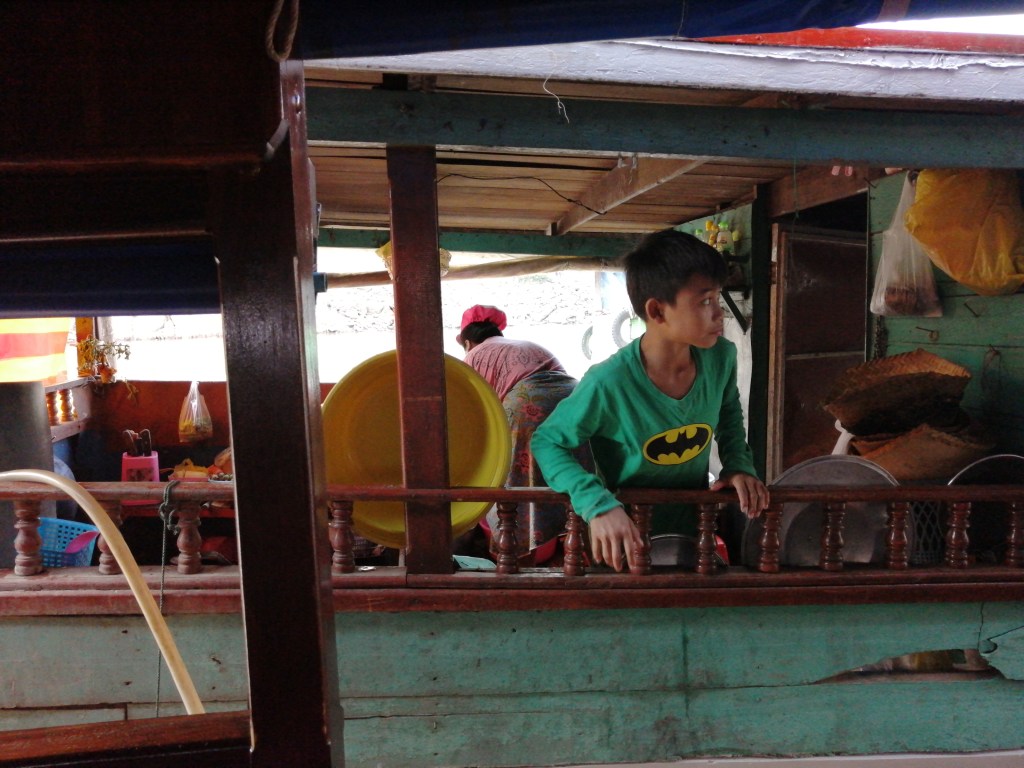
The other boats were lived in and carry out all their cooking in the open rear of the boat.

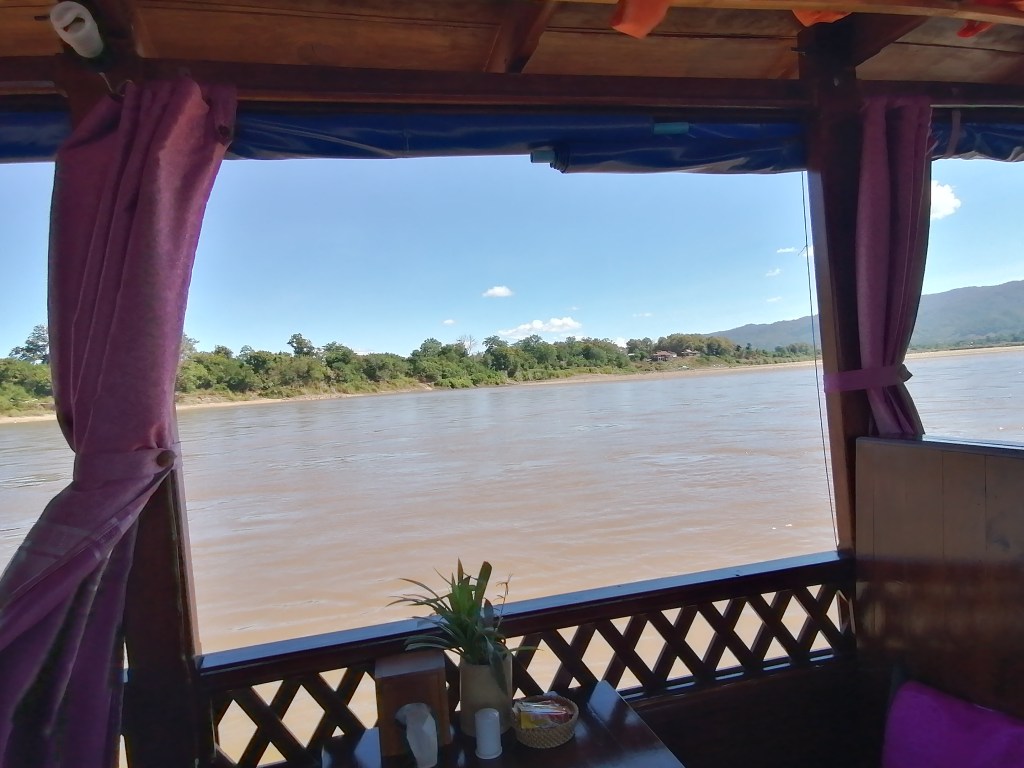
We had a long morning on the boat snoozing, reading and watching the world drift by.

On the horizon is one of the many plantations of banana trees we saw on our journey, with the bananas protected in blue bags. These plantations of ‘green’ bananas are owned by the Chinese and the fruit is solely for the Chinese market. Our guide told us that the owners use chemicals on the crop, a lot of which reaches the Mekong. The people in Laos prefer the small yellow bananas you see growing elsewhere in Laos, and the rest of south-east Asia. This is one way in which the Chinese have made themselves unpopular. They are also observed to come in groups, stay in Chinese-owned hotels and eat in Chinese-run restaurants. All the money they spend goes back to China, our guide said.
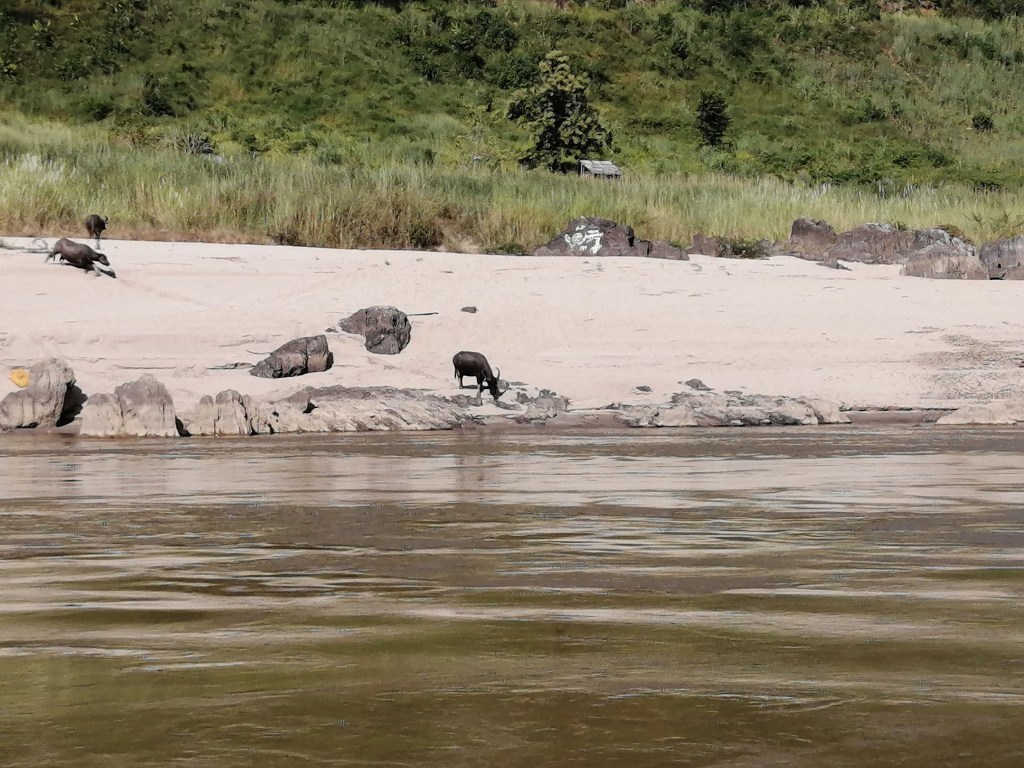
Water buffalo
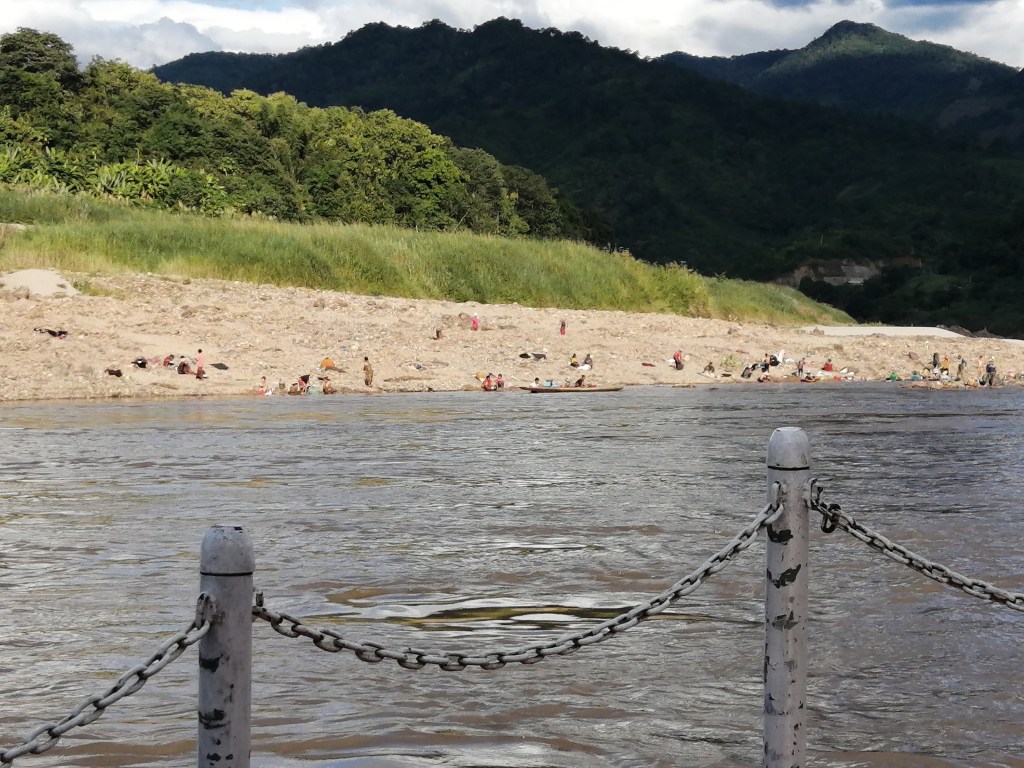
We saw a number of people along the Mekong panning for gold. I suspect there is not a lot to be found.

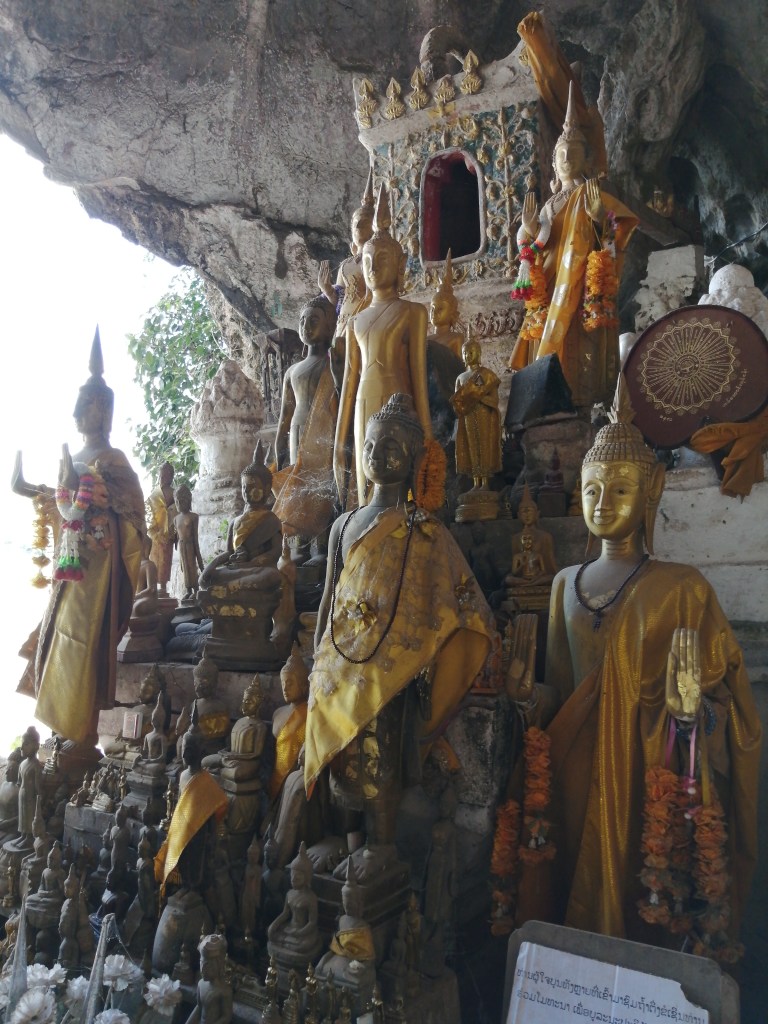
After another delicious lunch on board, we made a stop to visit the Pak Ou Buddha Caves. Two caves are filled with small statues of the Buddha that have been removed from temples around Luang Prabang owing to damage, or due to some ‘thinning out’ being required owing to the large number of images.

Inside the Pak Ou Caves

For most of the year the caves are only visited by tourists and sellers of ‘tourist tat’, but at Lao New Year the faithful turn up in great numbers to ritually wash the images, and in so doing, gain merit.

Soon after another stop was made at a local village, this one an opportunity to purchase some beautiful Lao silk, bags and Lao ‘whiskey’, which we avoided.

First glimpse of Luang Prabang

Our cruise was too soon at an end. Watching the world go by from a comfortable and well-fed spot – what a superb way to travel!

Cruising Down The Mekong Day One

After a lengthy process to pass from Thailand into Laos, we boarded the boat somewhat later than anticipated. Our guide blamed this on a bus-load of Chinese tourists who had turned up at the Laos immigration post shortly before us. (The Chinese aren’t much liked in Laos – more on why this is so in the next post).

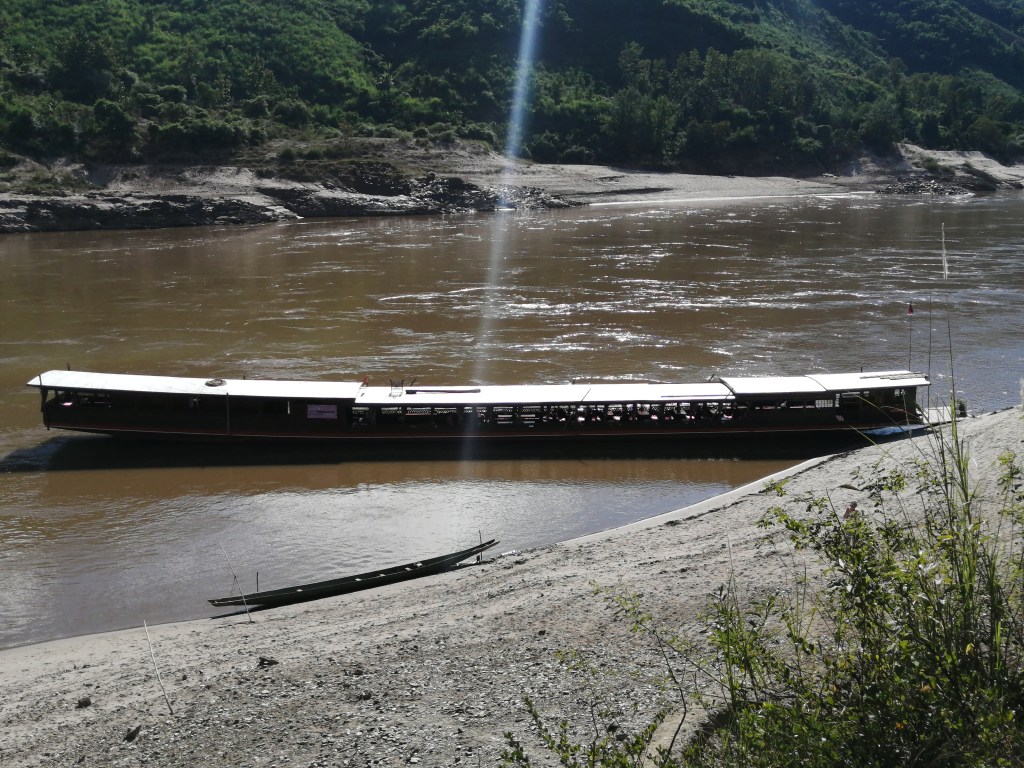
Our boat to take us down the Mekong. At 48m long there was plenty of space for our party of just 13 to sit, or lie. The boat can take up to 45 passengers.
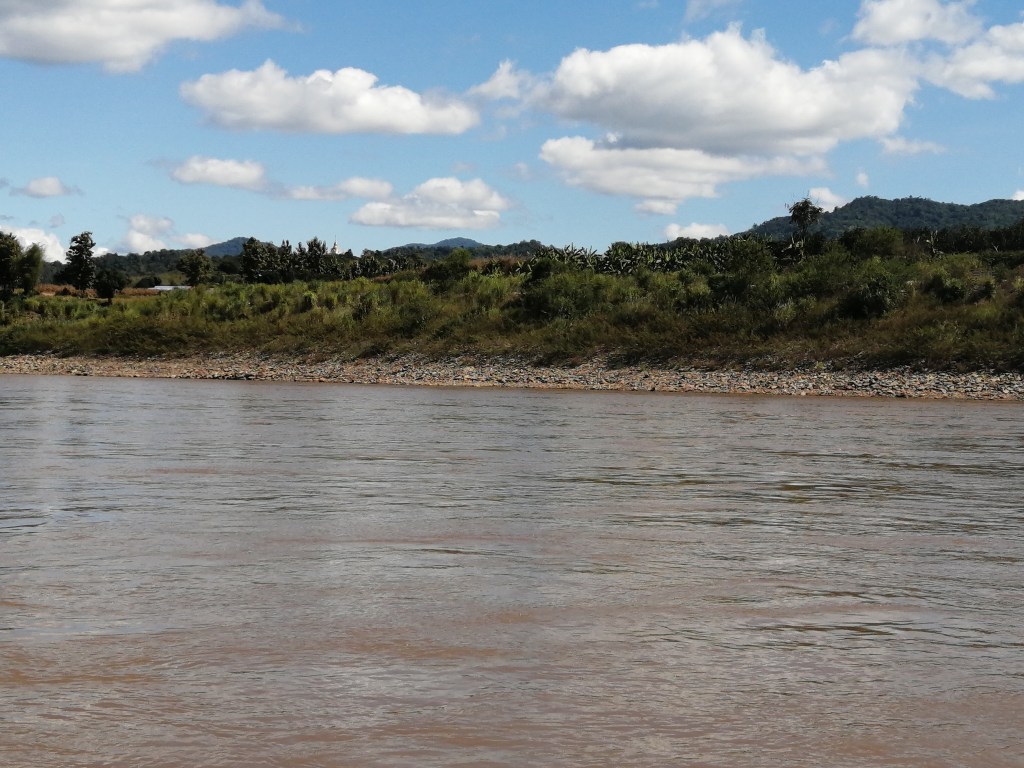
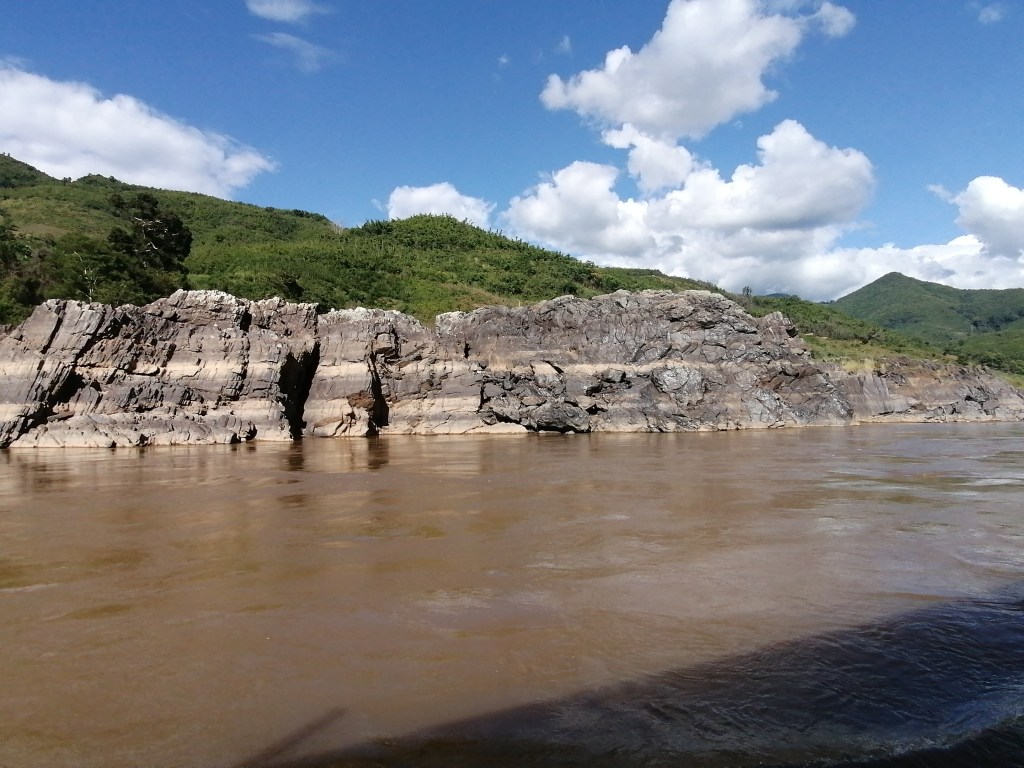
The fast-moving Mekong with rocky outcrops, sand bars and swirling eddies, is a difficult river to navigate. Our experienced helmsman watched the muddy waters constantly, checking for variations in hue which would indicate a change in depth.
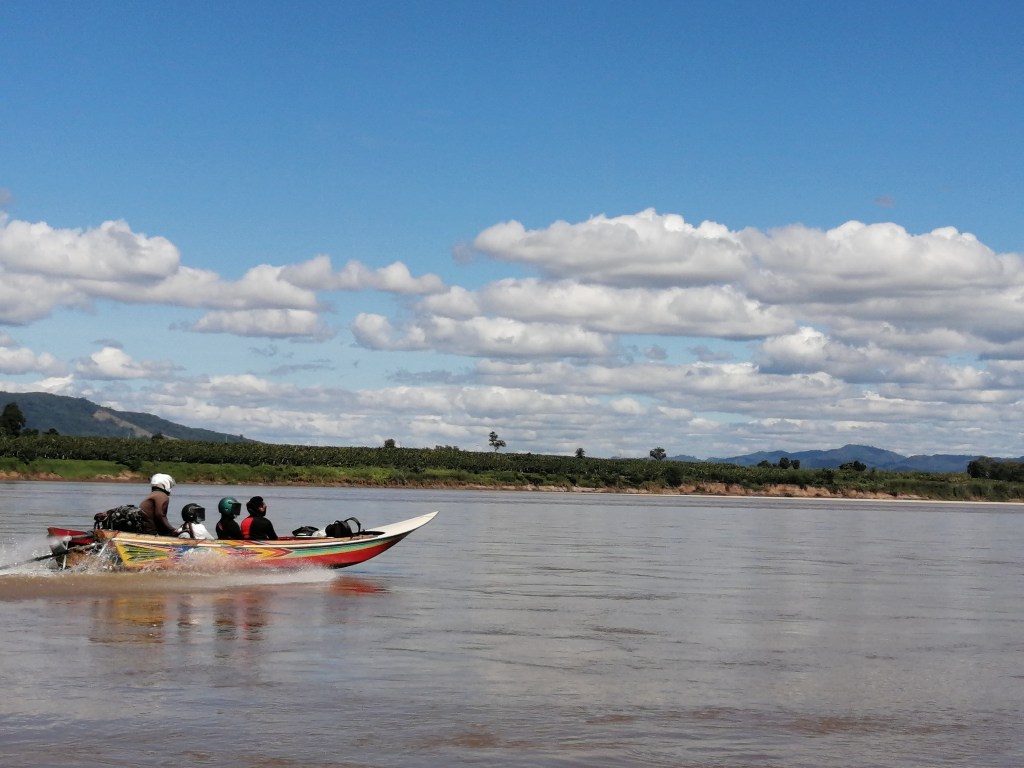
There was very little traffic on the river, but we were occasionally overtaken by speeding long-tailed boats carrying foreigners. The passengers in this one are wearing crash helmets, but very often none was worn, the occupants oblivious to the dangers.
The changing river levels are marked on the rocks on the bank. We were told that the current level of the Mekong is unusually low after a drier than expected rainy season. ‘Mountain rice’ is grown high up on the slopes in July, August and September, when the rainfall is usually sufficient. Apparently the harvest this year was very poor.

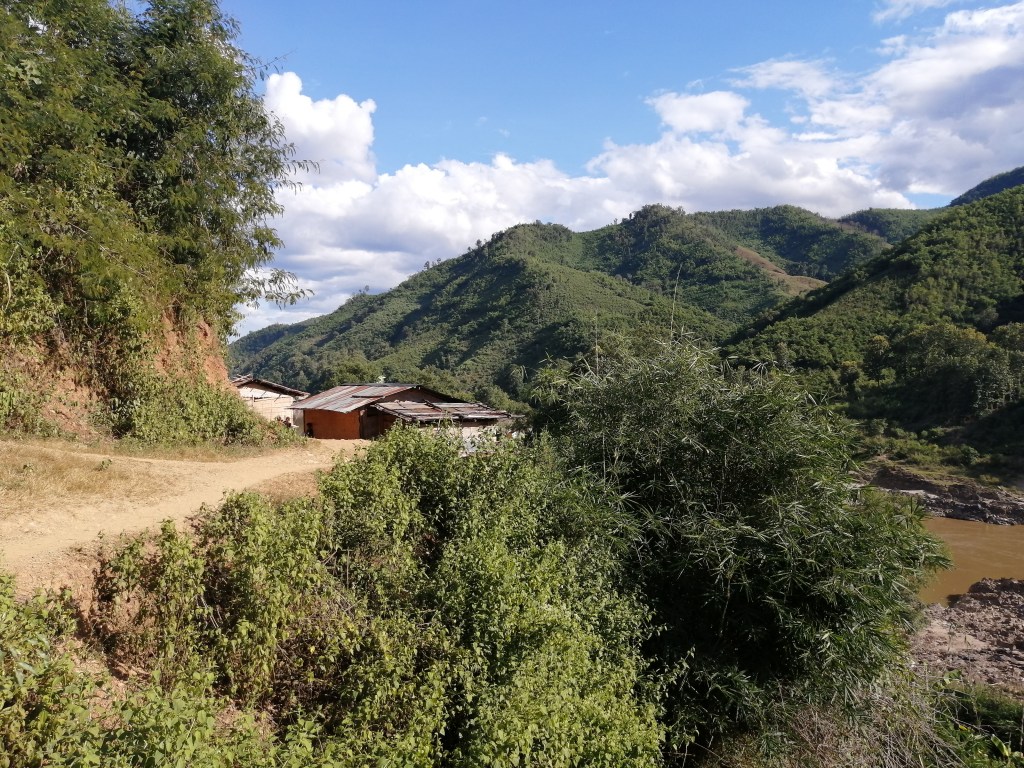
Watching out for the occasional water buffalo, and the few people going about their activities was very pleasant, and after a freshly-prepared lunch showcasing the best of Lao cuisine, we made a stop to visit a village that is supported by the boat company.

We climbed a steep slope to reach the village …
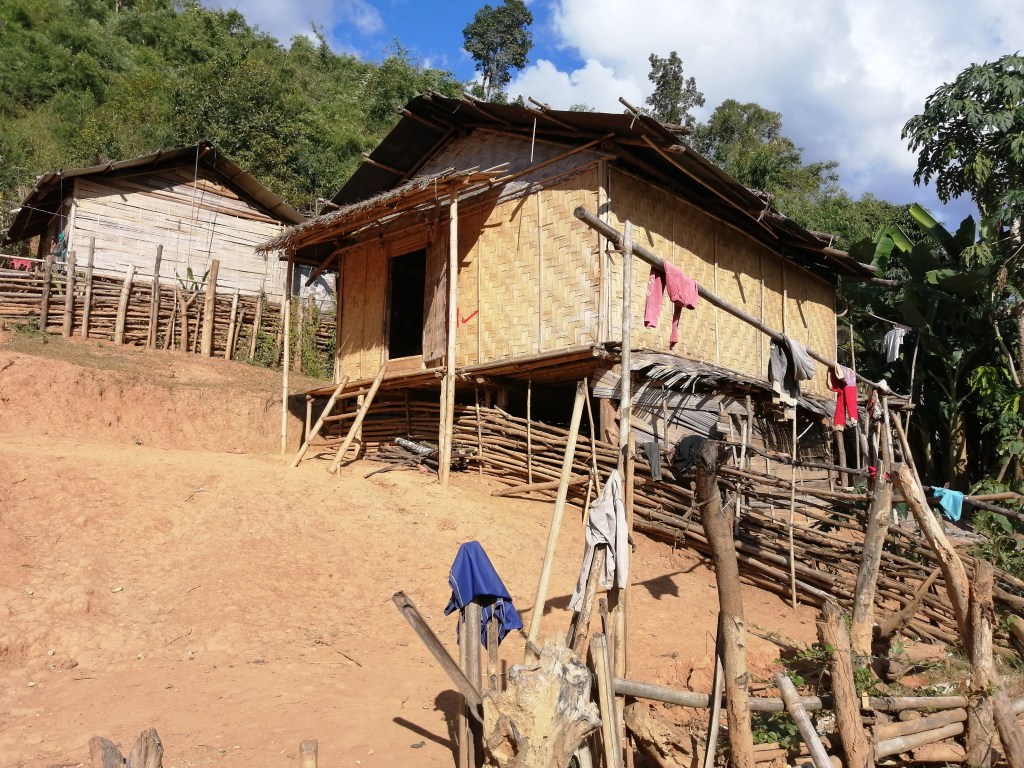
and found the houses perched rather precariously. Animals are kept in the space beneath the houses. We saw one solar panel, but apart from this the village has no electricity.
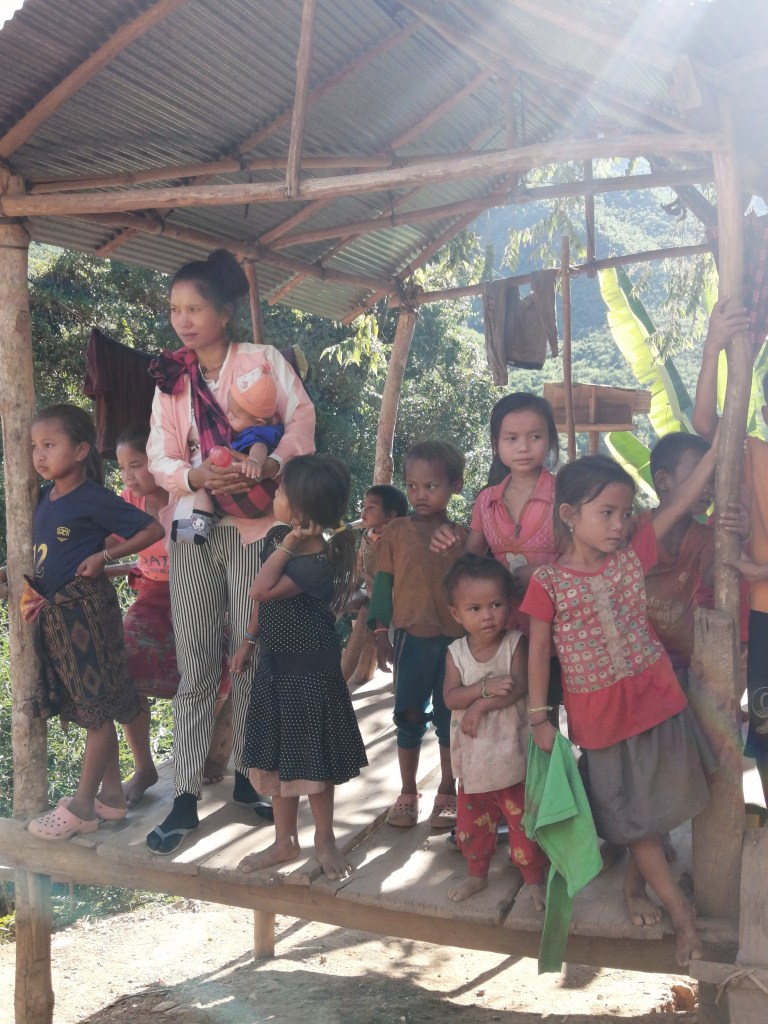
It being the weekend, the children had no school. I think they were as curious about us as we were about them.
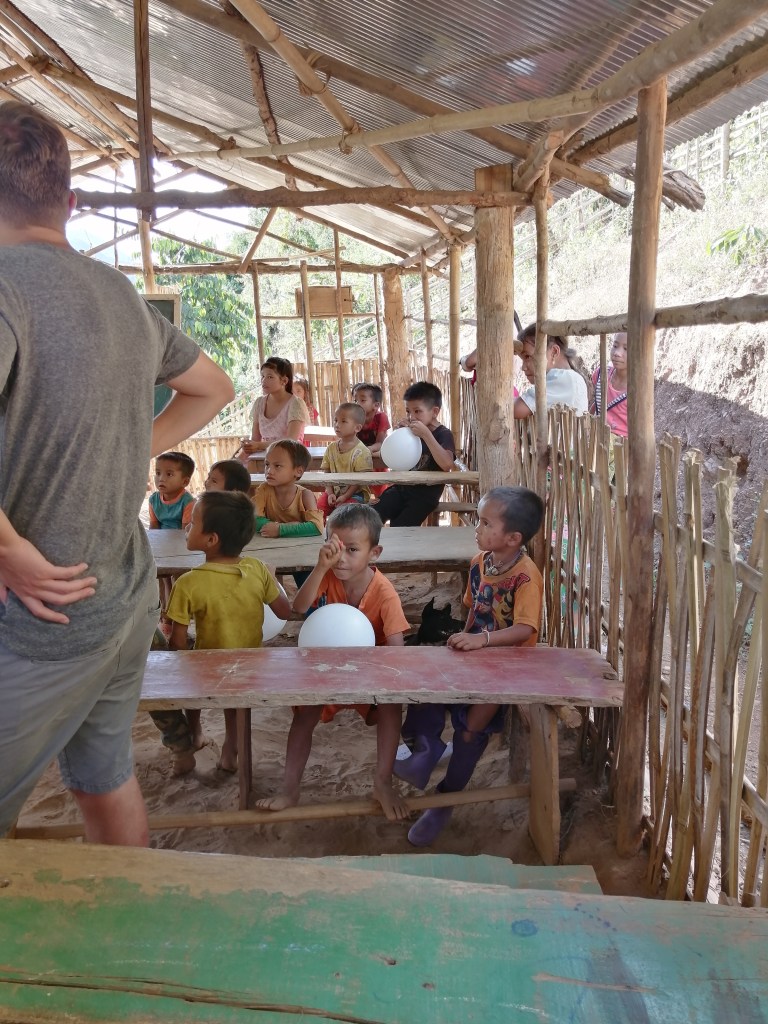
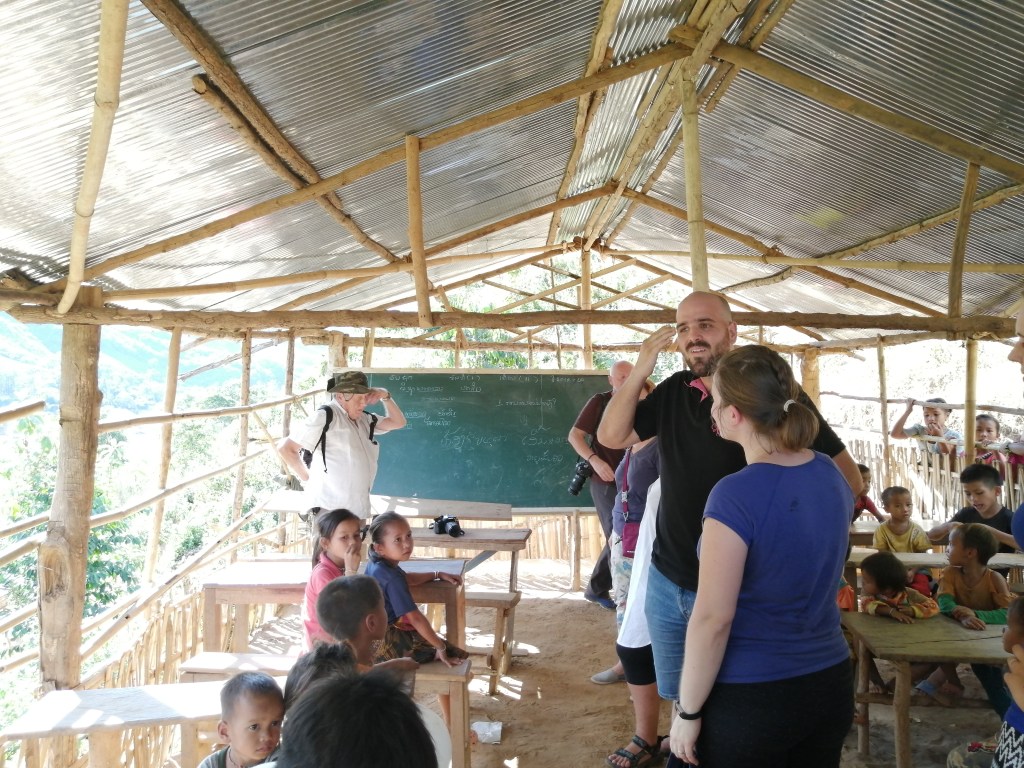
When we reached the school, the children took their seats, some holding balloons which one of our fellow passengers had given them. The school room accommodated two classes covering the entire primary years. The nine, younger, children in Primary One faced a blackboard in one half of the room …
and the twenty older children in Primary Two faced a blackboard at the other end. The children must be very well-behaved to allow the single teacher time to work like this. The government in Laos has very little money for education, and provision in rural areas like this is sketchy.
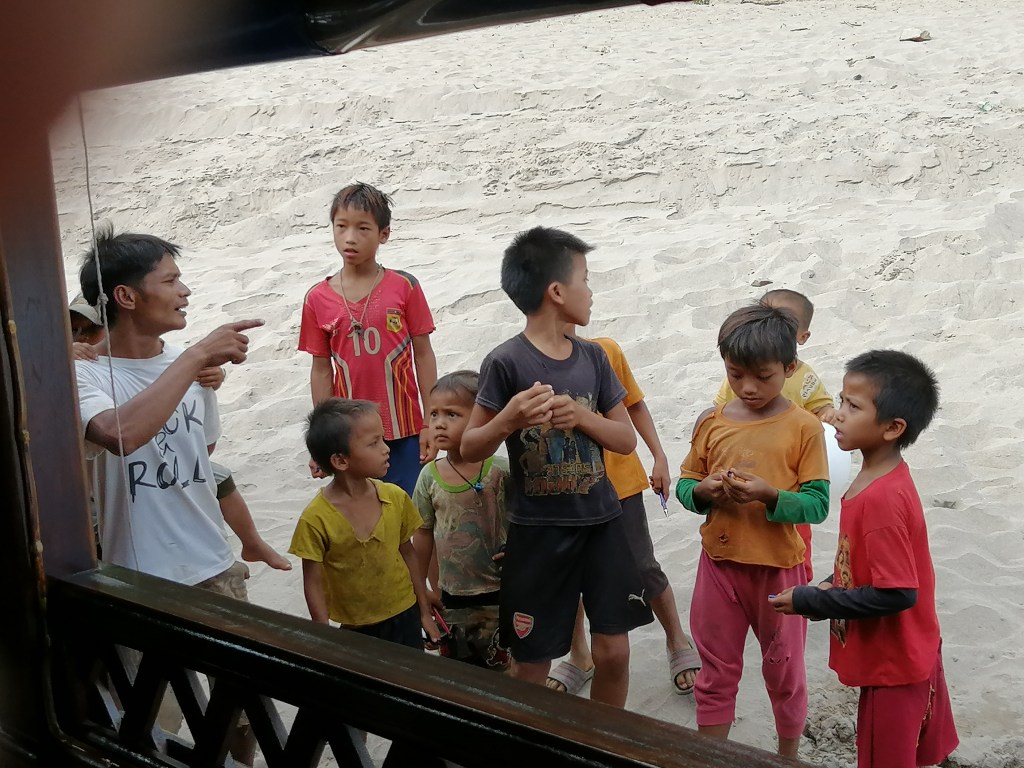
Some of the children followed us down to the boat and were given pens by another passenger. I wish I’d taken paper and pencils for them. The chap in the white t-shirt is the village chief.

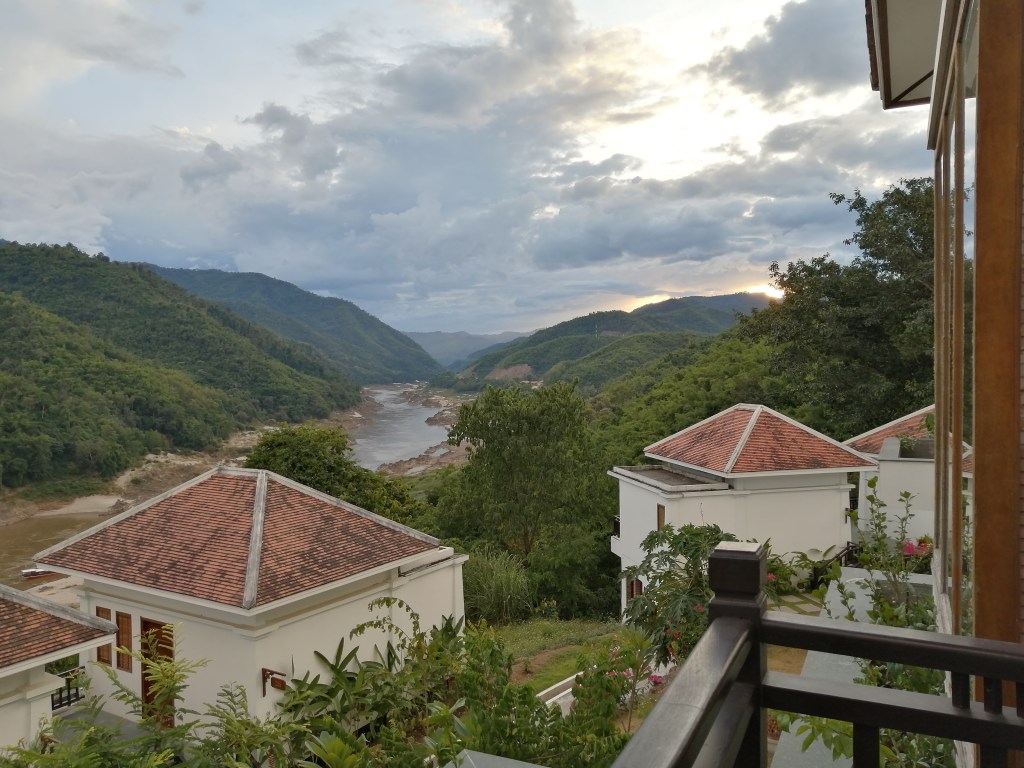
We made an overnight stop in Pakbeng at the end of our first day and found ourselves at a very quiet, but plush, hotel on high ground overlooking the river.

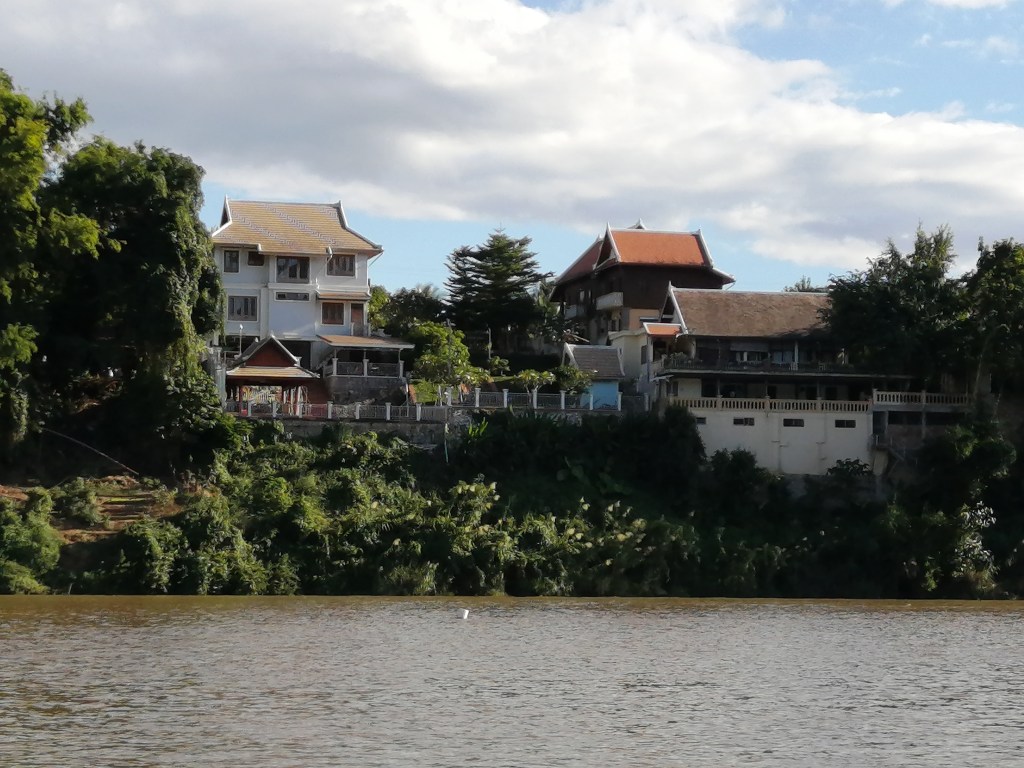
View of the Mekong from our balcony

The only other guests were two Scottish ladies, Heather and Shirley, cycling from Chang Rai in Thailand, through Laos and into Vietnam in aid of two charities, the Cystic Fibrosis Trust and The Motor Disease Association.

(You can read about their travels here https://heathersasiacyclechallenge.com).

Heather had come off her bike earlier in the day and she had stuck her face back together with steri strips. On hearing of the accident, Shirley’s husband decided they needed somewhere more luxurious than their usual overnight stops, and booked them into the hotel where we were also staying.

Puppet on a Klong

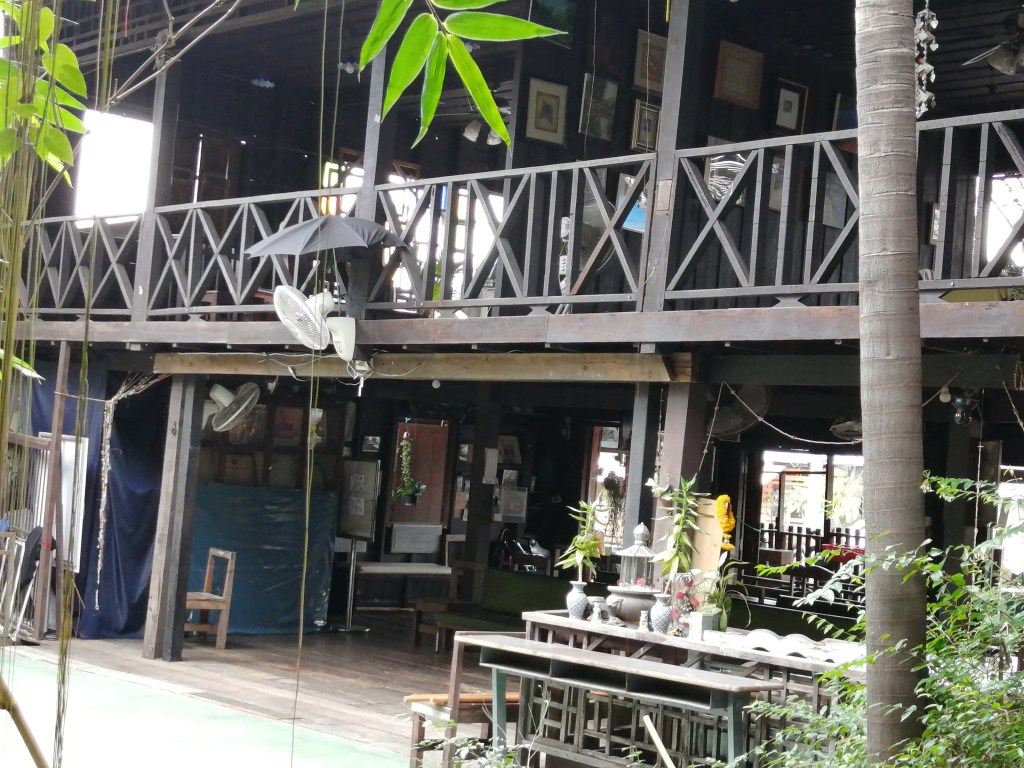
Before our trip to Laos, we paid a trip to the Artists’ House in Bangkok, an old traditionally-built house, now used as a gallery for local artists, and as a puppet theatre, situated on one of the klongs away from the hustle and bustle of central Bangkok.

Artists’ House
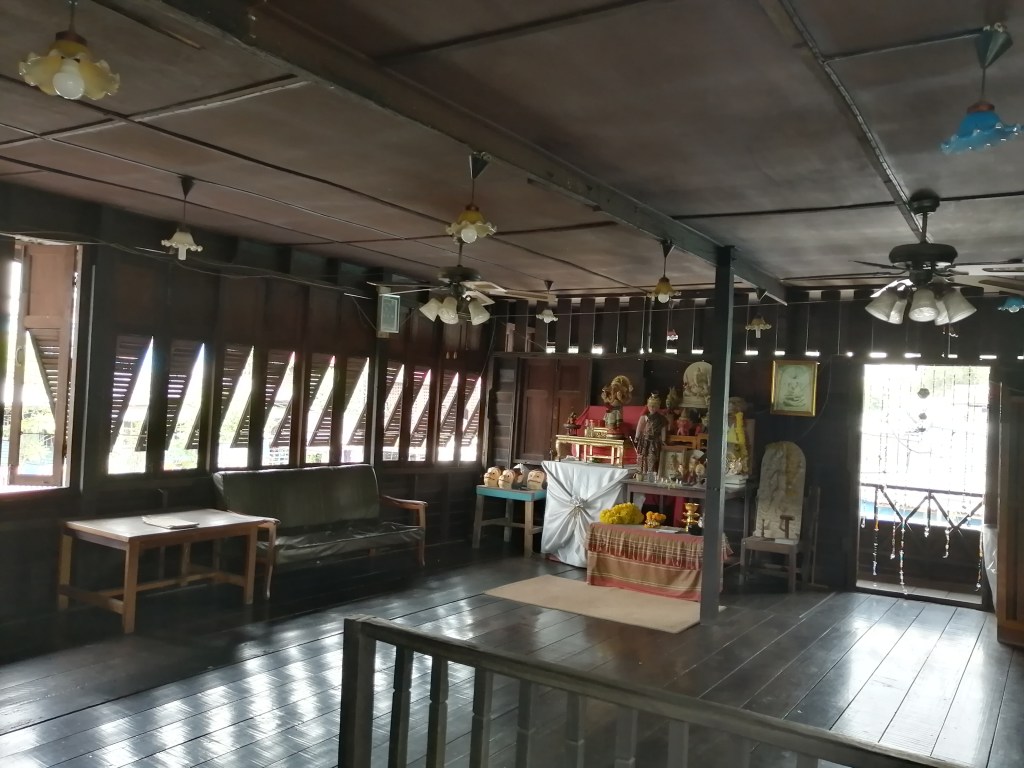
Upstairs in the Artists’ House
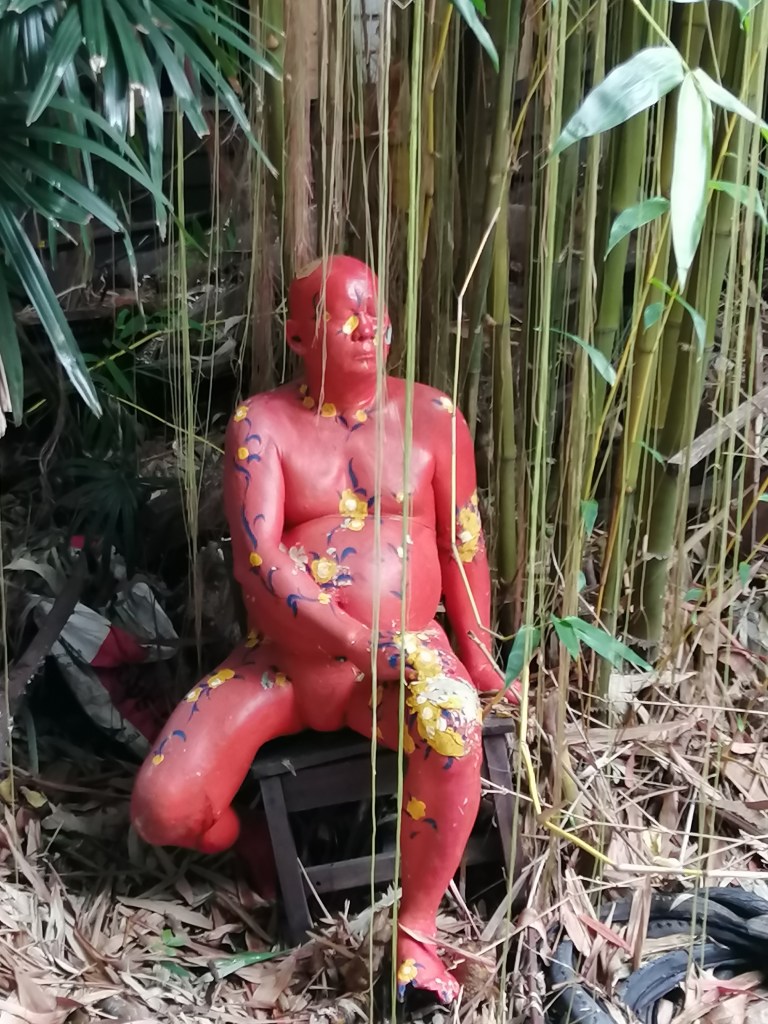
Relaxed statue in the garden. The only other work we saw by local artists was in the form of greetings cards and postcards produced for tourists.
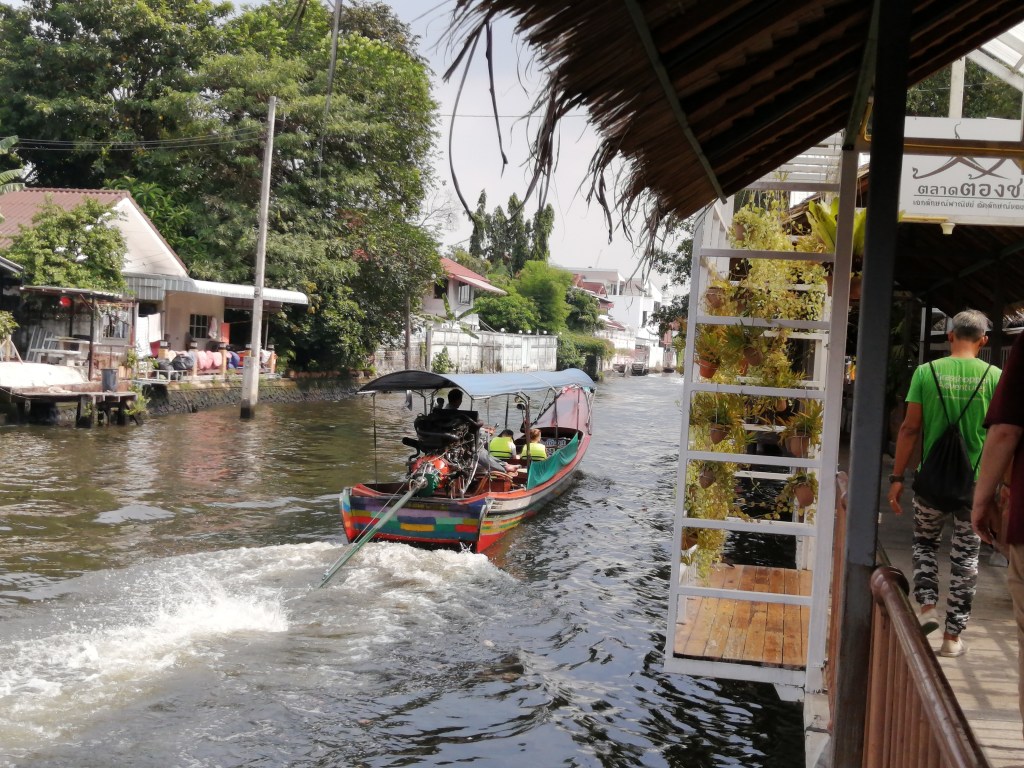
The klong was busy with fast, noisy long-tailed boats carrying farangs (foreigners).
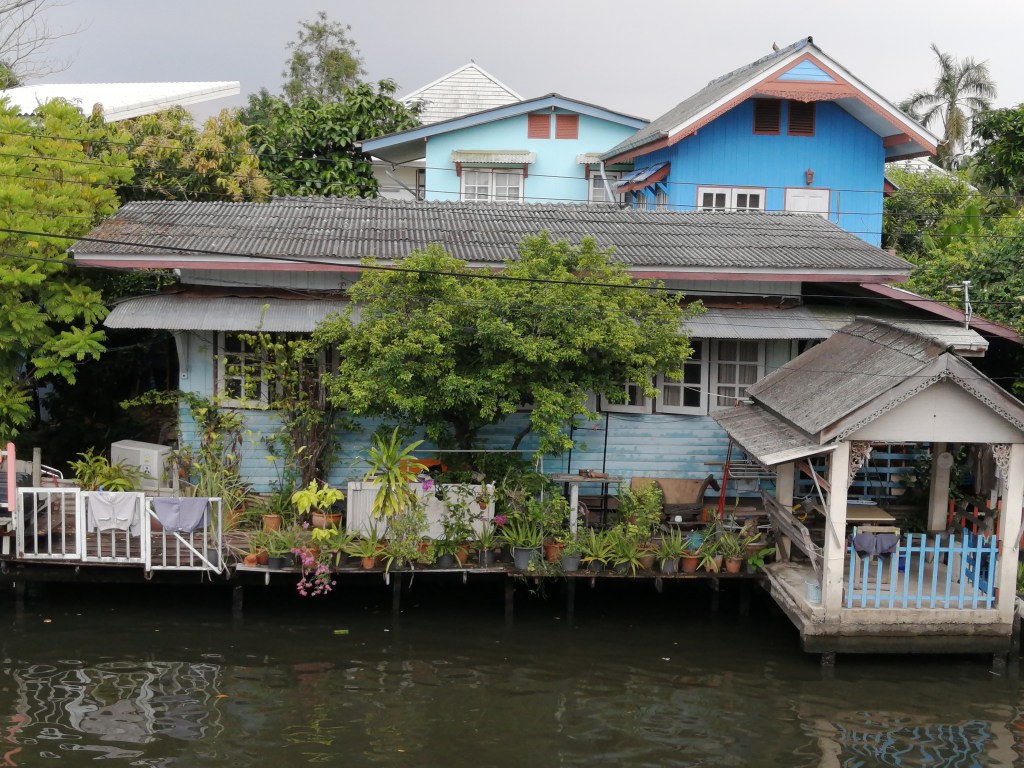
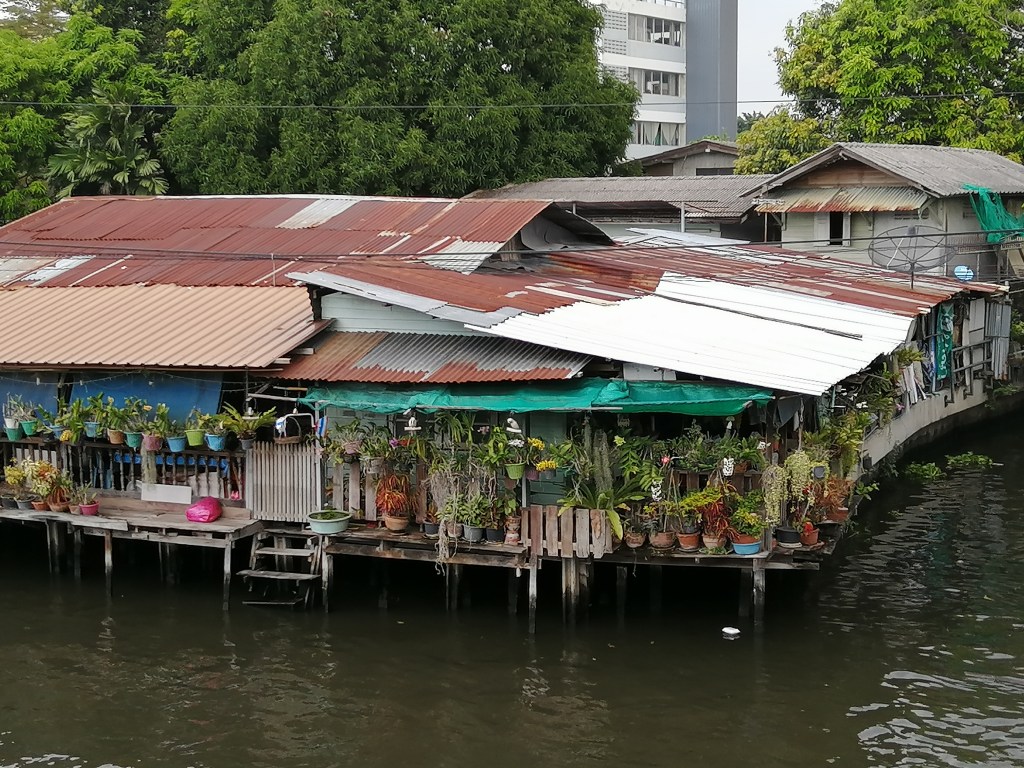
House on the klong. People are very keen on pot plants which adds to all the greenery.
More houses on the klong.
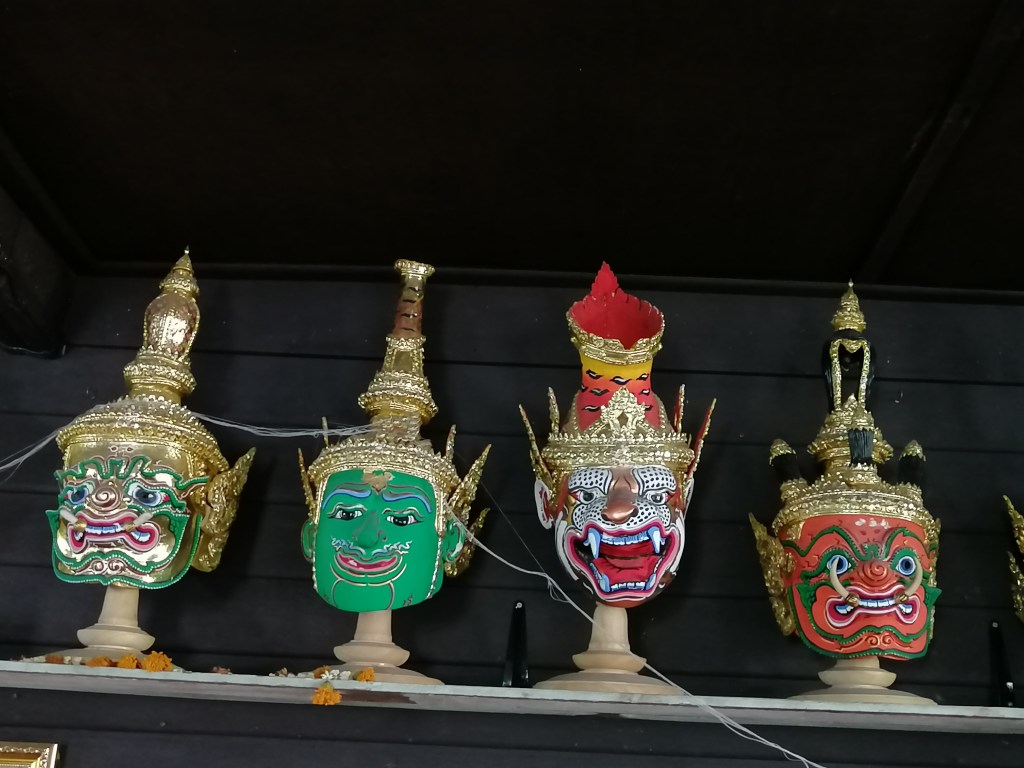
Traditional masks on display in the Artists’ House

One reason for visiting the house was to watch a puppet show, but owing to its cancellation, we returned today.

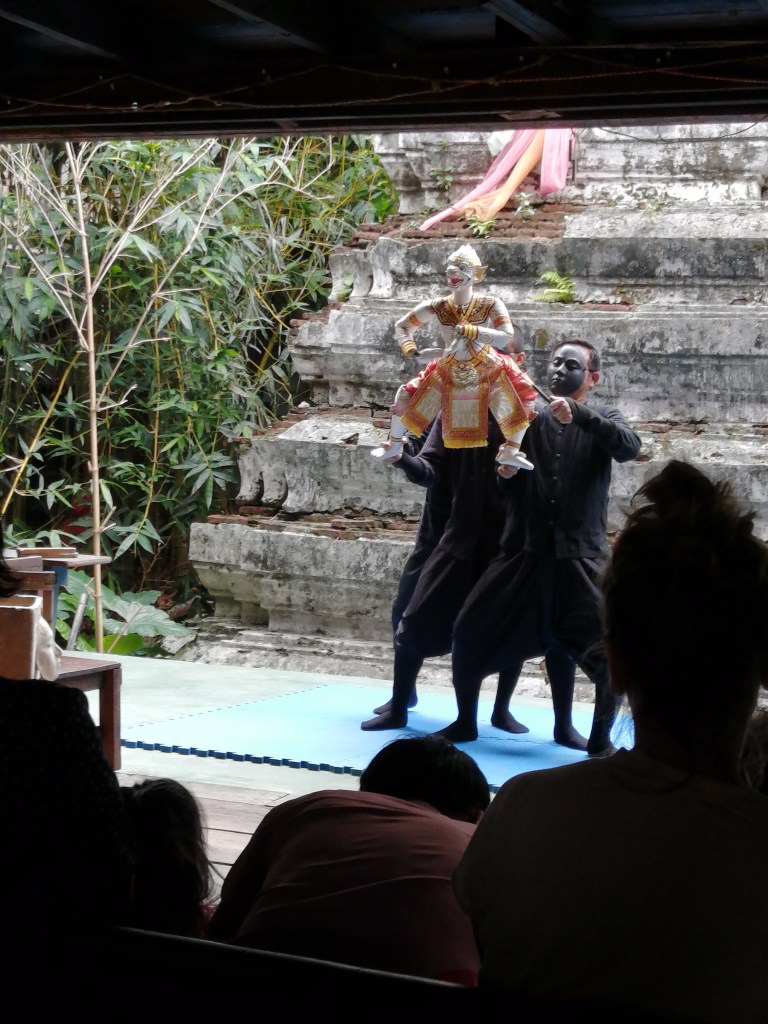
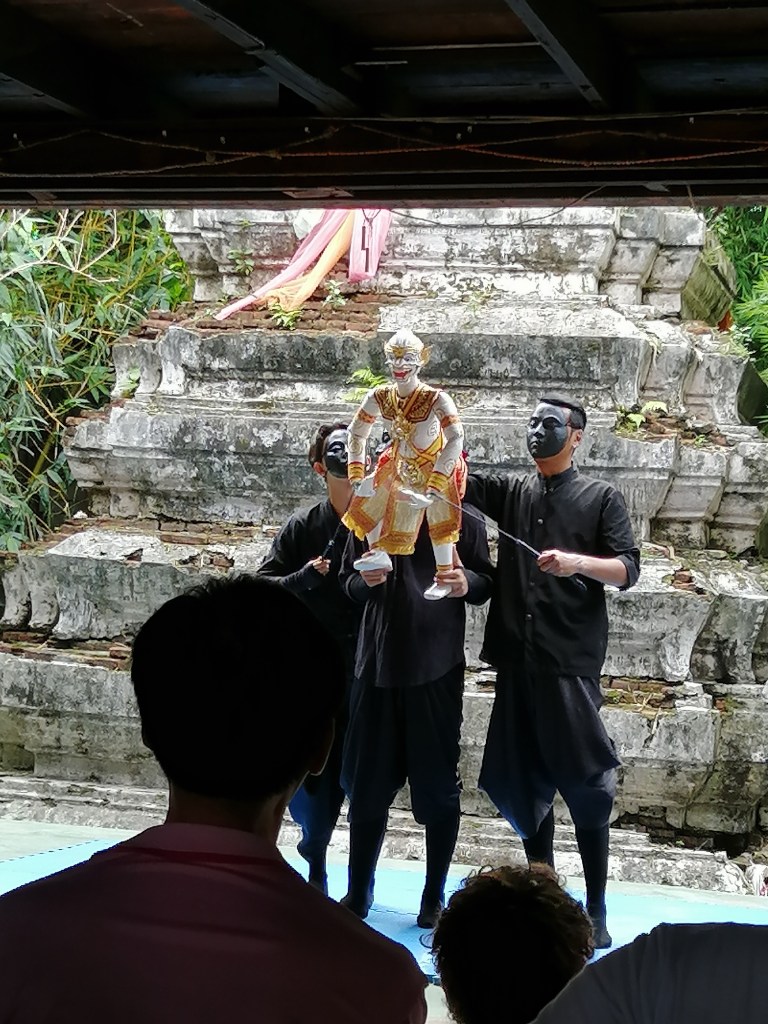
This puppet, representing Hanuman, the king of the monkeys in the Ramayana, was one of two we saw. Thai puppets are manipulated by a trio of black-clad puppeteers. One puppeteer has an arm inside the puppet and controls one hand with a rod, a second puppeteer controls the other hand, whilst the third puppeteer moves the feet.
The puppeteers move in unison with balletic grace, mirroring the movements of the puppet. All puppeteers must be masters of traditional khon dance. It is worth going to a show to watch their performance alone.
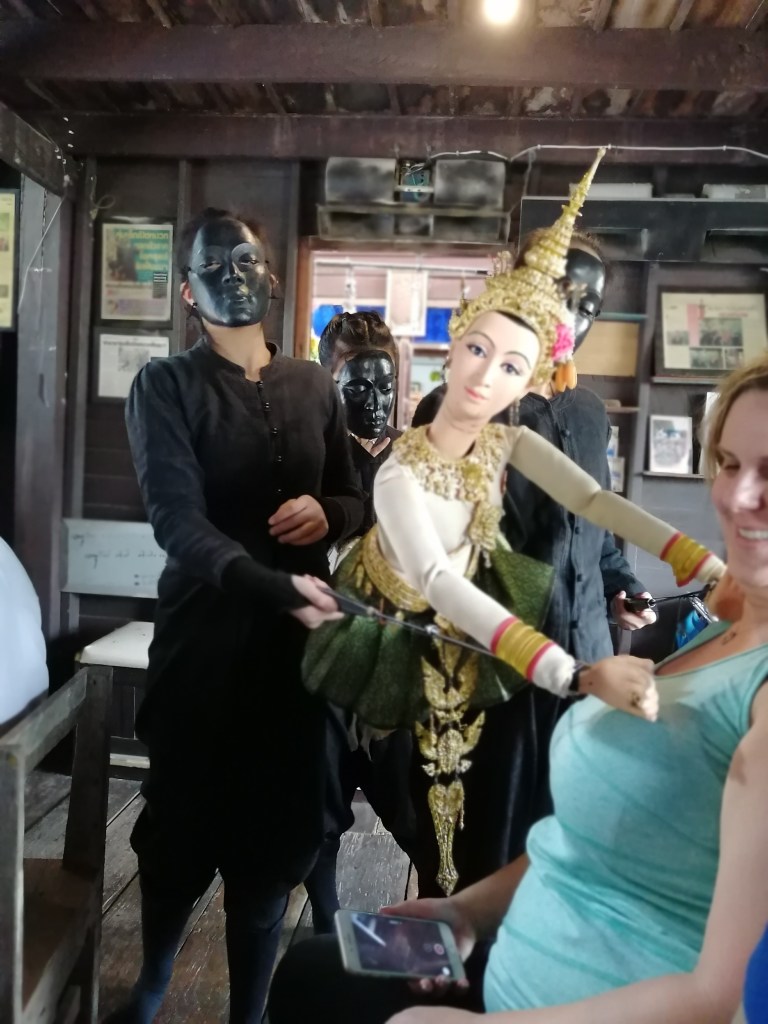
The second puppet was a mermaid and together with Hanuman was brought to the audience for some interaction. All these puppeteers were masked. You can just make out the tiny slits the performers had to see through.
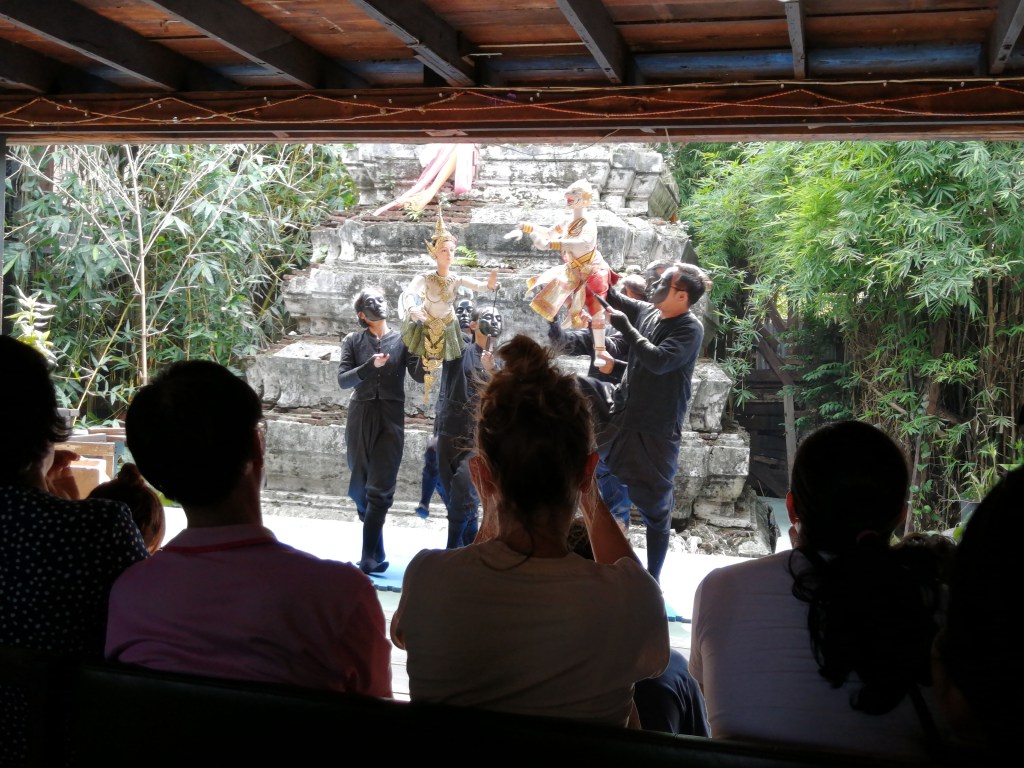
Both puppets on the stage. The story was very short, but the show was free. Everybody left a donation.
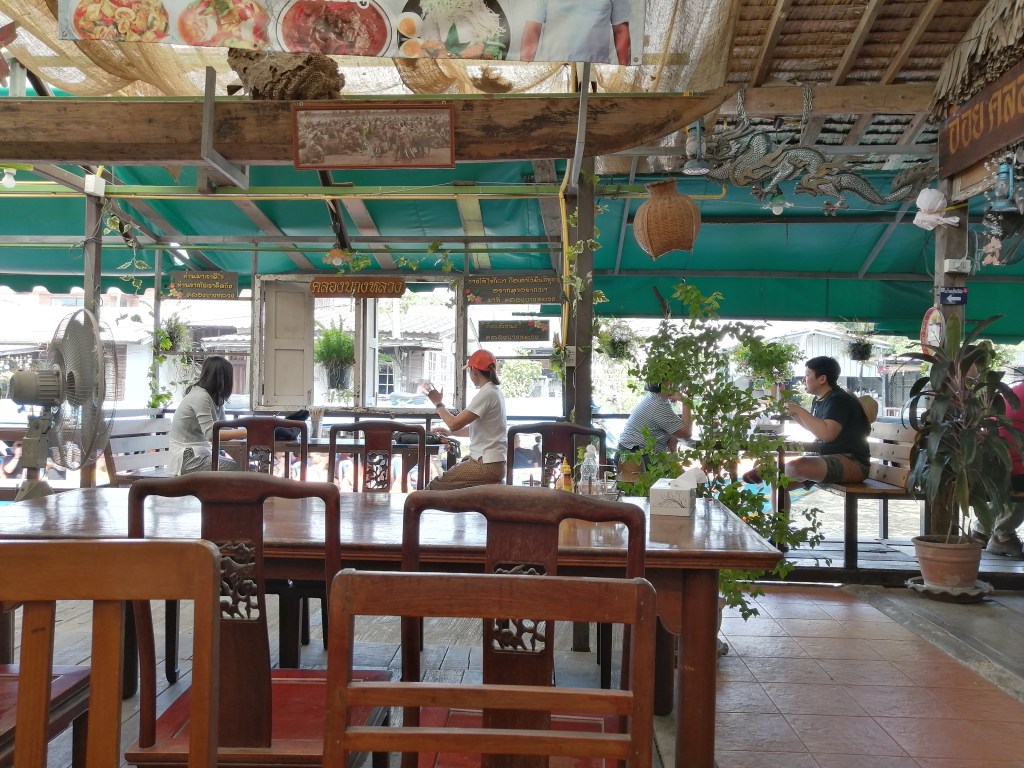
A nearby restaurant where we had lunch. Chicken, onion, green peppers and rice for two for the sum of 100 baht (£2.58). The drinks were extra – I declined any ice in my Sprite – best not take the risk in these small establishments. The food was very good though. (This is about as adventurous as we get).
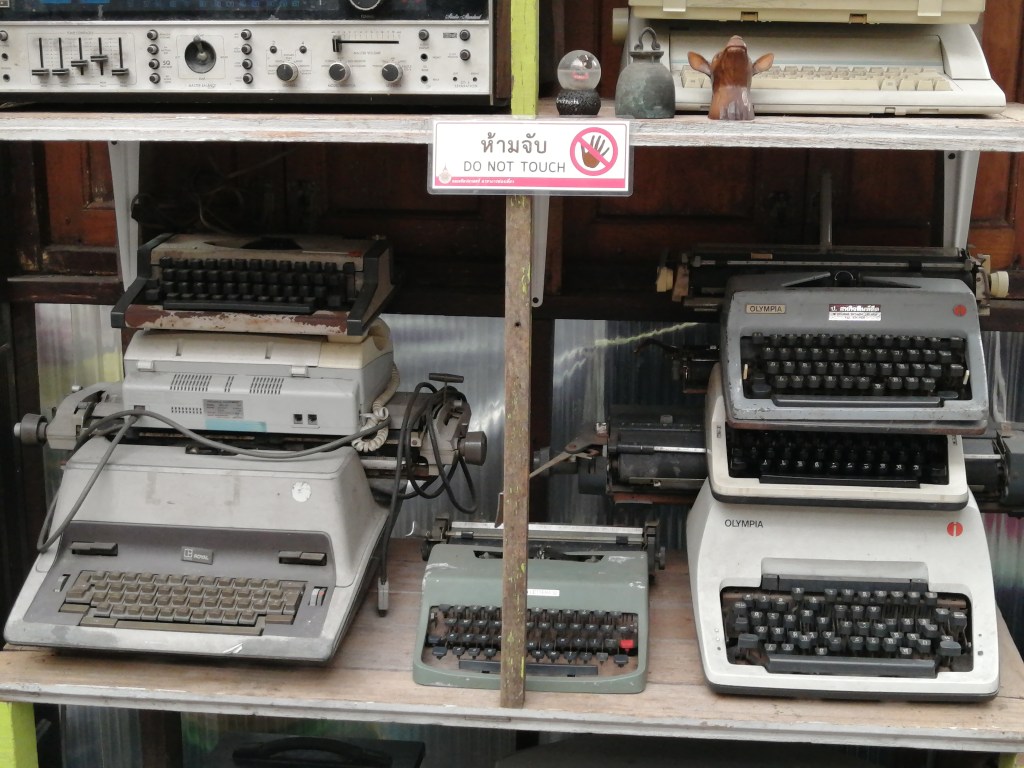
We came across a sign not far away saying ‘Museum’. There was no one there, but the door was open so we went in. I think that the collections were things that hadn’t got thrown away. I had a typewriter like that small one in the middle.
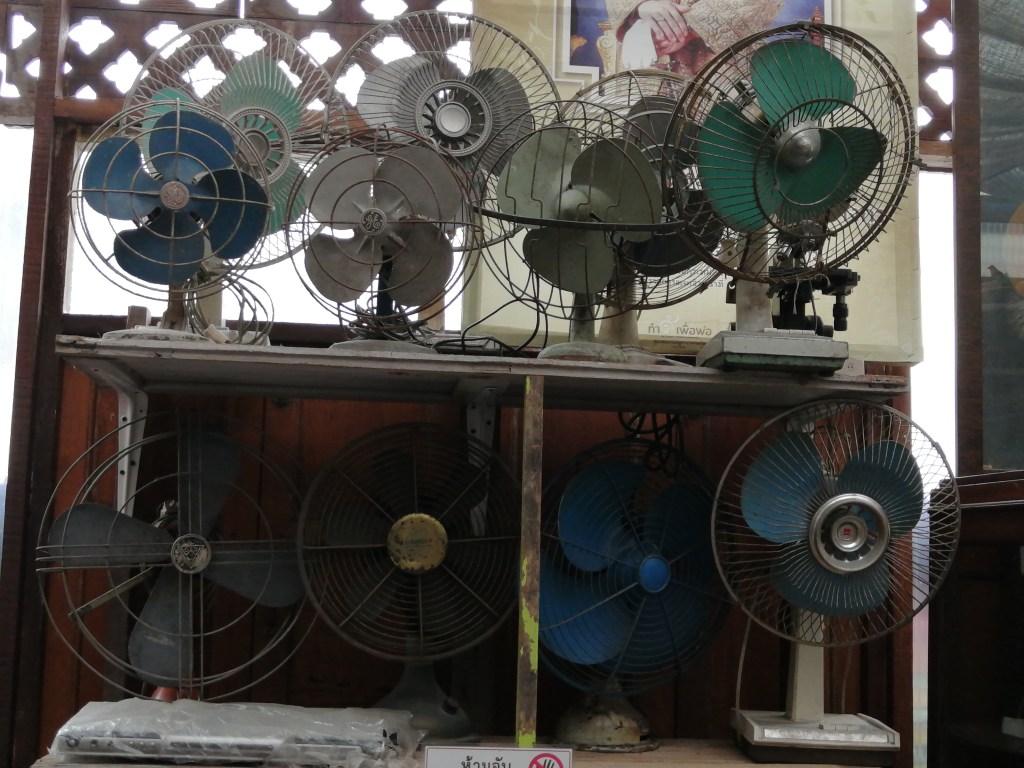
A collection of fans.
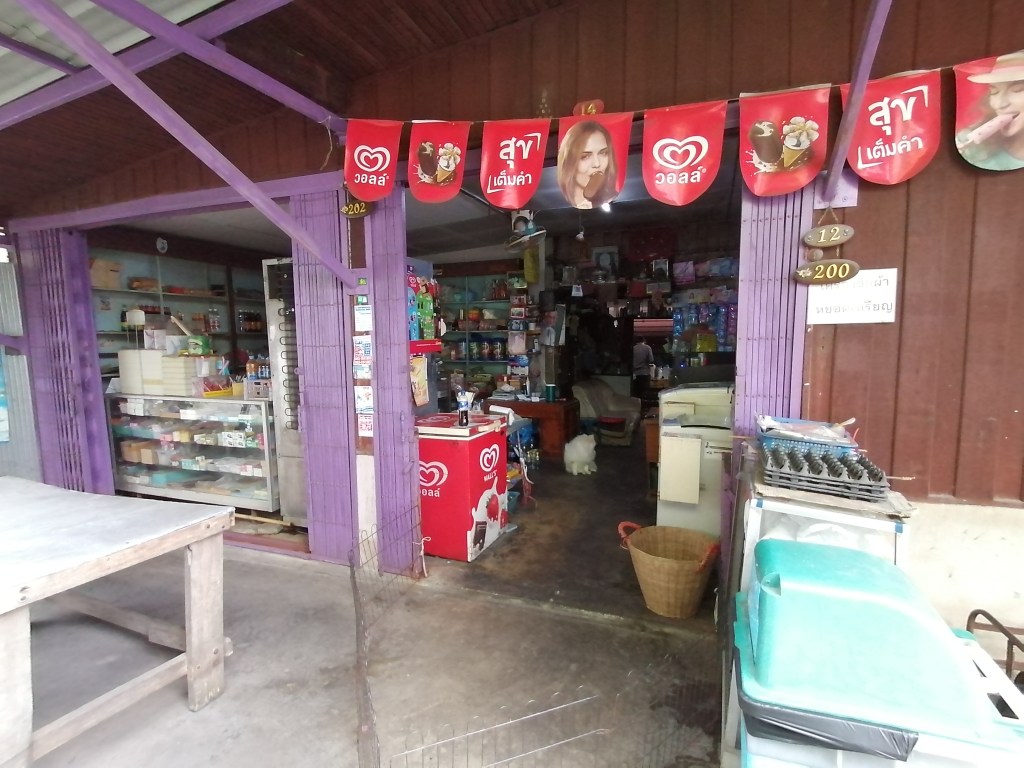
Neighbourhood shop

PS

We had a fantastic time in Laos, but I have got very behind with the blog as broadband speed was so slow it took all my free time to upload my photos. I’m hoping to catch up over the coming week.

The Mighty Mekong

We travelled up from Bangkok today to Chiang Khong, ready to cross over to Laos tomorrow. A slow boat will then take us on a two-day cruise downstream to Luang Prabang where we have booked in for four nights. From there we’ll fly back to Bangkok where we’ll have 10 more days before moving back to the UK and into our new home.

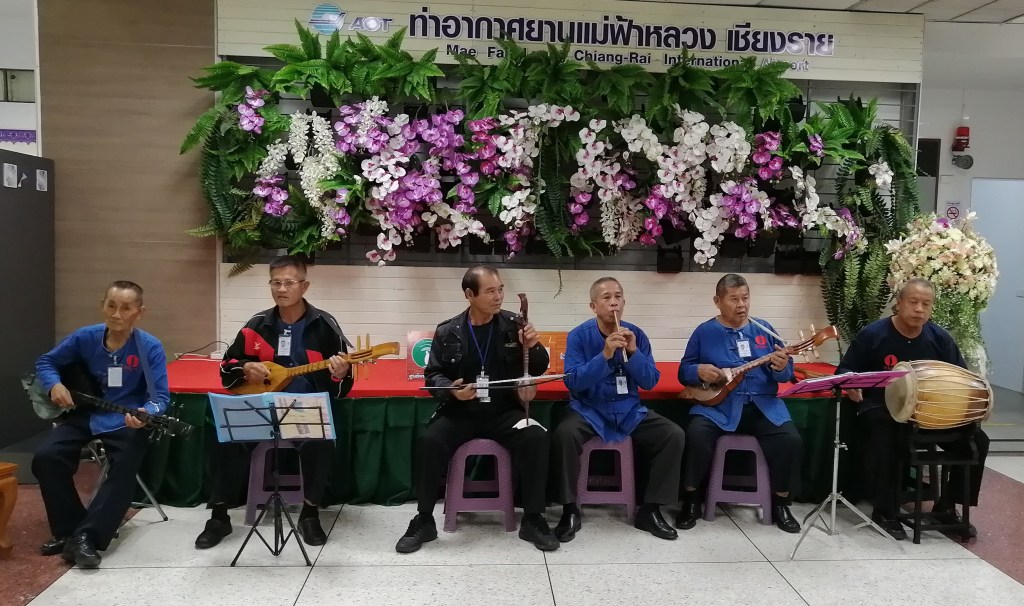
A band greeted us at Chang Rai airport which made us feel very welcome.
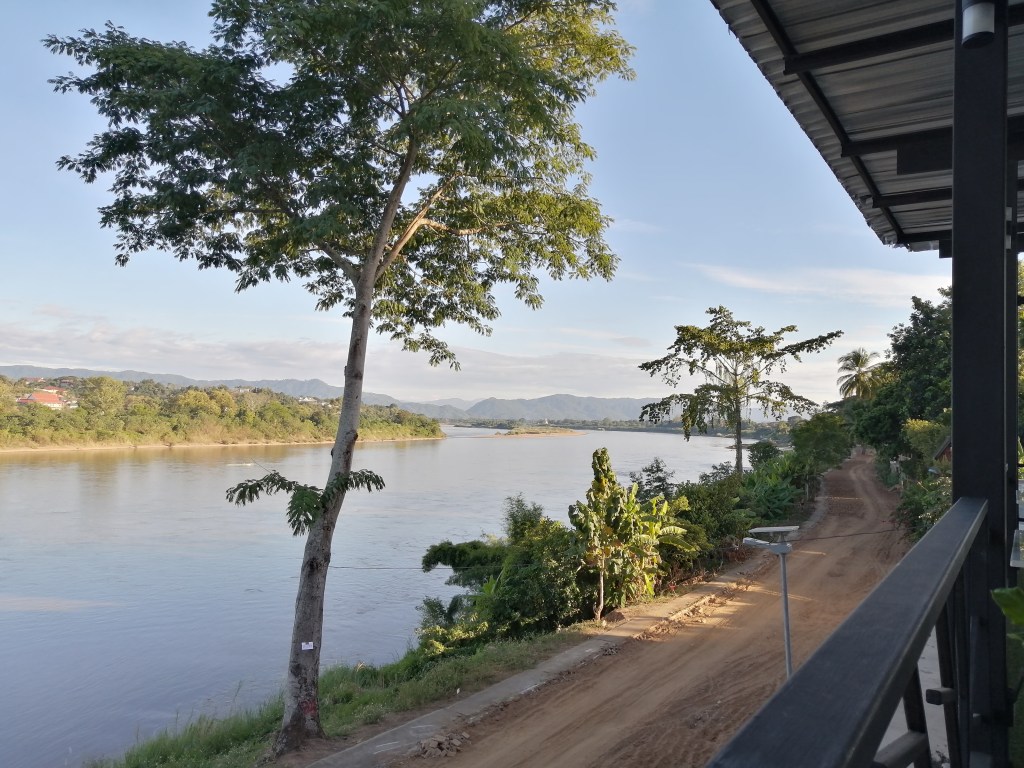
Our first view of the Mekong in Thailand. We visited the Mekong delta when we were in Vietnam eight years ago.
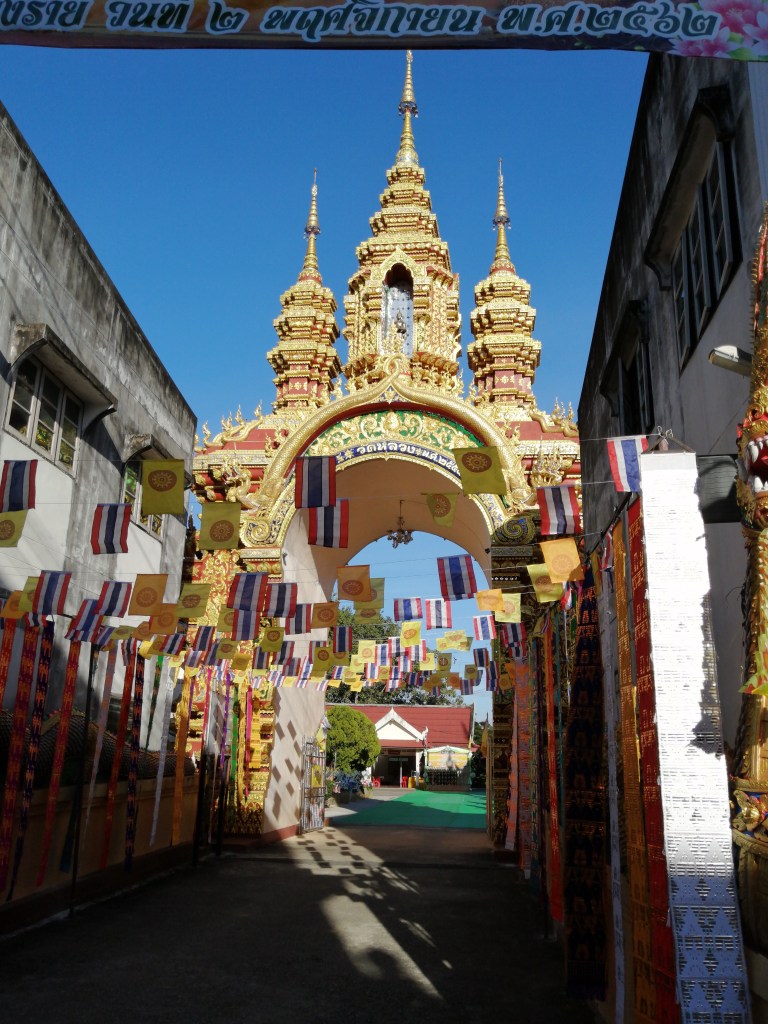
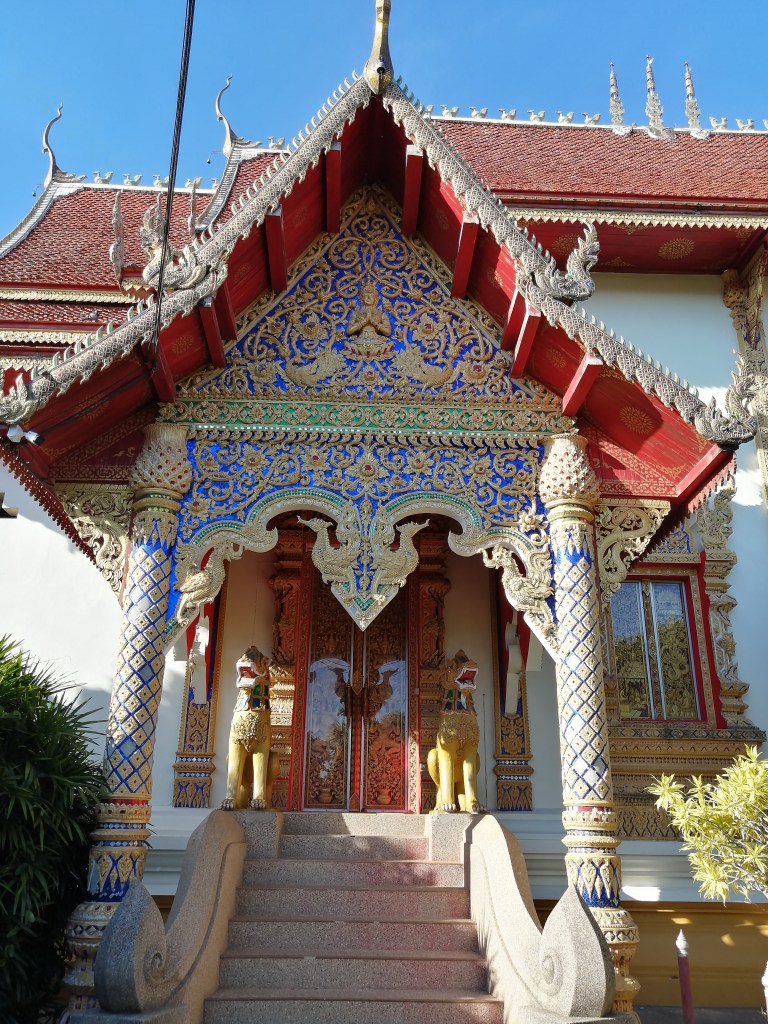
Entrance to a wat (temple) in Chiang Khong.
Wat, Chiang Khong
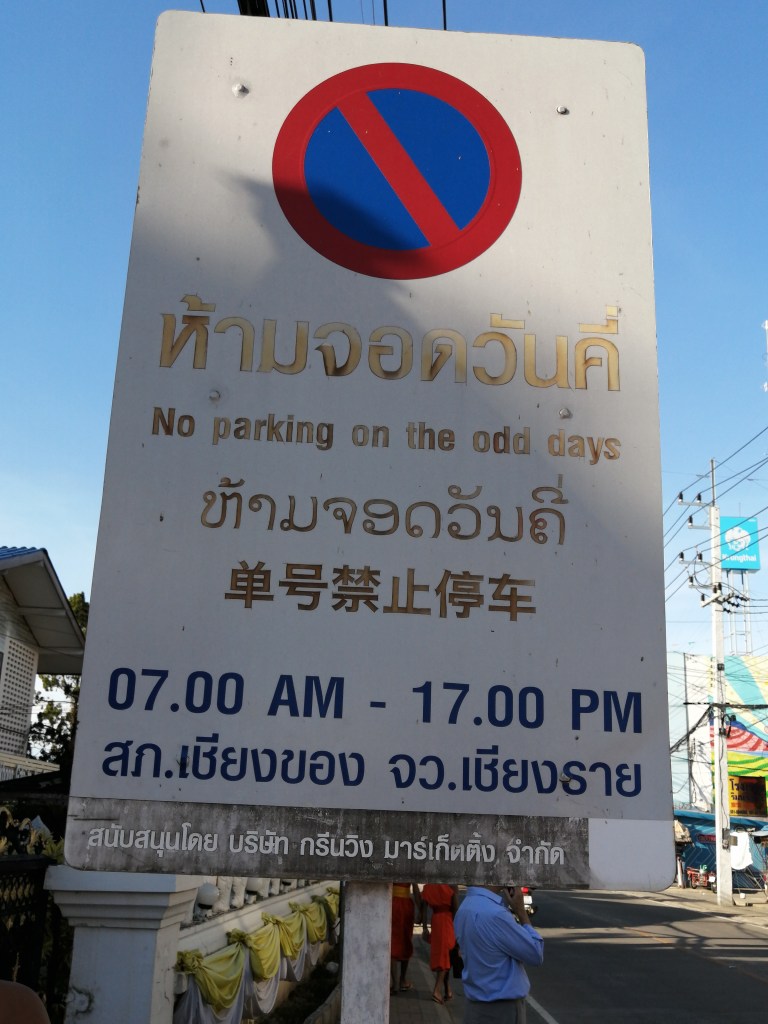
Sign in Chiang Khong
Subtleties, like the difference between ‘the odd days’ and ‘odd days’ must make English tricky for foreign learners, but today being 1 November and an ‘odd day’, everyone was dutifully parked on the opposite side of the road. In Thailand you drive on the left (or ‘correct’) side of the road.
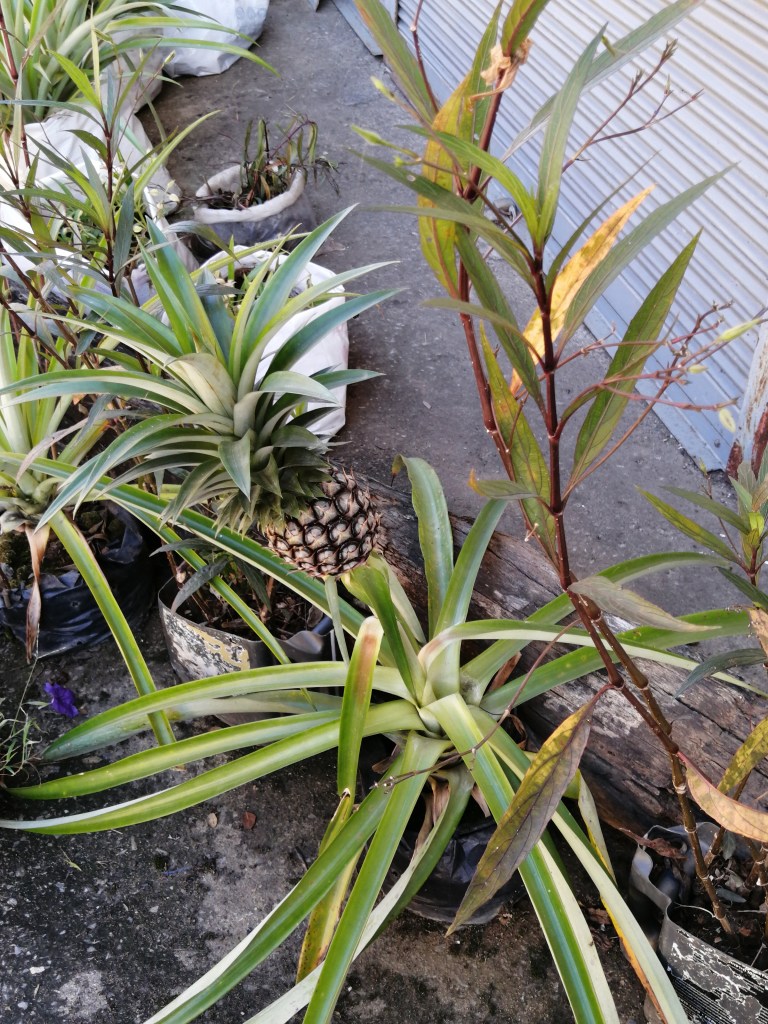
Pineapple growing by the side of the road.
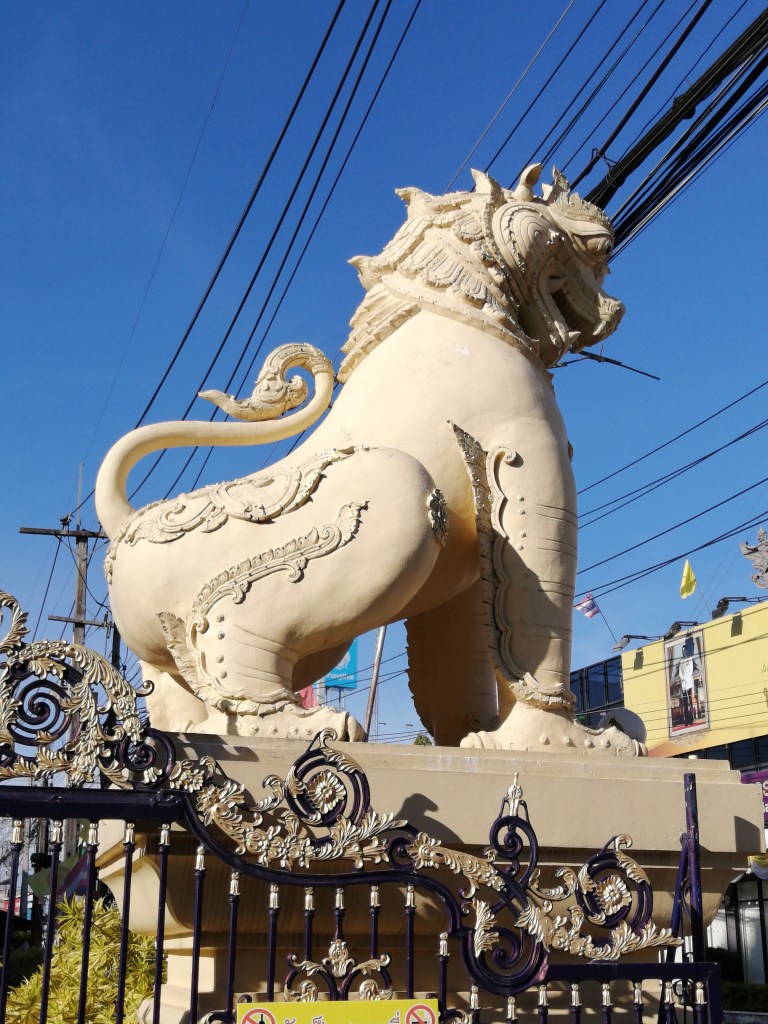
Lion outside a wat.
The sky is much bluer here than in Bangkok as Bangkok is so polluted. The only upside of that I can think of is that we don’t bother to wear sunscreen there and never get burnt. We’ll have to watch it on the Mekong though.
Dragon outside a wat.
The last wat picture for today.

We’d love to see more of Laos, but sadly we will have to move on after Luang Prabang. I think it’s good to have an excuse to come back again!

M. R. Kukrit and Son

Mom Rajawongsee Kukrit Pramoj, or M. R. Kukrit for short, (1911-1995) was a writer, scholar, teacher of Thai dancing and prime minister of Thailand from 1975-76.* As a great-grandson of Rama II, he spent time in the Grand Palace in Bangkok during the last years of the absolute monarchy (ended in 1932 by an almost bloodless revolution).

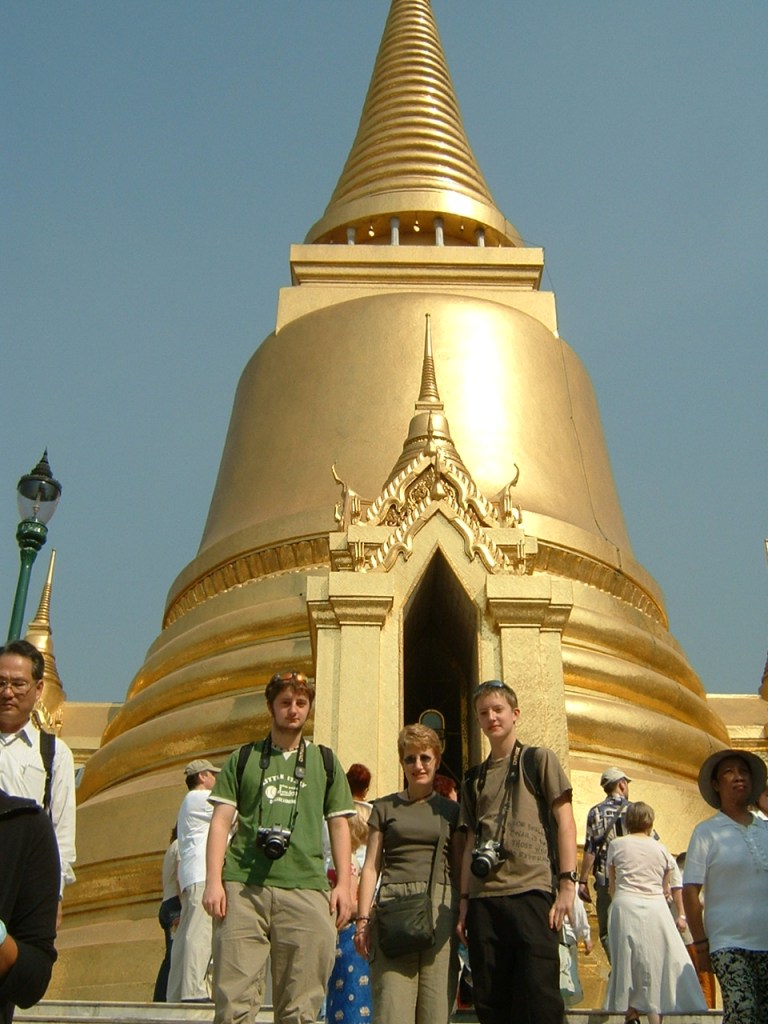
Myself, Guy (16) and Alasdair (14) at the Grand Palace, Christmas 2004

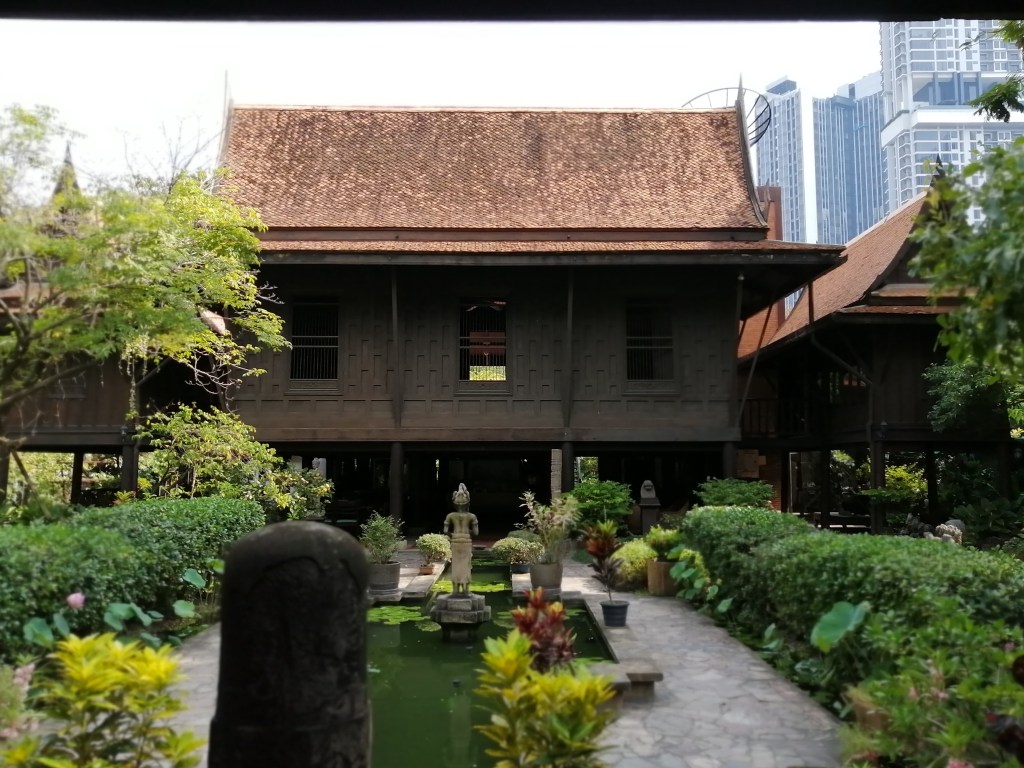
Yesterday afternoon we foolishly walked for over thirty minutes through the Bangkok heat and humidity to reach his home,* comprised of five old teak buildings brought from other parts of Thailand. The buildings, standing on poles and designed to lean in, look very similar to those at Jim Thompson’s, however, Kukrit’s house has not made it onto the popular tourist trail and we were the only visitors in sight.

* Visiting the house was not foolish, but walking for half an hour in the heat was. Mad dogs and Englishmen/women …

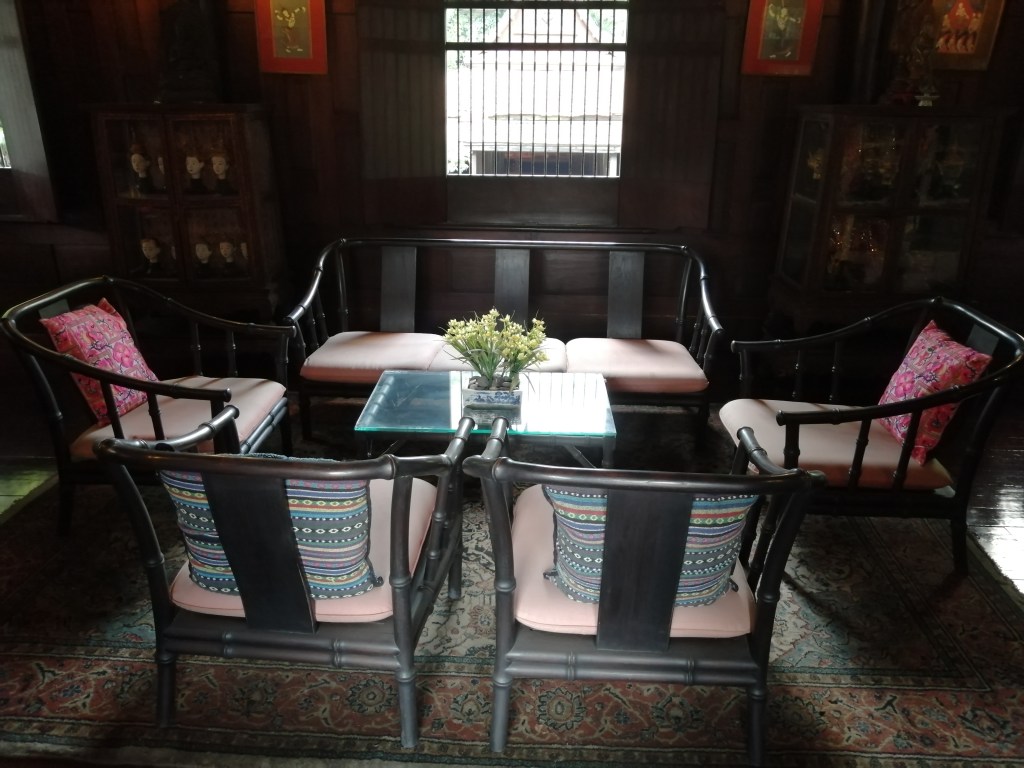
The ground floor of the buildings, though open to the elements, were used for meeting friends, politicians and journalists, while the upstairs rooms remained more private.
Upstairs seating area
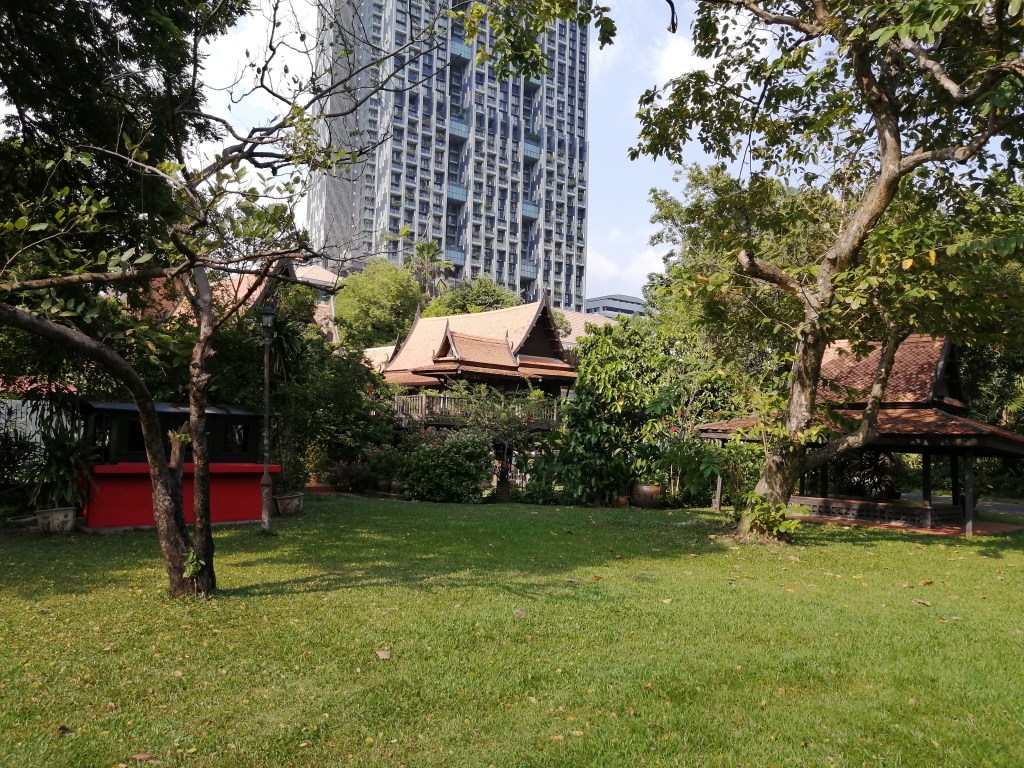
The garden occupies a huge space in the centre of Bangkok.
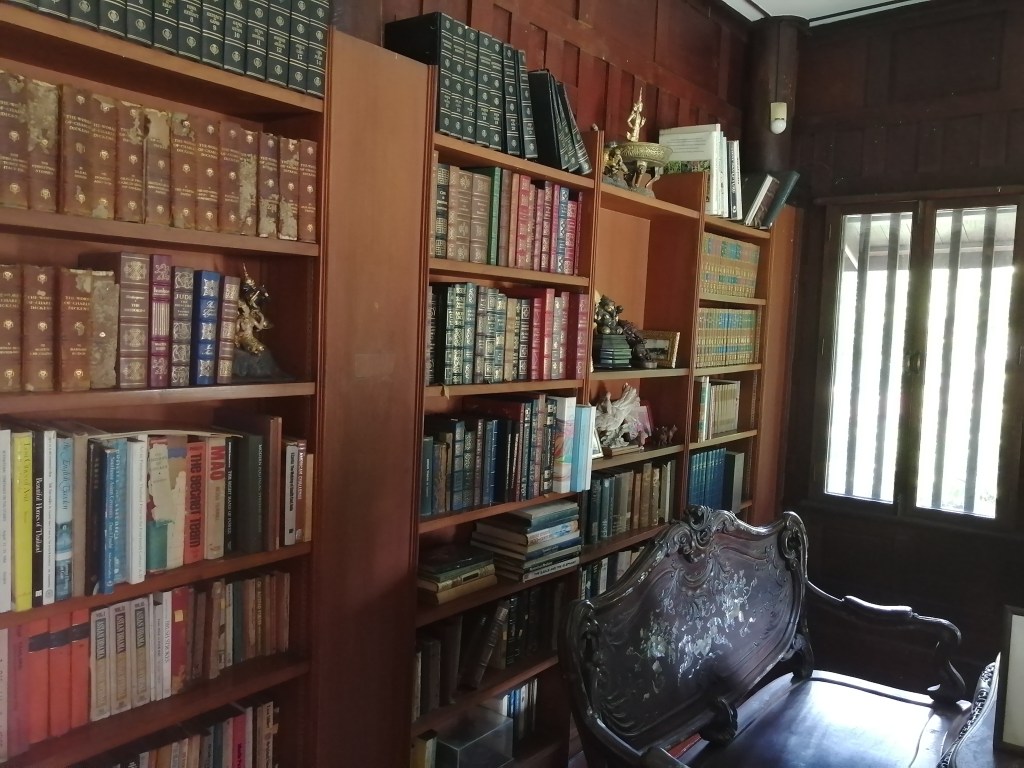
The library
M. R. Kukrit studied PPE at Oxford, and was a prolific writer of serious books, poetry and fiction.
M. R. Kukrit read widely as some of his books show.
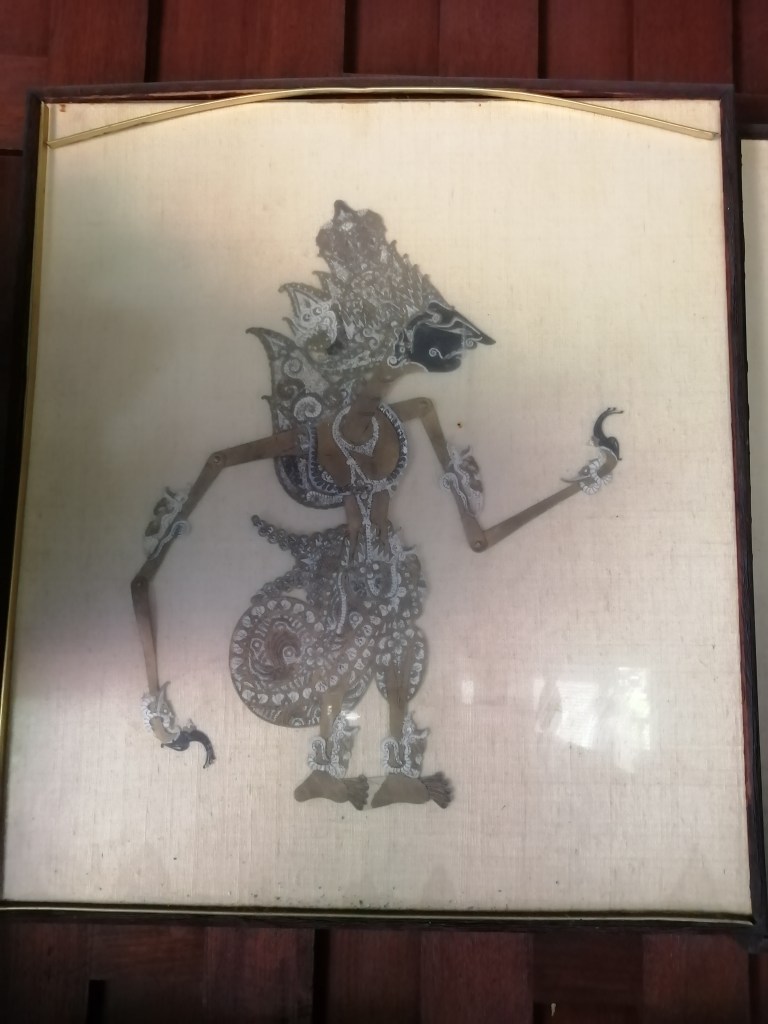
A shadow puppet from M. R. Kukrit’s collection
Kukrit was an enthusiastic promoter of Thai culture and taught traditional Thai dance in his own house.

Halfway through our visit an elderly white-haired gentleman, reclining on a wooden dais, called out to us in impeccable English. Did we have any questions? Obviously anxious for conversation, he invited us to sit down while he told us his life story.

He was, we realised M. R. Kukrit’s son, named Mom Luang Rongit Pramoj, or M. L. Rongit for short. Born in the 1930’s, at a time when the house we were standing in was surrounded, not by high-rise blocks as it is now, but by paddy fields, he grew up playing with the children of the workers in the rice fields, rather than those of the upper echelons of society. His father had been keen for him to go to public school in England, as he himself had done and was fitting for those in aristocratic circles. However, M. L. Rongit said he didn’t want to go to England as he wouldn’t fit in with the other children.

His father accepted this, but instead, M. L. Rongit was taken to America by his Russian grandmother (where an uncle of his was Thai ambassador). There he did go to school and learned American (he still spoke with a slight American drawl).

M. L. Rongit wanted to study art and was accepted by St Martin’s School of Art in London, a time he especially loved. On his return to Thailand the diploma he gained was looked down upon as a degree was seen as the only acceptable qualification. M. L. Rongit continued to paint and we saw a couple of examples of his work on the walls.

When we came to take our leave, M. L. Rongit insisted we took a couple of books written by his father. As The English editions are out of print, he gave us copies in Thai, telling us to ask a friend to translate them. Any takers?

Quite an extraordinary encounter! I feel we’ve been touched by royalty.

…………………………………………………………………………………………………………

On another note, we have just exchanged and will be moving to our new house at the end of November, in just over four weeks.

Remember Rama

We only belatedly realised that it is Chulalongkorn Day today, a public holiday in Thailand to remember King Chulalongkorn, who ruled 1853-1910, and who is otherwise known as Rama V. That explained why so many people were wearing yellow t-shirts (to show their respect to the Royal Family) and there wasn’t the usual crush in the metro at rush hour. It might also explain why our apartment block has a banner saying, ‘Happy New Year.’ Either that, or it’s left over from the western New Year in January, Chinese New Year in February or Songkan (Thai New Year) in April.

For those who are familiar with the film, ‘The King and I’, Chulalongkorn was the King’s son, the one who Anna Leonowens was engaged to tutor.

Chulalongkorn travelled extensively and worked hard to move Thailand into the modern age by, for example, abolishing slavery and introducing a railway system into the country. The reason that the Thais use a spoon and fork to eat their food, in preference to chopsticks, is apparently a custom that Chalalongkorn brought back after a trip to Europe.

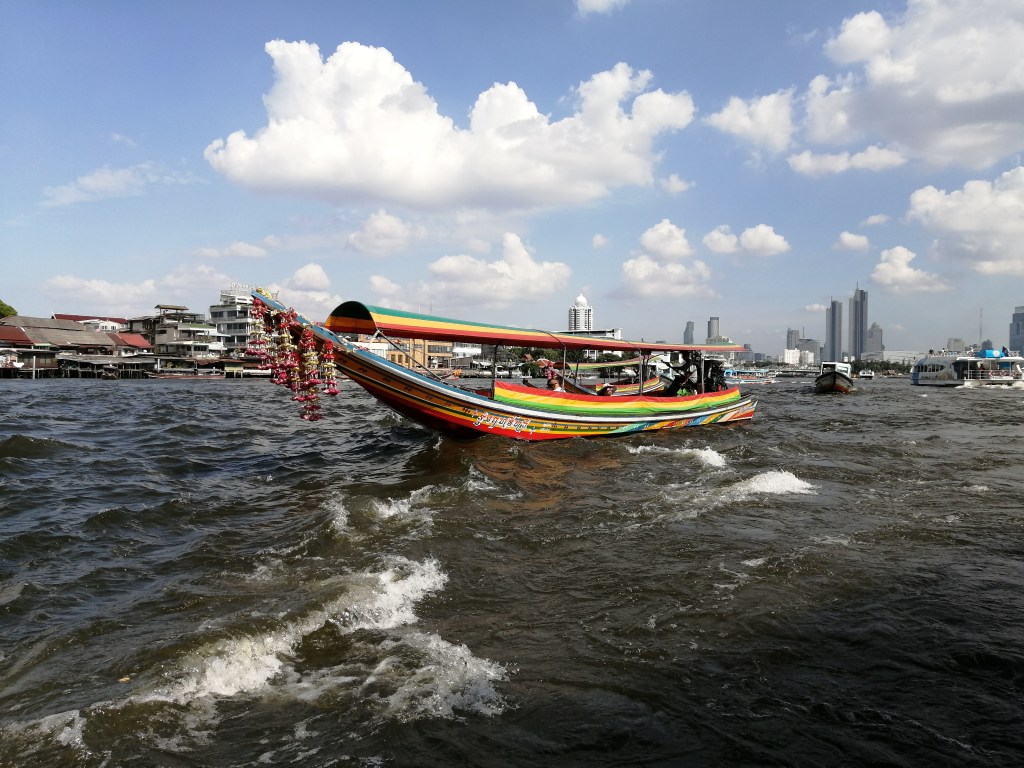
A long-tailed boat, one of the hundreds taking tourists up and down the Chao Phraya River.
We travel on the public boat, though, only 15 baht (38p) for any stop along the whole route.

Dance With Your Supper

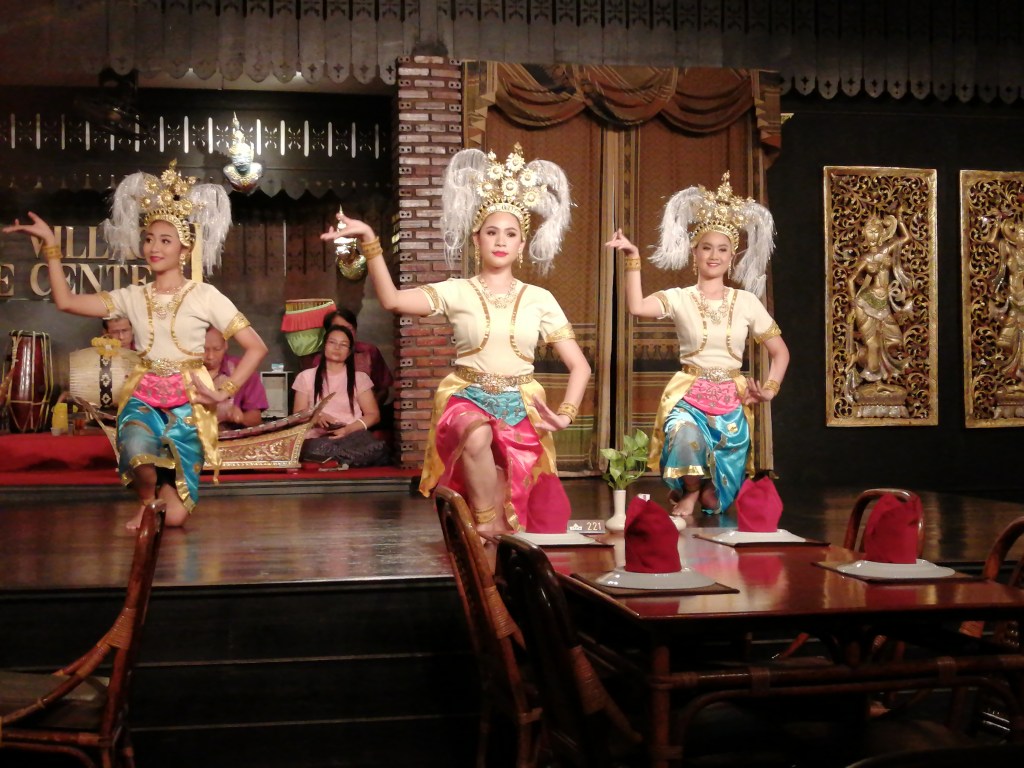
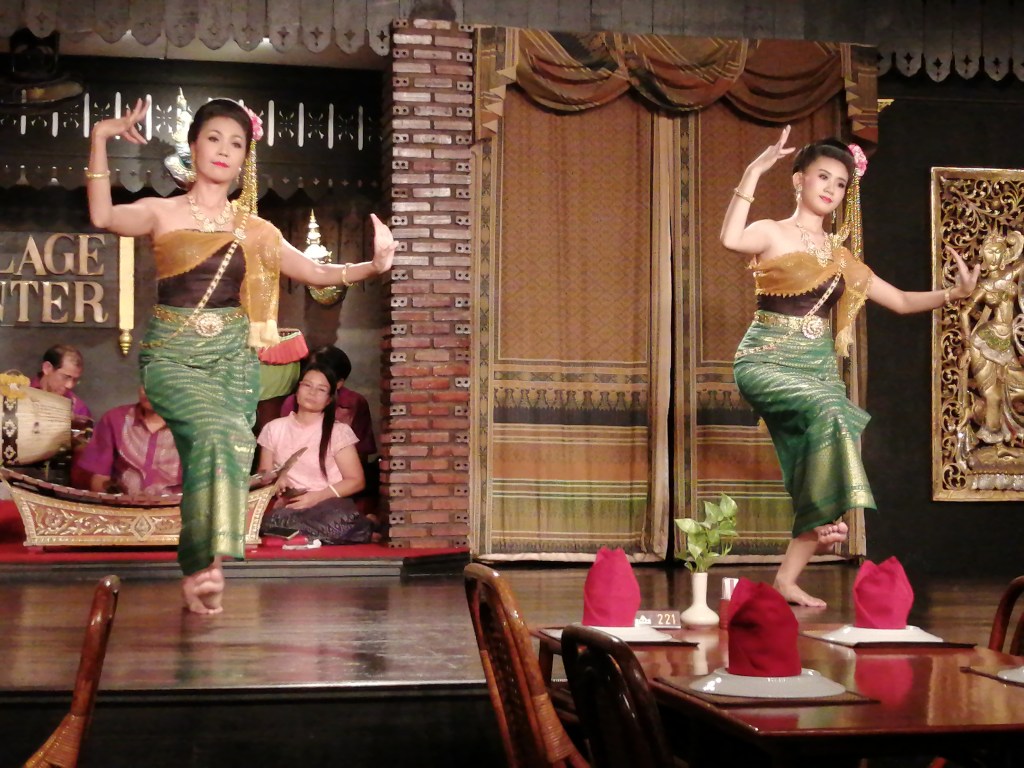
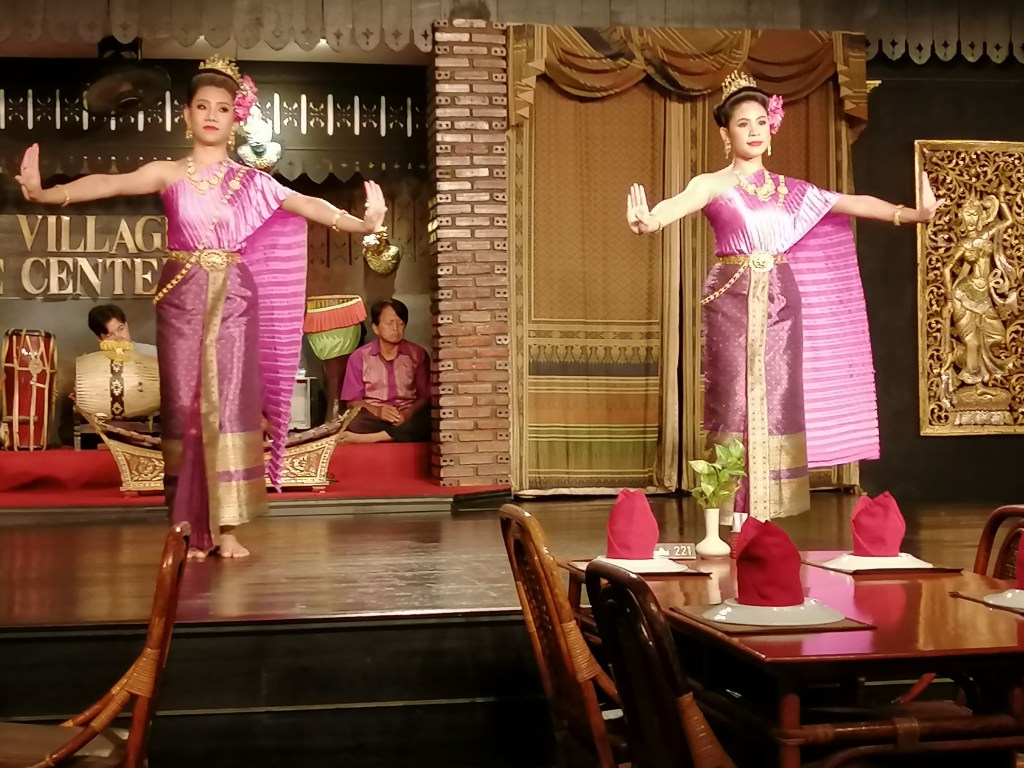
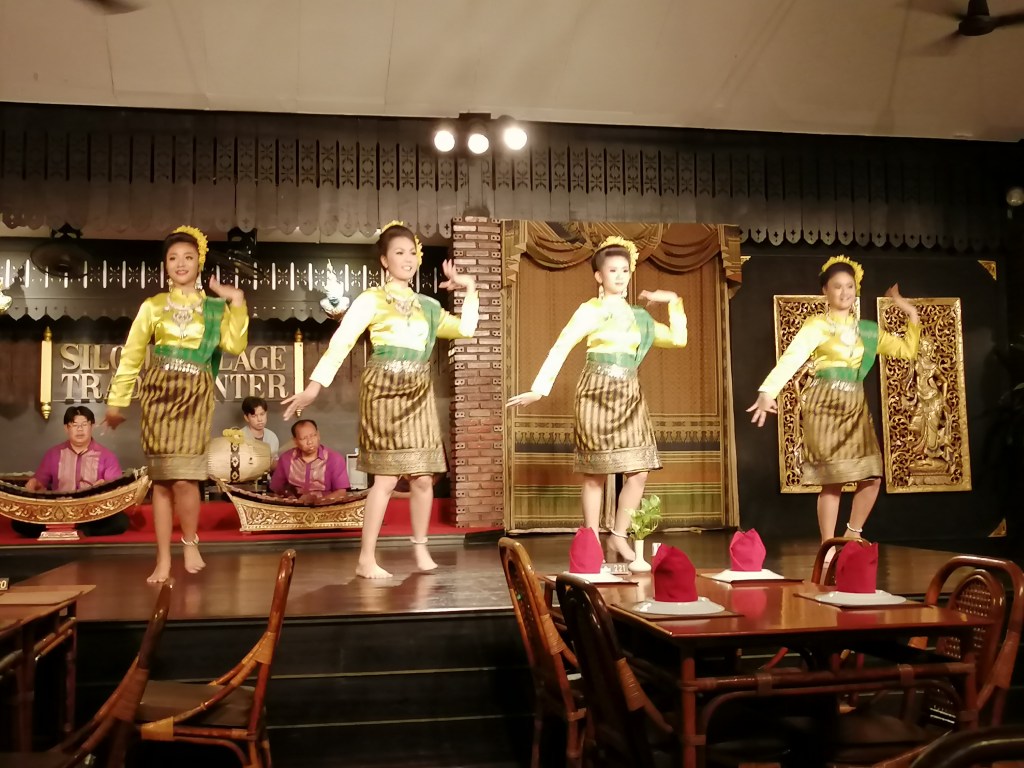
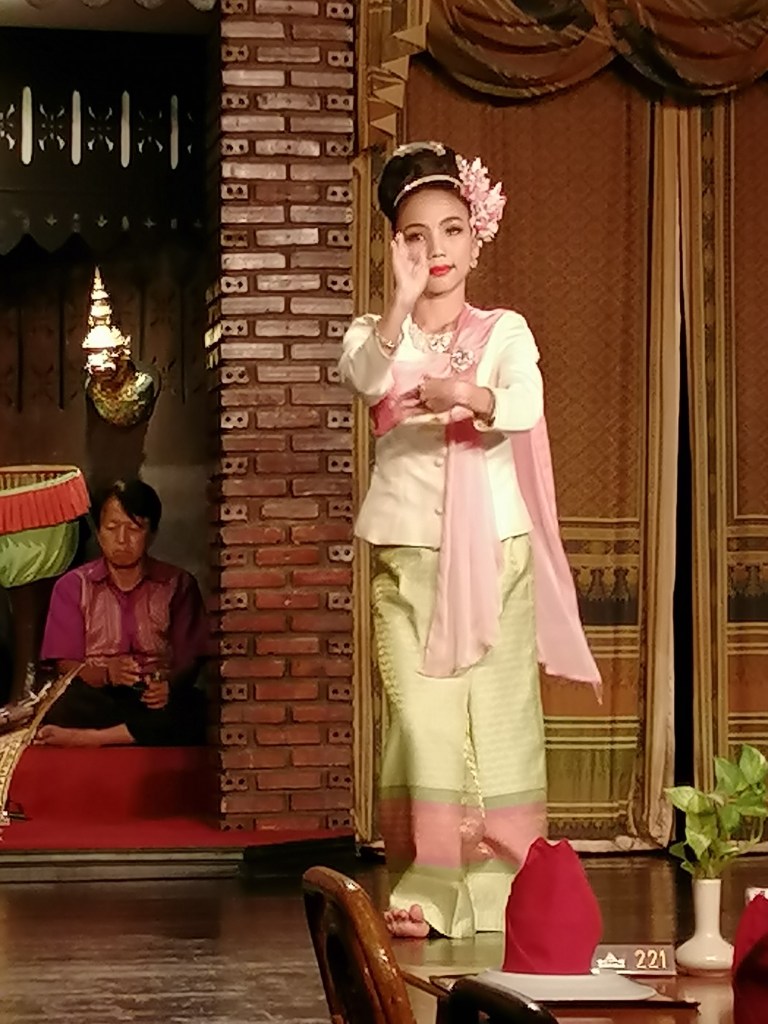
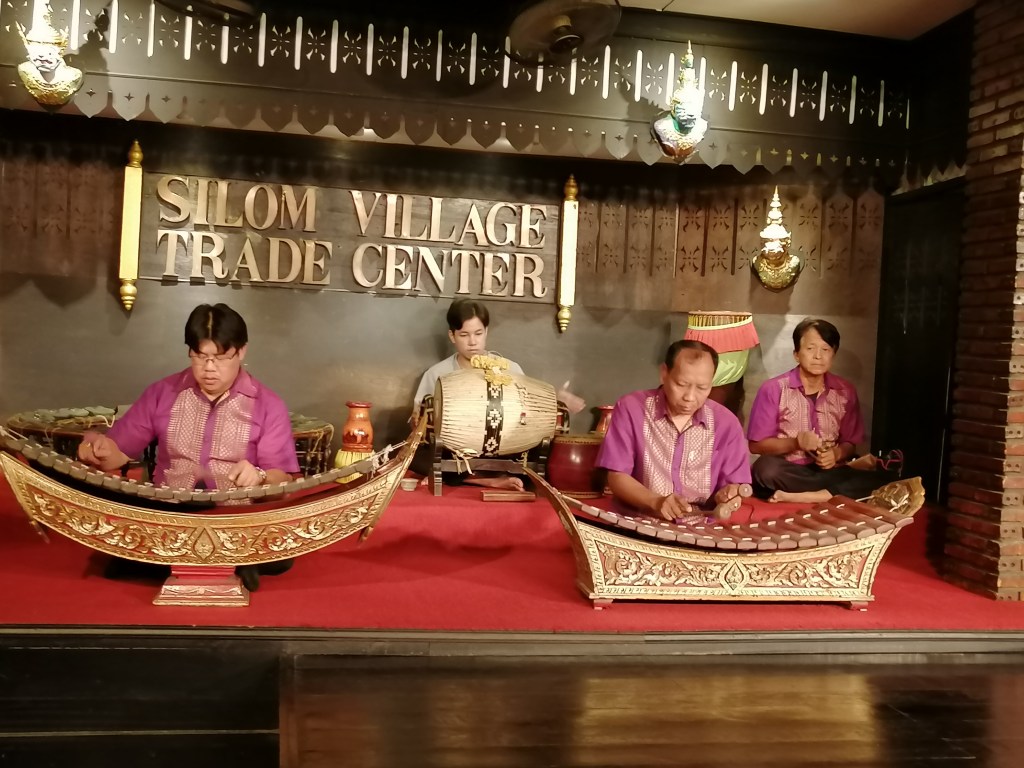
Silom Village is a restaurant in Bangkok where a small band of musicians play and heavily made-up and coiffed young women, wearing exquisite matching costumes, put on a wonderful display of traditional Thai dance while you eat your meal.

All the dances are performed barefoot.
Keeping your balance while on one foot is an important requirement.
Thai silk is known for its beautiful jewel-like colours.

The dances are based on annual activities in the farming calendar, or on traditional stories like the Ramayana. The movements are stylised, with arms and legs bent, and hands, fingers, feet and toes flexed to make a series of right angles. Looking at the way the girls are able to hold their hands back, and the way I can (or can’t) mine, I imagine most dancers start learning when they are very young.

We were surprised at these outfits as we had never seen the dancers in short skirts before.
The girls either dance with no expression, or hold the same smile for the whole dance.
The band

Jim Thompson’s House of Silk

Our host threw up her hands in horror when we said we were planning to visit Jim Thompson’s house on our first day. It was too commercialised, she thought, and recommended the home of M. R. Kukrit, a former prime minister of Thailand, instead. We have actually been to both houses before, but are keen to make return visits. I have the added incentive of writing about them in my blog.

Jim Thompson, an American born in 1906, initially practised as an architect and only found himself in Thailand when sent as part of the liberating force just before the Japanese surrender at the end of the Second World War.

He returned to Thailand after the war as part of a consortium to purchase and restore the Oriental Hotel in Bangkok. After a falling out with the other investors, he switched his attention to the ailing Thai silk industry and bought a plot of land in the centre of Bangkok, specifically to make use of the Muslim weavers living across the klong (canal).

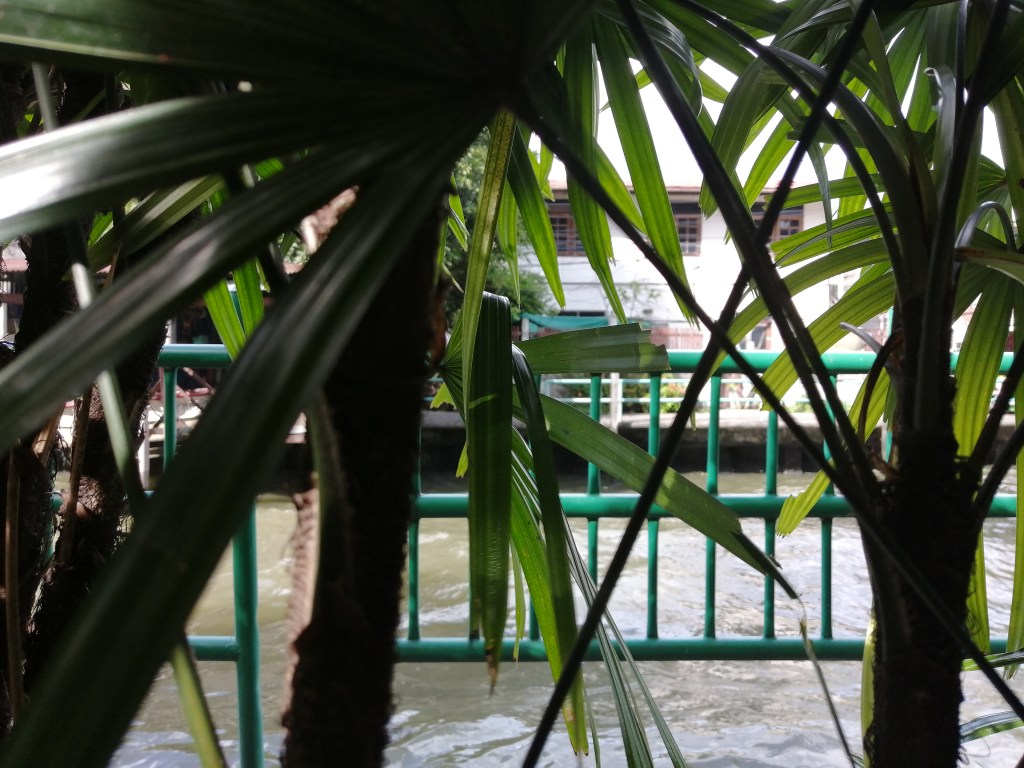
View across the klong from Jim Thompson’s place.

Thompson encouraged the weavers (mostly women) to work from home and allegedly raised thousands of the poorest out of poverty. All the silk used in the film of ‘The King and I’ came from Jim Thompson’s business, and this helped save the silk industry in Thailand from extinction.

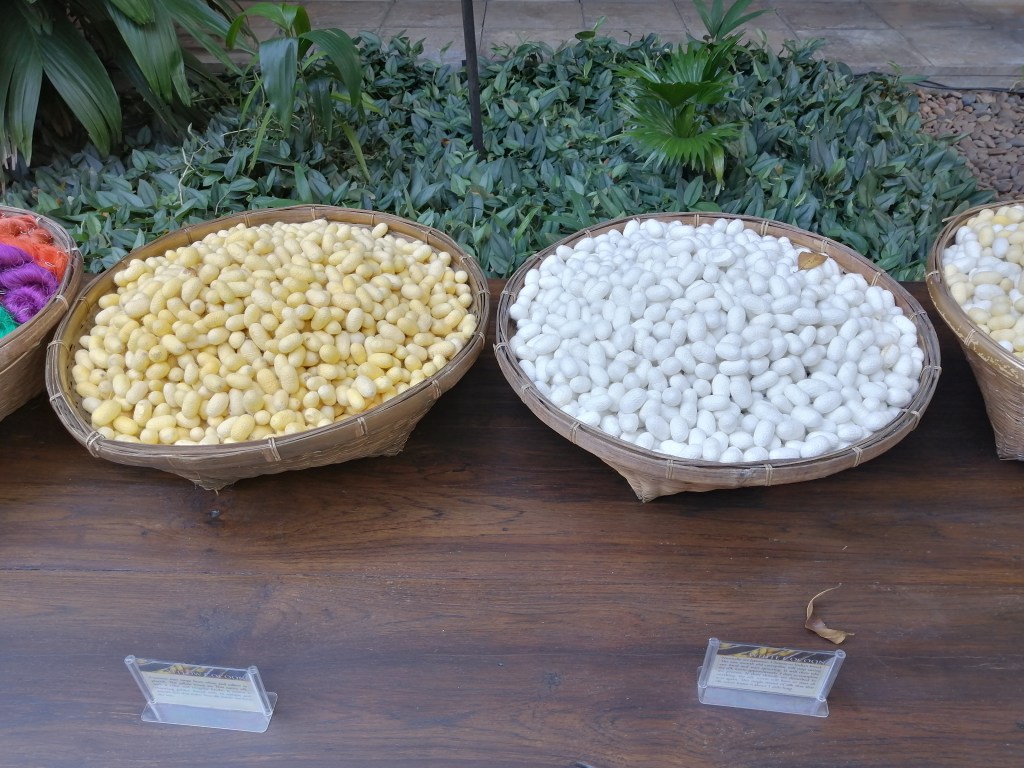
The yellow cocoons on the left are of Thai silk worms. Thai silk can be distinguished from silk from other parts of the world by its knobbly texture.
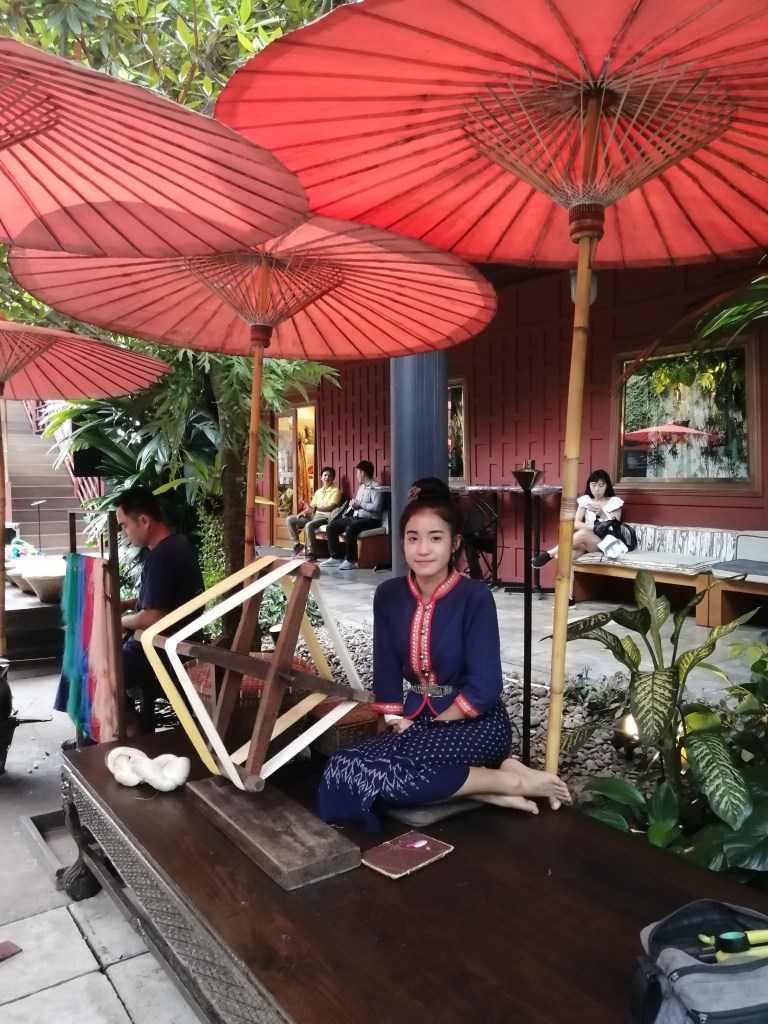
A spinning wheel

Jim was also keen to have a place to live and, after clearing the land, brought six traditional buildings from other locations in Thailand, some from the old capital, Ayudhya, and erected them to make a house for himself. Each building was raised one storey above ground, a traditional and practical measure to avoid flood water entering the house during the rainy season. The walls were designed to slope inwards, a feature used to increase the strength of the building. Thompson broke with tradition in two respects though, one by building a staircase inside the house, as opposed to on the exterior, and also lighting the traditionally furnished and decorated interiors with chandeliers. While looking incongruous, they are Thai, and were brought from 18th and 19th century Bangkok palaces.

Two of the traditional buildings used. The red is of the colour of the paint conventionally used as a preservative.

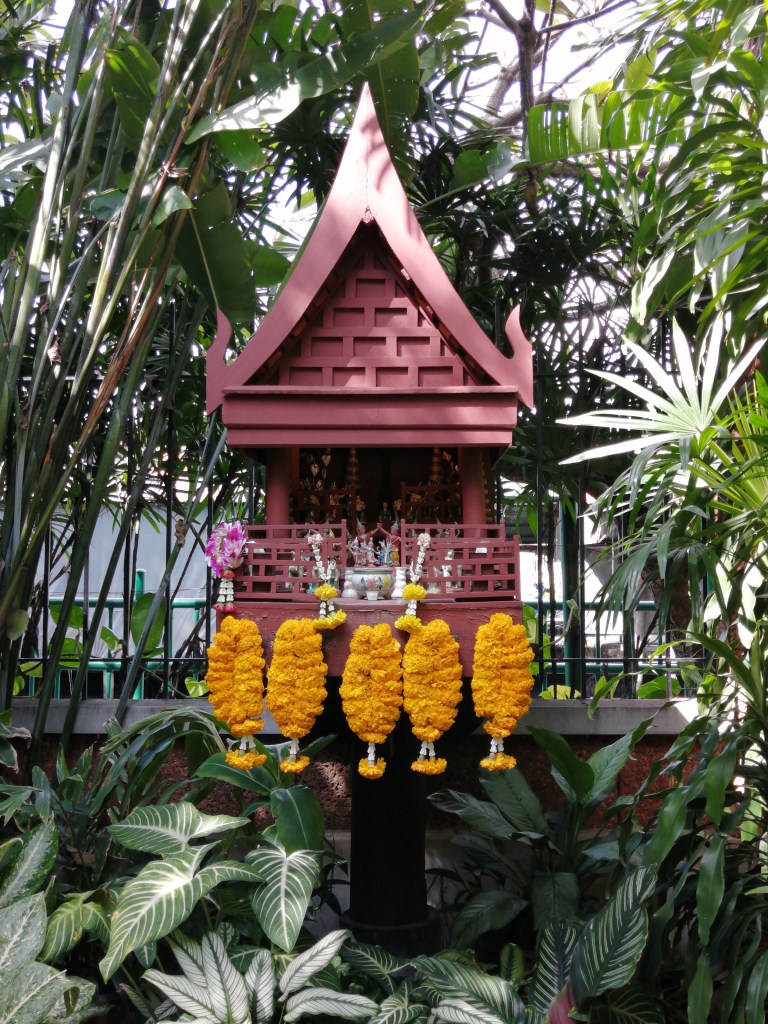
Thompson further followed local custom by moving into the house on a day deemed to be auspicious in the spring of 1959. To house the spirits that had been disturbed by the demolition of the old buildings, a spirit house was erected in the garden. Offerings of food and flowers are placed at the entrance to the spirit house.

The Spirit House
This must be placed so that the shadow of the new building does not fall on it.

Jim Thompson then set about arranging his large collection of furniture and ceramics inside the house. So much interest was shown in the dwelling and its contents that Thompson opened up to the public, donating proceeds to Thai charities and the preservation of Thai culture.

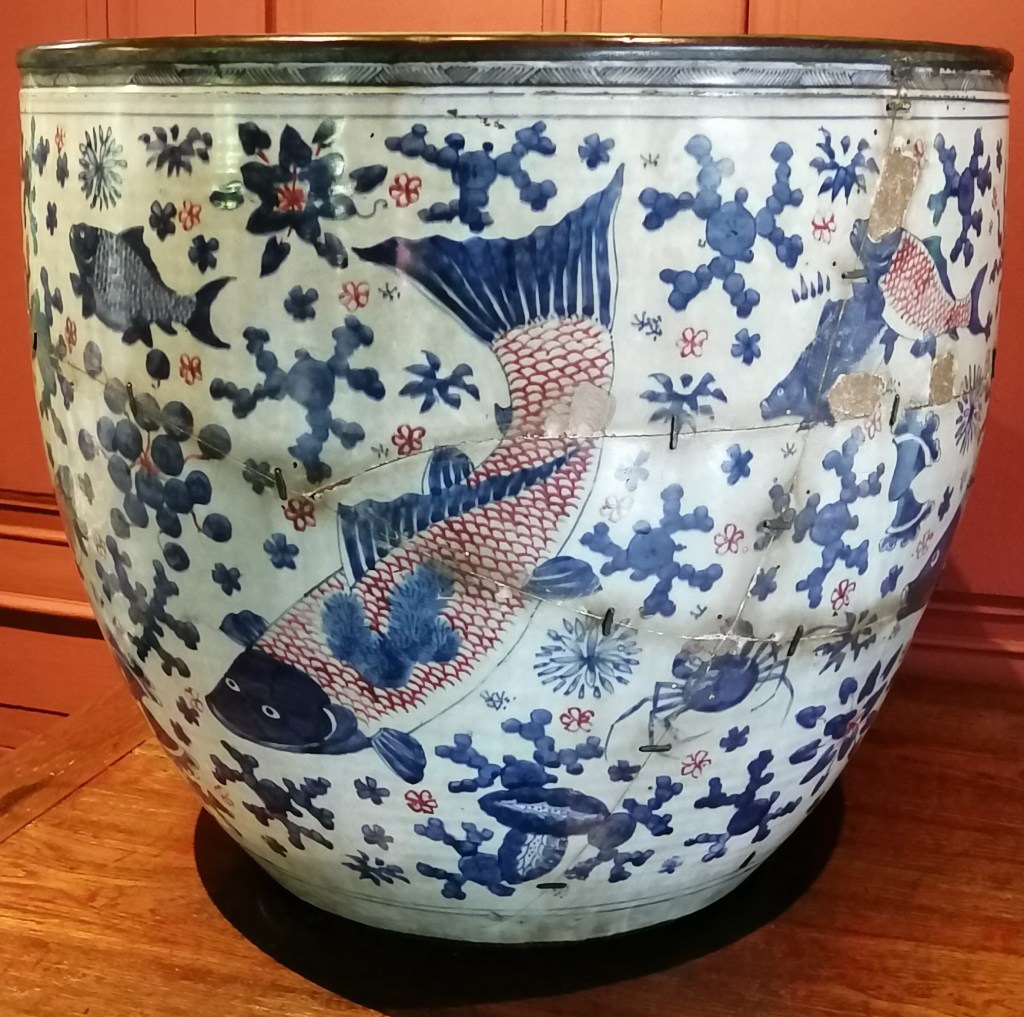
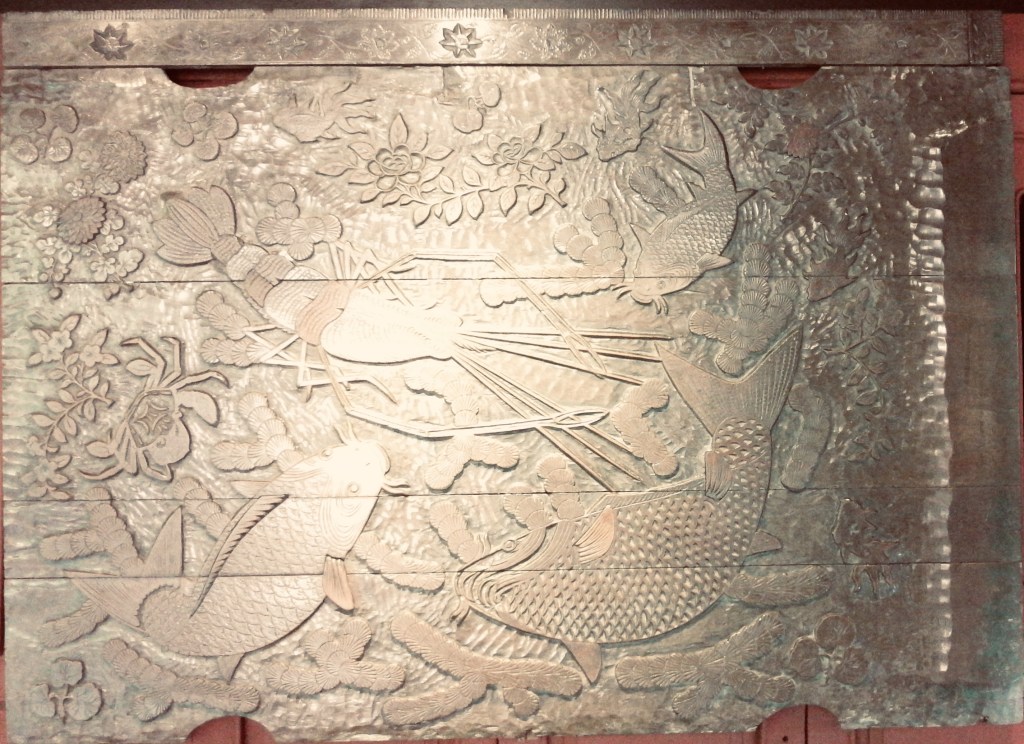
The images on this pot, part of Thompson’s collection, inspired Jim in the carving of the printing block below.
Printing block used in Jim’s silk production.

While out for a walk in the Cameron Highlands, Malaysia, in 1967, Jim Thompson disappeared. One of the largest land searches in S. E. Asia followed, but no trace of Thompson has ever been found and to this day his disappearance remains a mystery. (When our guide related this story, one of our tour group suggested the disappearance might be due to ‘a tiger’. Our guide understood him to say, ‘a Thai girl’, a mistake which she, in particular, found very amusing).

After Thompson’s disappearance, the silk manufacturing business was moved to purpose-built factories in Korat, 250 miles north-east of Bangkok.

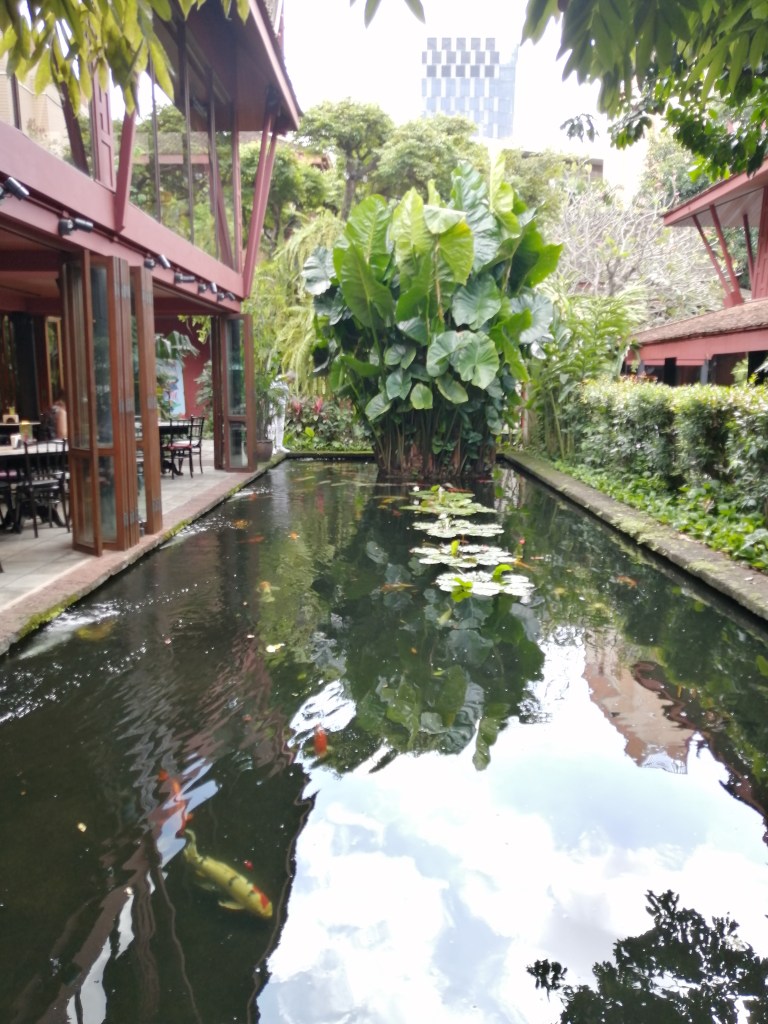
Koi carp pool next to the restaurant

Surrounding the house, or houses, is a wonderfully luxuriant jungly garden. A shop sells the beautiful, but highly priced, items from his factory. The house can be visited only with a guided tour and no inside photos are allowed.